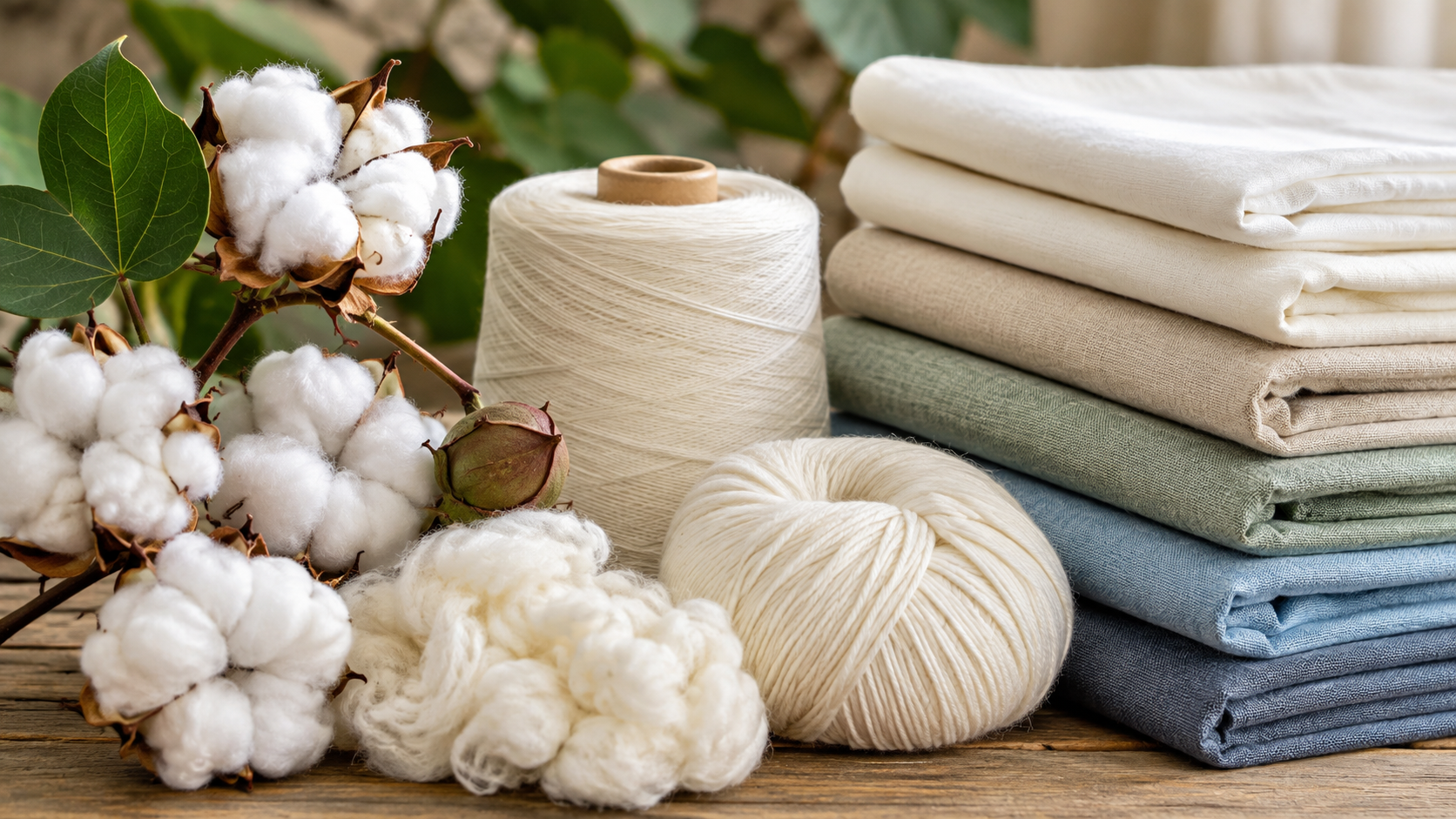
Cotton fabric is a natural textile made from the fibers of the cotton plant (Gossypium species). It’s soft, breathable, and highly absorbent, which is a big part of why it’s one of the most widely produced fabrics on earth, used in everything from apparel to home textiles to medical supplies.
Cotton is everywhere. The T-shirt on your back, the towel in your bathroom, the sheets you slept on last night, there’s a good chance all three are cotton. Yet for something this common, most people couldn’t tell you where it comes from or how it’s actually made.
This guide walks through what cotton fabric is, how it’s produced, where it’s used, the different types you’ll come across, its environmental footprint, and the certifications worth knowing. Whether you’re a designer, a buyer, a student, or just curious, you should come away with a genuinely solid understanding of one of the world’s most important textiles.
See our full guide to every fabric type in Fabric Wikipedia
What Is Cotton Fabric?
Cotton fabric comes from natural fibers harvested from the seed pods, called bolls, of the cotton plant (genus Gossypium). Those fibers are almost entirely cellulose, a natural polymer responsible for cotton’s strength and absorbency.
It helps to know the difference between four related terms:
- Raw cotton: the unprocessed fiber straight off the plant, still tangled up with seeds and plant matter
- Cotton fiber: the cleaned, separated fiber, ready to be processed
- Cotton yarn: fiber that’s been spun into continuous thread
- Cotton fabric: yarn that’s been woven or knitted into usable textile
What makes the finished fabric so popular comes down to a handful of properties: it’s soft against skin, breathable in heat, highly absorbent, holds up well with proper care, and takes dye and print easily. Put those together and you get one of the most versatile natural fibers there is.
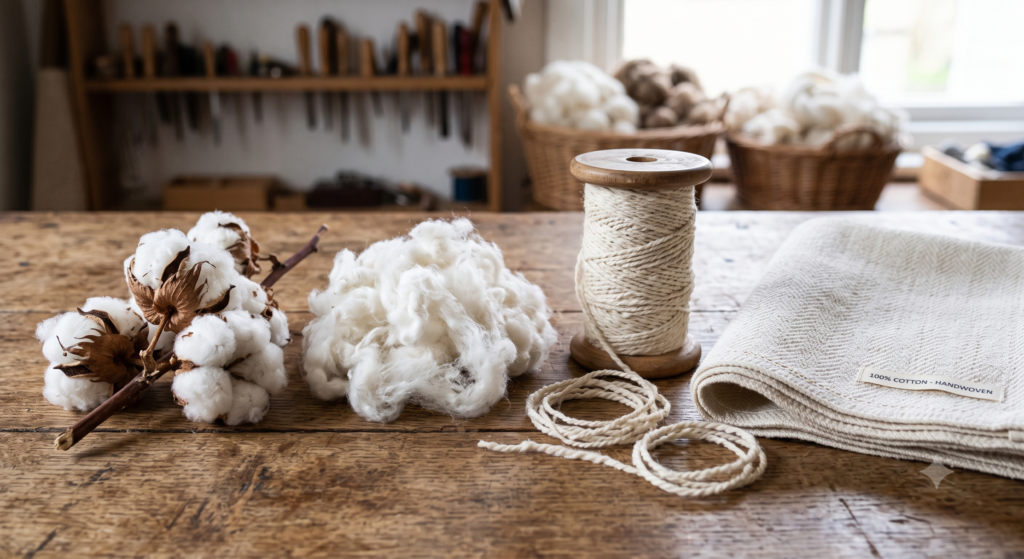
Pima cotton is a premium variety of cotton with long, fine fibers and a soft feel.
How Is Cotton Fabric Made?
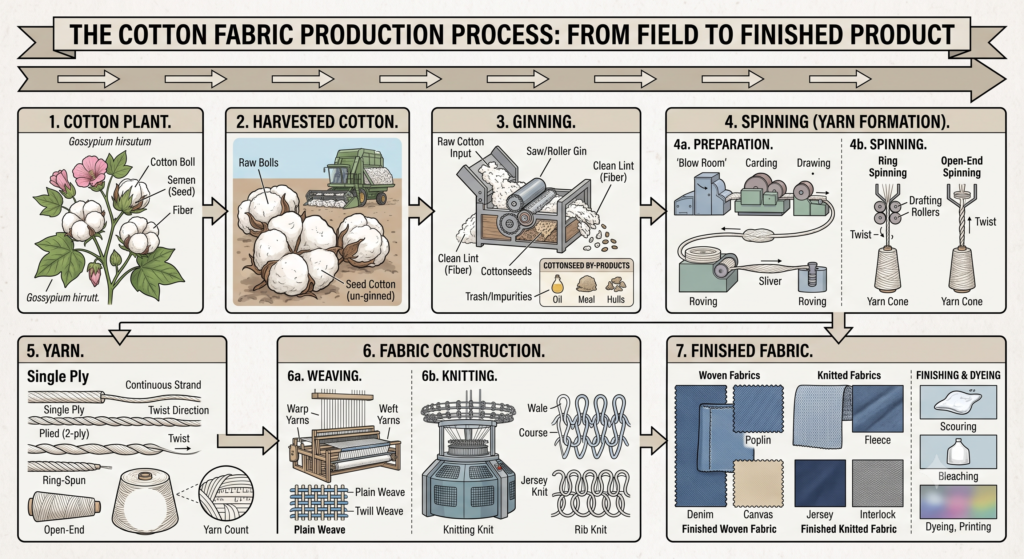
Getting from raw cotton to finished fabric takes several stages, starting in a field and ending on a finishing line.
Cultivation and Harvesting
Cotton needs a warm climate and a long frost-free growing season. Once the bolls mature and burst open, revealing the white fiber inside, the crop gets harvested by hand or by mechanical picker, depending on the region and scale.
Ginning
The raw cotton then runs through a cotton gin, a machine that separates fiber from seeds and plant debris. What comes out the other end is cleaned fiber, often called lint, ready for the next step.
Cleaning and Fiber Preparation
The ginned fiber gets cleaned again to strip out any leftover plant material, dust, and short broken fibers. This step is what keeps the final yarn consistent.
Carding and Combing
Carding straightens the fibers into a soft, continuous rope called a sliver. For higher-end yarns, that sliver is then combed to remove the shorter fibers, leaving behind a smoother, stronger thread.
Spinning
The fibers get drawn out and twisted together into yarn. How heavy the yarn is, how tightly it’s twisted, and which spinning method is used all shape how the final fabric feels and performs.
Weaving or Knitting
From here, yarn becomes fabric, either woven (two sets of threads interlaced at right angles) or knitted (loops of yarn interlocked together). This structural choice has a huge effect on texture, stretch, and weight.
Dyeing, Printing, and Finishing
Color and pattern get added through dyeing or printing. Finishing treatments, mercerizing, calendering, sanforizing, further shape how the fabric looks, feels, and holds up over time, including shrink resistance.
Supima cotton represents a particularly high-grade form of extra-long-staple cotton.
How Is Cotton Fabric Used?
Cotton’s versatility is really its biggest advantage. You’ll find it in:
- Clothing and apparel: T-shirts, shirts, dresses, jeans, underwear, socks, sportswear
- Home textiles: bedsheets, pillowcases, duvet covers, blankets
- Towels and washcloths: cotton’s high absorbency makes it a natural fit for bathroom and kitchen use
- Curtains and upholstery: heavier cotton weaves hold structure well in home furnishings
- Bags and accessories: canvas totes, backpacks, hats
- Medical and hygiene products: bandages, gauze, cotton swabs, surgical drapes
- Industrial applications: filter materials, polishing cloths, reinforcement in composites
Not many natural fibers stretch across this many everyday and specialized uses at once.

Cotton is also commonly included among breathable fabrics for warm-weather clothing.
Where Is Cotton Fabric Produced?
Growing cotton and turning it into fabric are two separate steps, and they often happen on opposite sides of the world.
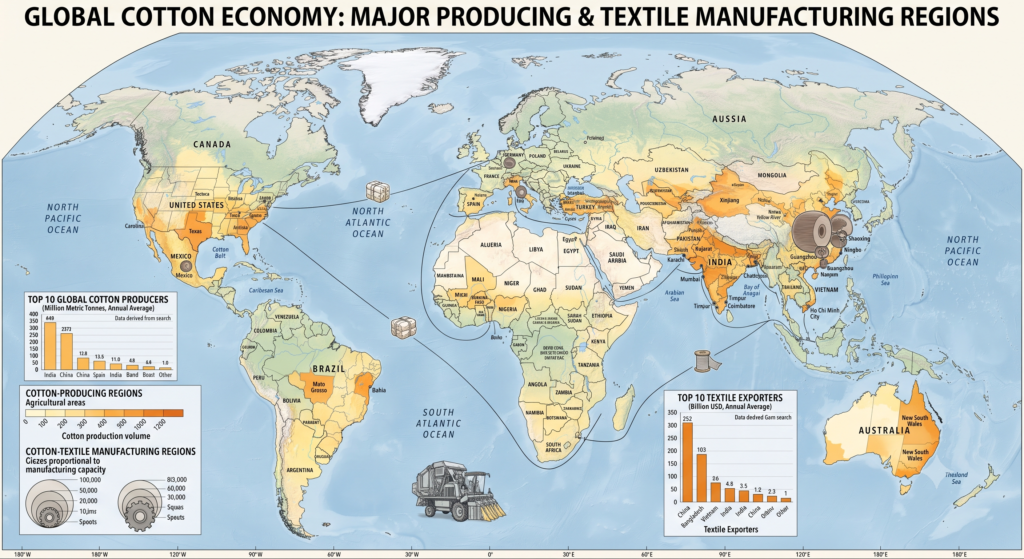
The biggest cotton-growing countries are China, India, the United States, Brazil, and Pakistan, all places with the climate, land, and agricultural setup to grow cotton at real scale.
Fabric manufacturing, the spinning, weaving, dyeing, and finishing, is concentrated mostly in Asia: China, India, Bangladesh, Vietnam, and Turkey lead here, with textile industries built specifically for turning raw fiber into finished fabric for global brands.
Cotton typically crosses several borders before it becomes a garment: grown in one country, ginned and spun in another, woven or finished somewhere else entirely, then shipped to a brand or retailer. That long chain is exactly why traceability and ethical sourcing have become such a big deal for buyers who actually care where their materials come from.
Cotton can also be considered alongside other sustainable fabric options depending on how it is grown and processed.
How Much Does Cotton Fabric Cost?
There’s no single price tag on cotton fabric. What you pay depends on several factors:
- Fiber quality: longer, finer fibers (like those from Gossypium barbadense) cost more than shorter staple fibers
- Fabric weight (GSM): heavier fabric uses more fiber per square meter, which pushes the price up
- Yarn quality: combed and ring-spun yarns cost more than carded or open-end spun ones
- Weave or knit construction: more complex constructions add cost
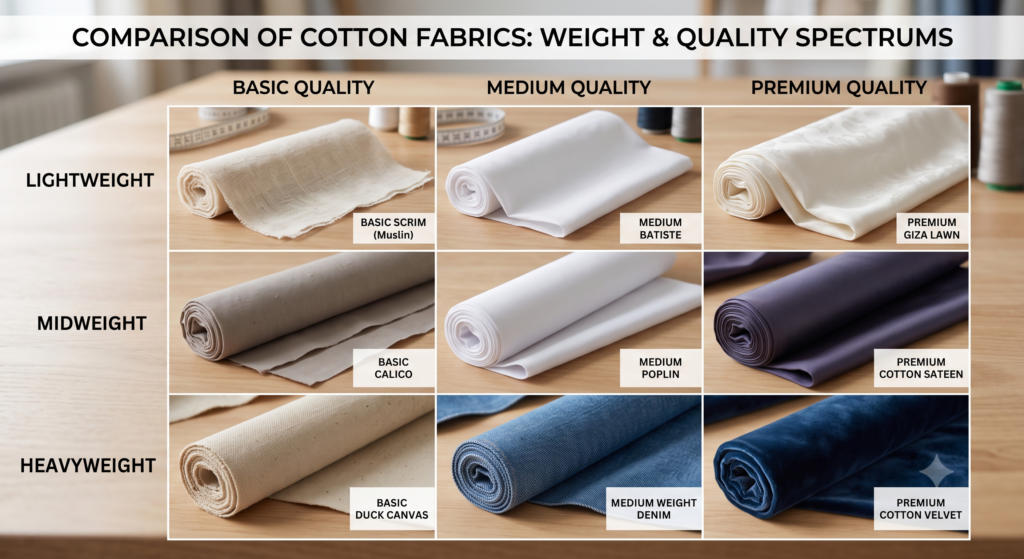
- Fabric type: basic poplin is cheap; premium sateen or organic-certified muslin isn’t
- Dyeing and finishing: printing, enzyme washing, special coatings, all add to the price
- Conventional vs. organic: organic cotton usually runs 20-30% more than conventional at the fiber level
- Certifications: certified fabrics (GOTS, OEKO-TEX, Fairtrade) often carry a premium
- Wholesale vs. retail: bulk buyers pay noticeably less per meter than retail shoppers
- Region: labor costs and currency swings shift pricing across manufacturing regions
What Different Types of Cotton Fabric Are There?
Cotton fabric splits into two categories: which species of cotton plant the fiber came from, and how the finished fabric was constructed.
Cotton Plant Varieties
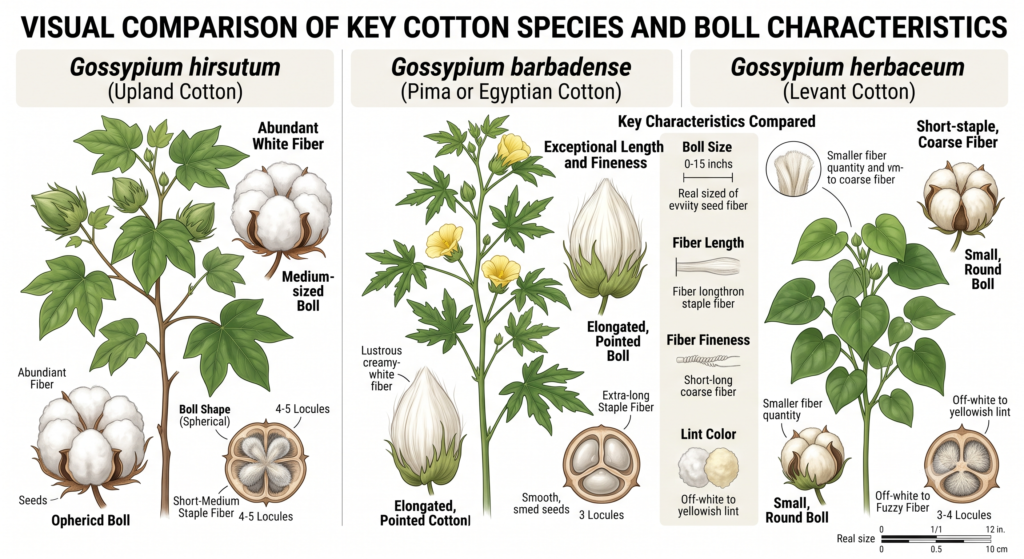
The Gossypium genus has four commercially important species, each producing fiber with its own character:
- Gossypium hirsutum (Upland cotton): roughly 90% of global cotton production. Medium staple length, used across everyday textiles.
- Gossypium barbadense (Extra-long staple cotton): includes Egyptian and Pima cotton. Long, fine, strong fibers, the kind used in luxury fabrics and fine shirting.
- Gossypium arboreum (Tree cotton): native to South Asia, with shorter, coarser fibers. Less commercially relevant today.
- Gossypium herbaceum (Levant cotton): one of the earliest cultivated species, short and coarse, mostly grown in Africa and Asia.
Fiber length, fineness, and strength, all tied partly to the species, are what ultimately determine how soft, strong, and high-quality the finished fabric feels.
Cotton Fabric Varieties
How the yarn gets woven, knitted, or finished is what actually creates all the different fabric names you see on labels:
- Poplin: plain weave with a fine horizontal rib. Crisp and smooth, common in shirts and dresses.
- Muslin: loosely woven, lightweight plain weave. Used in fashion prototyping, home décor, and food prep.
- Denim: durable twill weave, traditionally indigo-dyed. The base fabric for jeans and workwear.
- Chintz: plain weave with a glazed finish, often printed with florals. Common in home furnishings.
- Corduroy: cut-pile fabric with ridged texture (wales). Warm and durable, used in trousers, jackets, upholstery.
- Flannel: soft, napped fabric, usually twill or plain weave. Common in pajamas, shirts, bedding.
- Oxford cloth: basket weave with subtle texture. A staple in casual and business-casual shirting.
- Sateen: satin-weave cotton with a smooth, glossy surface. Popular for premium bedding.
- Canvas: heavy plain weave known for strength. Used in bags, shoes, outdoor gear.
- Voile: lightweight, sheer plain weave. Common in summer clothing and curtains.
- Jersey: single-knit fabric with natural stretch. The default for T-shirts and casual wear.
- Cotton twill: diagonal weave with good drape and durability. Used in chinos, workwear, upholstery.
Soft cotton fabrics are often considered when choosing clothing for sensitive skin.
How Does Cotton Fabric Impact the Environment?
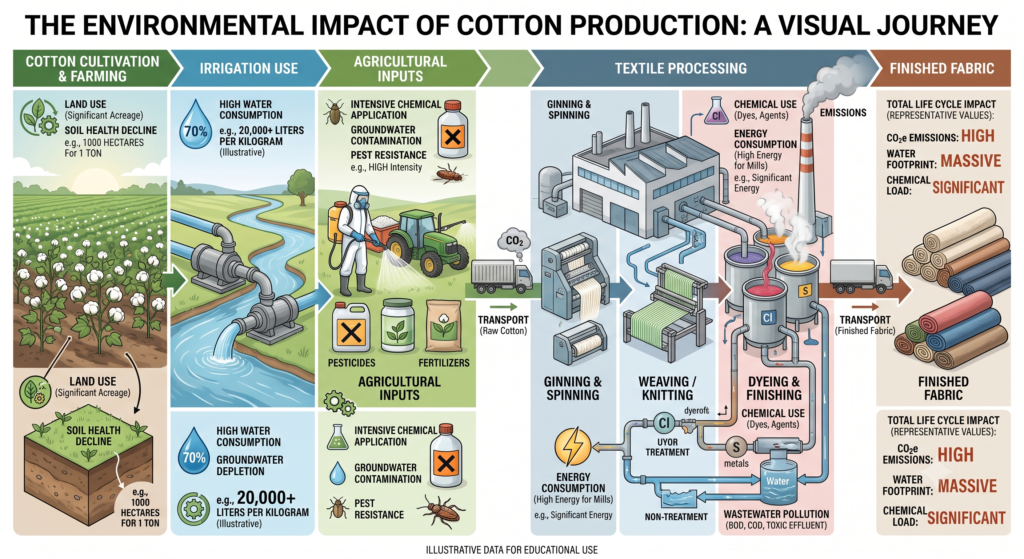
Cotton’s environmental footprint is real, and it’s more complicated than a simple “good” or “bad” label. It plays out across both the farming and manufacturing stages.
Water use is probably the most talked-about issue. Conventional cotton farming relies heavily on irrigation in many of its major growing regions, and it takes an estimated 1,500 to 2,000 liters of water to produce enough cotton for a single T-shirt, according to the World Wildlife Fund.
Pesticide and fertilizer use is the other major concern. Conventional cotton accounts for roughly 6% of global pesticide use while occupying only about 2.5% of cultivated farmland, according to figures from the Pesticide Action Network. That imbalance takes a toll on soil health and local biodiversity.
Processing adds its own impact. Dyeing and finishing generate significant wastewater, often loaded with synthetic dyes, heavy metals, and chemical residue. When that water isn’t treated properly, it’s a real risk to nearby ecosystems and communities.
Textile waste is the last piece of the puzzle. Cotton garments generally last longer than synthetic ones, but fast fashion has cut average garment lifespans down substantially in recent years.
There’s a positive side too. Cotton is biodegradable, unlike polyester and most synthetics. Organic cotton skips synthetic pesticides and fertilizers entirely, which cuts chemical runoff and helps soil health recover. Recycled cotton takes post-industrial or post-consumer waste and turns it into new fiber, using far less water and energy than growing cotton from scratch.
The industry is slowly shifting toward better practices too, precision irrigation, integrated pest management, closed-loop dyehouse systems, though adoption still varies a lot by region and manufacturer.
See Also: What Is Supima Cotton? The Ultimate Guide to a Luxury Fabric
Cotton Fabric Certifications Available
A growing list of certifications help brands and buyers figure out which cotton fabric actually meets specific environmental, social, or safety standards. Here’s what each one actually covers:
- Global Organic Textile Standard (GOTS): widely seen as the gold standard for organic textiles. Covers the entire supply chain, fiber to finished product, including both environmental rules and social criteria like labor conditions and restrictions on hazardous chemicals.
- Organic Content Standard (OCS): confirms a product contains a certain percentage of organically grown cotton. Tracks fiber from farm to finished product, but doesn’t go as deep into processing chemicals or labor practices as GOTS does.
- Better Cotton: technically a sustainability initiative rather than a certification. Trains farmers in more responsible practices around water, soil, and labor. It’s mass-balance sourced, so it doesn’t guarantee traceable fiber in any specific product.
- Fairtrade Cotton: centers on improving livelihoods for cotton farmers and workers in low-income countries through fair pricing, minimum standards, and community development premiums.
- OEKO-TEX (Standard 100 and others): tests fabric for harmful substances at every production stage. An OEKO-TEX Standard 100 label means the finished fabric has been tested and cleared of a defined list of harmful chemicals, regardless of whether the cotton itself is organic.
- Cotton Made in Africa (CmiA): supports African cotton farmers through more sustainable agricultural practices and better market access and income.
- USDA Organic: certifies cotton grown in the US under national organic program standards, no synthetic pesticides, no GMOs.
Each one covers a different slice of the supply chain. GOTS and OCS deal with organic fiber content and processing. OEKO-TEX is about chemical safety in the finished product. Better Cotton and Fairtrade focus on farmer welfare and how the crop is grown. Brands serious about sustainability often end up layering a few of these together rather than relying on just one.
Making Sense of Cotton: What You Should Take Away
Cotton sits at an interesting crossroads: natural origin, industrial-scale production, and a sustainability conversation that’s still evolving. It’s genuinely versatile, capable of becoming surgical gauze on one end and luxury bedsheets on the other, and its environmental impact swings enormously based on how and where it’s grown and processed.
Knowing the difference between cotton varieties, fabric types, and certifications gives you real tools for making better sourcing decisions. Whether you’re choosing fabric for a product line, writing spec sheets, or just trying to understand the label on your own T-shirt, understanding what cotton actually is, and what goes into making it, puts you in a much stronger position.
For anyone working in textiles, fashion, or sourcing, staying current on certifications like GOTS and OEKO-TEX, and understanding the difference between conventional and organic supply chains, isn’t optional anymore. Transparency is quickly becoming the baseline expectation, not a bonus.
Frequently Asked Questions
What is cotton fabric made from?
Cotton fabric comes from natural cellulose fibers found in the seed pods (bolls) of cotton plants in the Gossypium genus. Those fibers get harvested, cleaned, spun into yarn, then woven or knitted into fabric.
What are the main properties of cotton fabric?
Cotton is soft, breathable, absorbent, and durable. It also takes dye and print well, feels comfortable against skin, and biodegrades, which together explain why it’s one of the most widely used natural textiles around.
What is the difference between conventional and organic cotton fabric?
Conventional cotton is grown with synthetic pesticides and fertilizers. Organic cotton skips those chemicals entirely and follows certified agricultural standards instead. It typically costs more and has a lighter chemical footprint, but performs similarly to conventional cotton once it’s fabric.
Which countries produce the most cotton fabric?
China, India, the United States, Brazil, and Pakistan grow the most cotton. Most of the actual fabric manufacturing, spinning, weaving, finishing, happens in Asia, especially China, India, Bangladesh, Vietnam, and Turkey.
What certifications should I look for when buying sustainable cotton fabric?
Look for GOTS (organic fiber and processing), OEKO-TEX Standard 100 (chemical safety), OCS (organic content), Fairtrade (farmer welfare), and Better Cotton (responsible farming). Which one matters most depends on what you’re actually trying to verify.
What are the most common types of cotton fabric?
Poplin, denim, jersey, muslin, flannel, sateen, canvas, Oxford cloth, voile, corduroy, and cotton twill are the ones you’ll run into most. Each differs in weave or knit, weight, and texture, which is why they end up suited to such different uses.
Is cotton fabric environmentally friendly?
Cotton is biodegradable and natural, but conventional farming is resource-heavy, using significant water and pesticides. Organic and recycled cotton both have a lighter footprint. How the fabric is processed, dyed, and finished matters just as much as how it’s grown.
Read Related Article