Leather has been part of human material culture for thousands of years. Long before modern textile manufacturing, people learned how to turn animal skins into useful materials for clothing, footwear, shelter and tools. Today, leather is still widely used, although the processes behind it have become far more sophisticated.
Unlike cotton, linen or polyester, leather is not made by weaving or knitting fibers into a fabric. It begins as animal hide or skin and becomes leather through a process called tanning, which stabilizes its natural collagen structure and makes it suitable for long-term use.
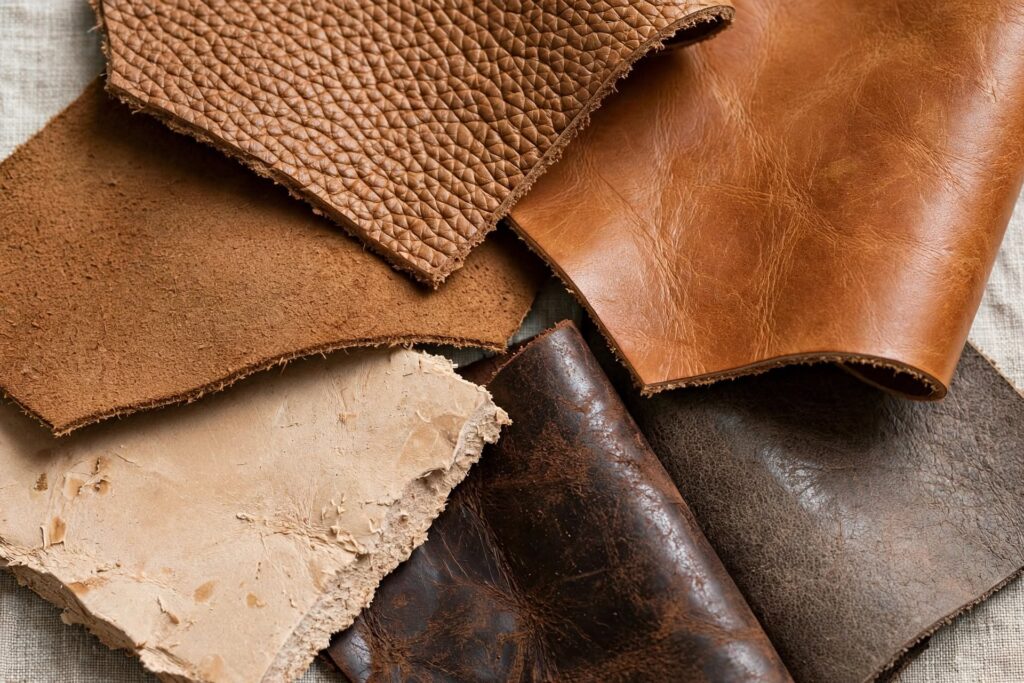
The finished material can be soft and supple, firm and structured, smooth and polished, or textured and suede-like. Its final character depends on the animal hide, the part of the hide used, the tanning method and the finishing process.
Leather is now found in everything from jackets and shoes to handbags, furniture, car interiors and luxury accessories.
Quick Facts About Leather Fabric
| Property | Details |
|---|---|
| Material type | Tanned animal hide or skin |
| Common sources | Cattle, sheep, goats, pigs and other animals |
| Main production process | Preparation, tanning and finishing |
| Major tanning methods | Chrome tanning, vegetable tanning and chrome-free tanning |
| Typical characteristics | Durable, flexible, abrasion resistant and long-lasting |
| Surface finishes | Natural grain, buffed, napped, pigmented, embossed or coated |
| Common uses | Footwear, clothing, bags, upholstery and accessories |
| Main quality factors | Hide quality, grain, thickness, tanning and finishing |
1. What Is Leather Fabric?
Leather is a material made by processing and tanning animal hides or skins.
The word fabric is often used commercially to describe leather because fashion designers, manufacturers and upholstery producers buy it as a material for making finished products. Technically, however, leather is different from conventional textile fabric because it does not originate as yarn that is woven or knitted.
The defining transformation happens during tanning.
A raw hide naturally contains collagen fibers that can deteriorate over time. Tanning stabilizes those fibers and produces a material that can remain flexible and durable rather than decomposing like untreated skin.
What makes leather particularly interesting is the amount of variation possible within the material itself. One leather may have a visible natural grain and firm structure, while another may be soft, lightly brushed and almost velvety. The difference can come from the animal, the section of the hide, the tanning chemistry and the finishing technique.
Leather and Faux Leather Are Different Materials
Leather should not be confused with faux leather, artificial leather or other non-animal alternatives.
Traditional leather is animal-derived. Faux leather is manufactured using materials such as polyurethane, PVC or other synthetic and emerging alternatives.
The term vegan leather is also broad. It describes a non-animal alternative rather than one specific material, so checking the composition is more useful than relying on the marketing name alone.
2. History of Leather
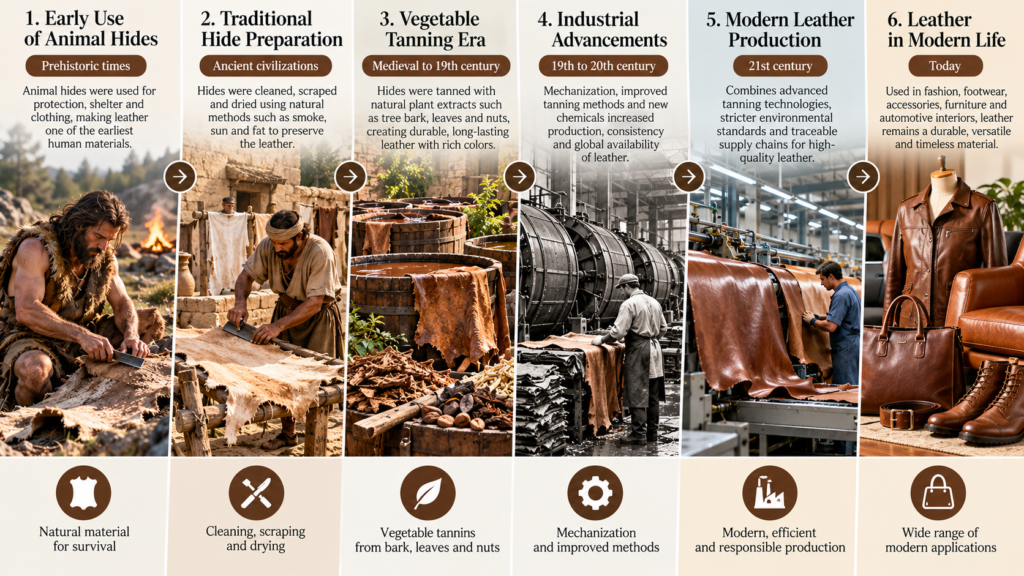
The history of leather is closely connected with the history of human survival.
Animal skins offered an immediately useful material for protection against cold, wind and rough environments. Early methods focused on preventing skins from drying out, rotting or becoming unusably stiff.
People eventually discovered that different preservation techniques could change the properties of animal skins. Smoking, drying, salting, oiling and treating skins with plant materials all became part of traditional leather-making practices.
One of the most important developments was vegetable tanning, in which tannin-rich plant materials were used to stabilize the hide. Bark, wood and other plant sources became important tanning materials in different leather-producing traditions.
Industrialization later transformed the craft. Machinery allowed hides to be processed at much larger volumes, while new chemical tanning systems made production faster and more consistent.
Chrome tanning eventually became one of the dominant modern methods. Its ability to produce flexible and consistent leather efficiently helped it become particularly important for large-scale manufacturing.
Leather’s applications also expanded. In addition to traditional clothing and footwear, it became widely used for luggage, saddlery, bookbinding, furniture, automotive interiors and fashion accessories.
3. How Is Leather Fabric Made?
Leather manufacturing can look complicated because a hide passes through many individual operations. Broadly, the process can be understood in three stages:
- Preparing the hide
- Tanning it
- Finishing the leather
Preparing the Hide
The process begins with a hide or skin that must be preserved and prepared for processing.
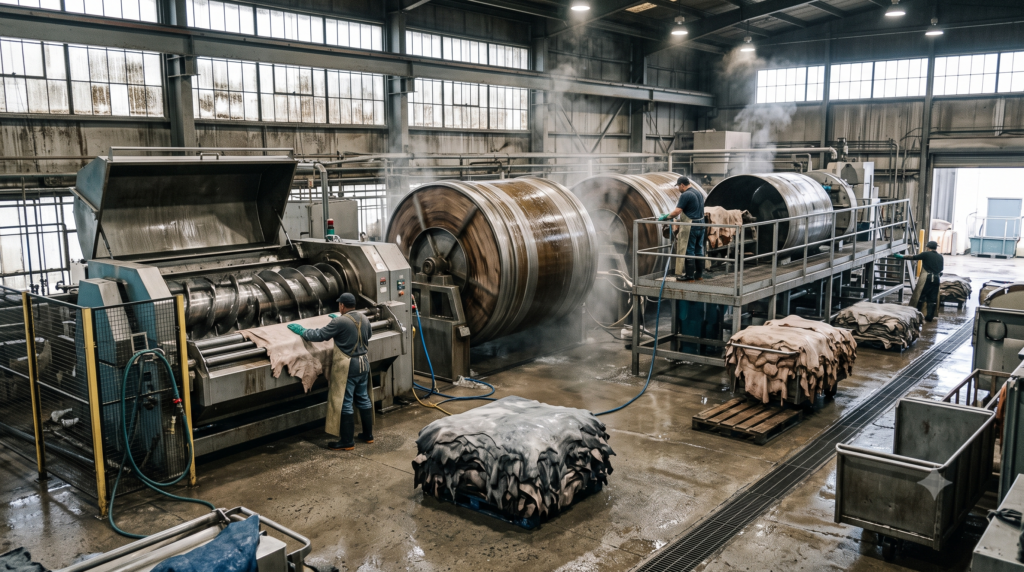
After arriving at a tannery, hides are cleaned and conditioned. Depending on the production system, they may undergo soaking, liming, hair removal, fleshing, deliming and other treatments.
These steps remove unwanted materials and prepare the collagen structure for tanning.
The preparation stage has an important practical purpose: the hide needs to become clean, flexible and chemically suitable for the tanning process.
Tanning the Hide
Tanning is the stage that converts prepared hide into stable leather.
There are several tanning systems, but three broad categories are especially important.
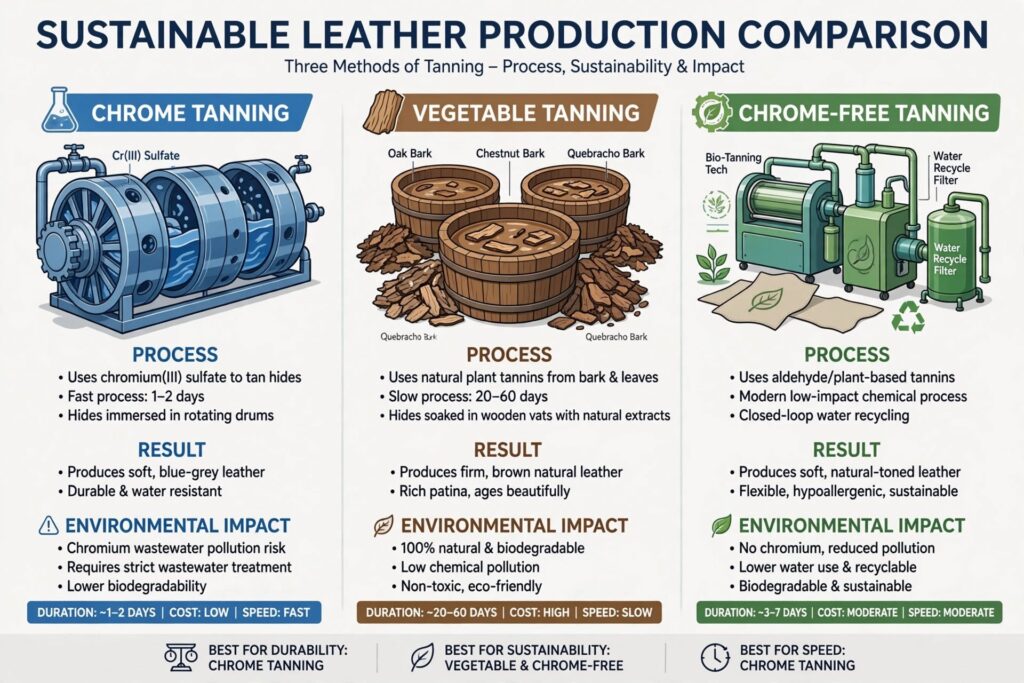
Chrome Tanning
Chrome tanning uses trivalent chromium compounds to stabilize the collagen structure.
It is widely used because it can produce leather efficiently in a broad range of softness, thickness and performance characteristics.
Vegetable Tanning
Vegetable tanning uses tannins obtained from plant sources.
It generally takes longer than chrome tanning and produces leather with a distinctive character. Vegetable-tanned leather is often valued for the way its color and surface can change as it ages.
Chrome-Free Tanning
Chrome-free leather is produced using tanning systems that do not rely on chromium tanning salts. Several different chemistries can fall into this category.
It is therefore important to understand that “chrome-free” does not automatically mean “chemical-free.” All tanning systems involve controlled chemical or biological processes.
Splitting and Finishing
Once tanning is complete, the leather may be divided into different thicknesses.
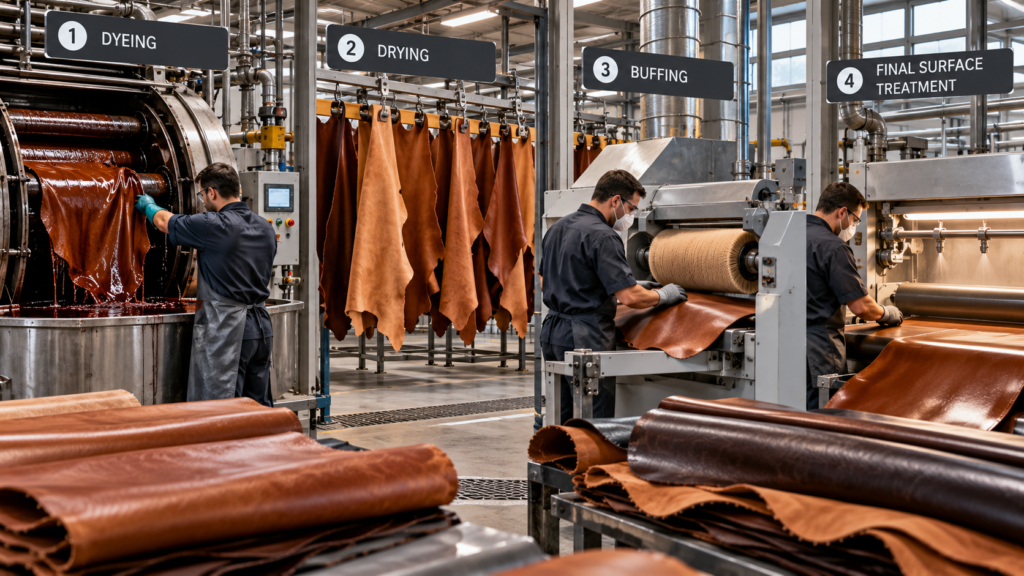
The surface can then be:
- Dyed
- Softened
- Oiled
- Waxed
- Buffed
- Sanded
- Embossed
- Pigmented
- Coated
These treatments can dramatically change how the leather looks and feels.
A manufacturer making a rugged boot may want a firm, abrasion-resistant surface, while a fashion brand producing a lightweight jacket may want exceptionally soft leather with a fluid drape.
Final Finishing
Finishing gives the leather its final identity.
Some leathers retain much of their natural surface, allowing marks and variations in the hide to remain visible. Others receive pigments or coatings that create a more uniform color and appearance.
This is one reason why simply calling a material “leather” tells a buyer surprisingly little about how it will perform.
4. How Is Leather Fabric Used?
Leather has remained popular because it combines durability with a distinctive appearance and tactile quality.
Clothing
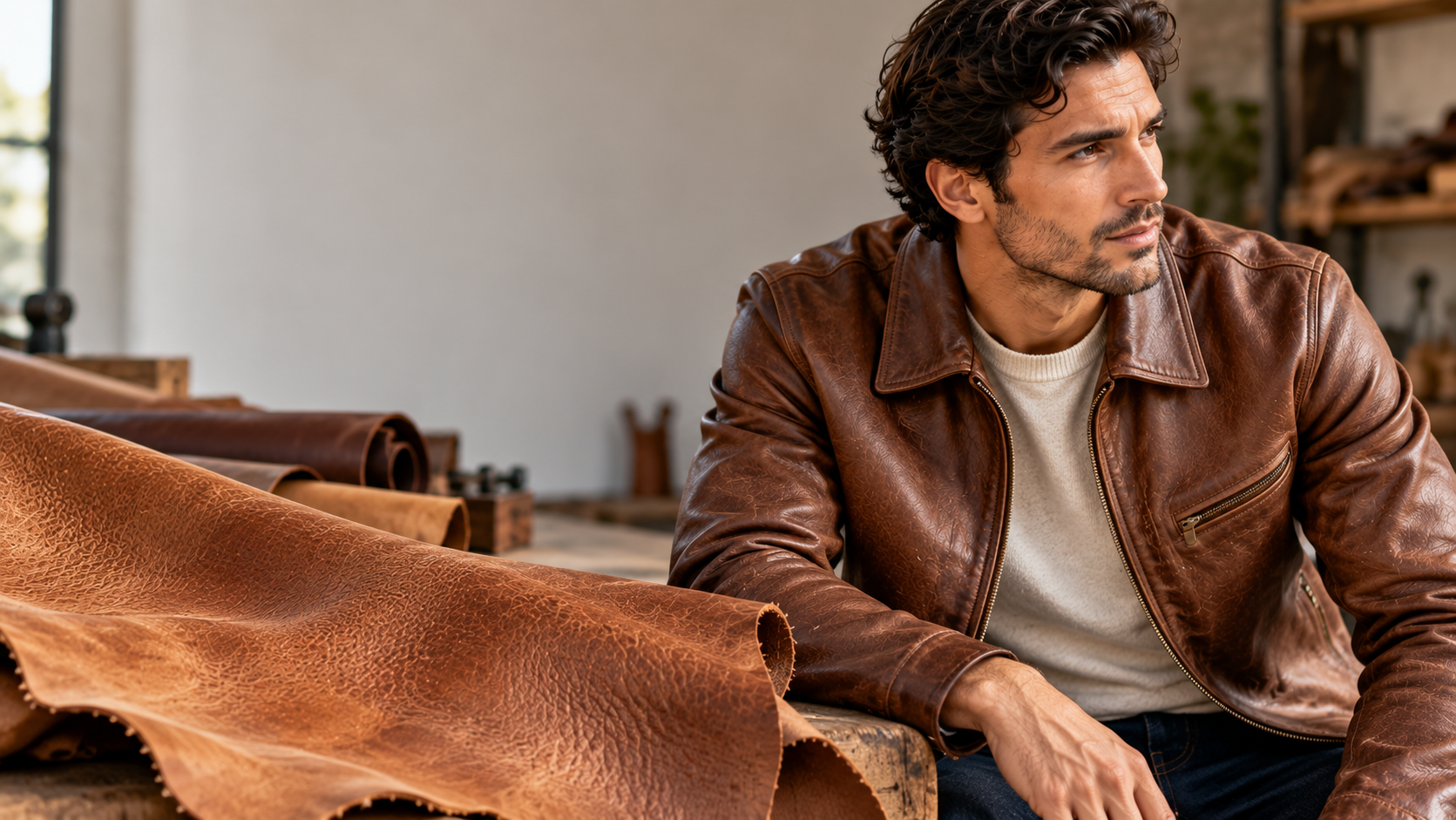
Leather is especially common in outerwear.
Typical applications include:
- Jackets
- Coats
- Trousers
- Gloves
- Vests
- Boots
- Shoes
Soft leather can also be used for fashion garments where flexibility and drape are important.

Footwear
Leather is one of the most established materials for footwear.
It can be used for:
- Shoe uppers
- Boots
- Sandals
- Formal footwear
- Work footwear
- Linings
- Insoles and other components
Different grades and finishes are selected depending on whether the footwear needs softness, structure, abrasion resistance or water resistance.
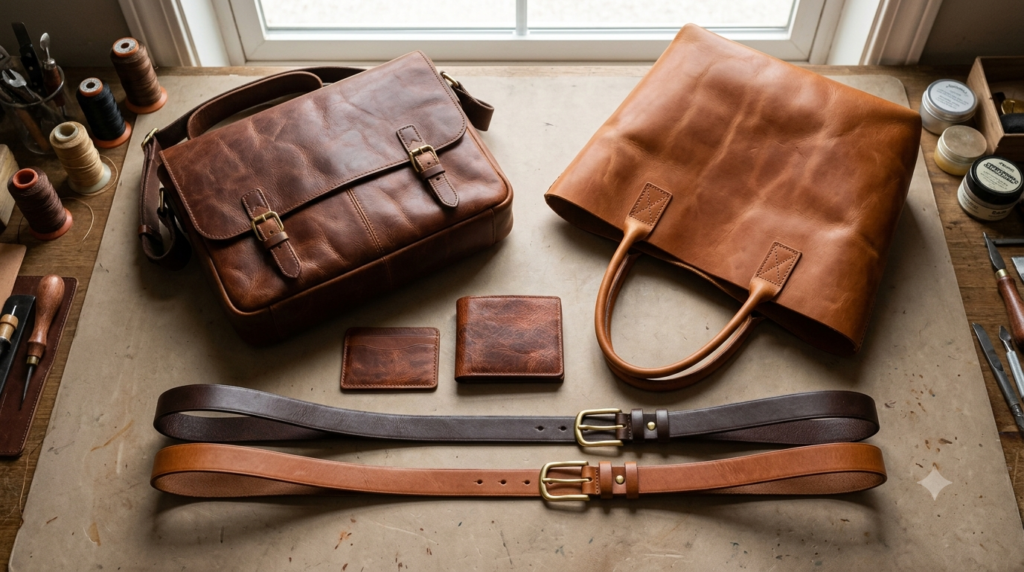
Bags and Accessories
Leather is widely used for products that need to withstand repeated handling.
Examples include:
- Handbags
- Backpacks
- Wallets
- Belts
- Briefcases
- Luggage
- Watch straps
- Cases
Its ability to maintain structure makes it particularly useful for bags and accessories.
Furniture and Automotive Interiors
Leather is also widely used in upholstery.
It can cover sofas, chairs and other furniture, as well as seats and interior components in automobiles.
Automotive leather is usually selected and finished according to specific performance requirements, including abrasion resistance, appearance retention and ease of maintenance.
Other Applications
Leather is also used for:
- Saddles
- Equestrian equipment
- Sporting goods
- Bookbinding
- Protective products
- Instrument cases
- Interior accessories
5. Where Is Leather Fabric Produced?
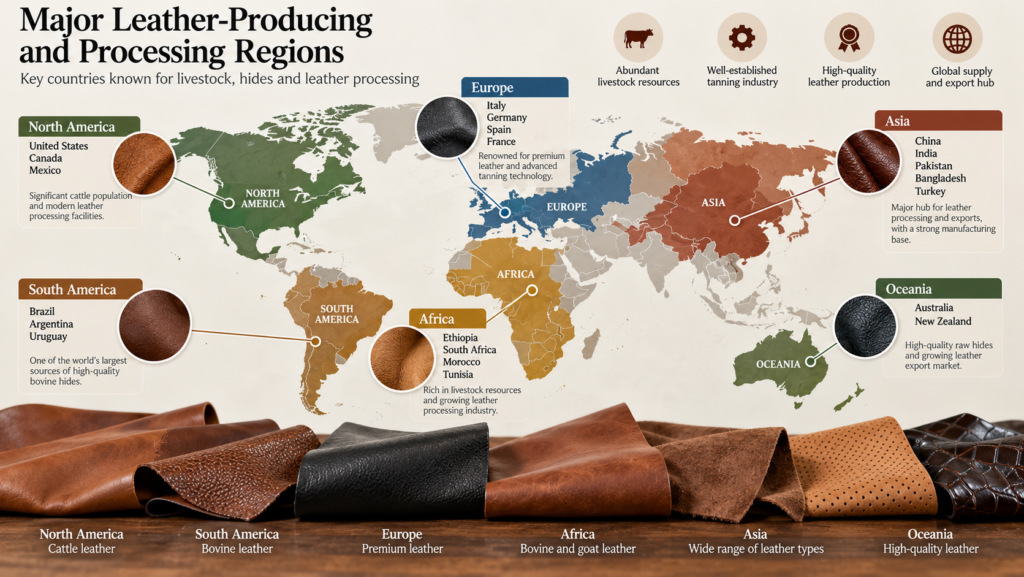
Leather is produced through a global supply chain rather than being associated with one particular country.
The process connects animal hide collection, preservation, tanning, finishing and manufacturing. Major leather-producing and processing industries exist across Asia, Europe, North and South America and other regions.
Italy is particularly well known for high-end leather processing and craftsmanship, while countries including China, India, Brazil and others have large leather industries.
However, country of origin should not be treated as a simple measure of leather quality.
Two tanneries in the same country can produce very different materials. Hide selection, tanning technology, finishing expertise, quality control and environmental management all influence the final result.
For brands and manufacturers, the individual tannery and its production standards can therefore be more informative than a country label alone.
6. How Much Does Leather Fabric Cost?
Leather does not have one standard price.
Unlike a basic woven textile, leather is often sold according to a combination of area, grade, thickness, quality and finishing.
The price can be influenced by:
- Animal species
- Hide size
- Grain quality
- Natural markings
- Thickness
- Tanning method
- Dyeing process
- Surface finish
- Country of production
- Order quantity
- Traceability requirements
Premium full-grain leather can command significantly higher prices than heavily corrected or lower-layer leather.
Specialized finishes can also increase the cost because they require additional processing.
This makes direct price comparisons difficult. A lower-priced leather is not necessarily poor quality, and an expensive leather is not automatically the best choice for every application.
The appropriate leather depends on the product being made.
7. What Different Types of Leather Fabric Are There?
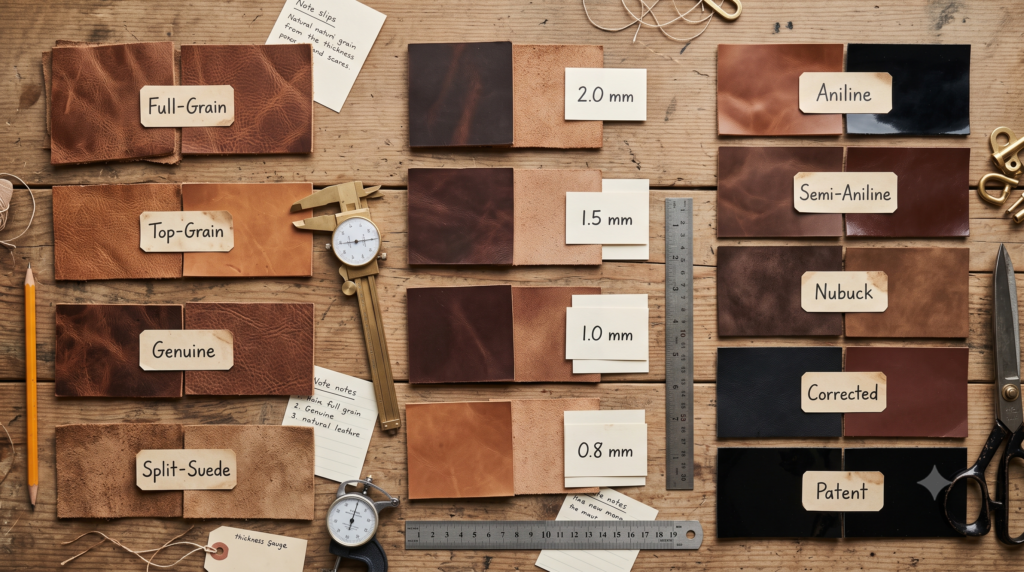
Leather types are often confusing because different names describe different characteristics.
Some terms describe which part of the hide is used. Others describe how the surface has been treated.
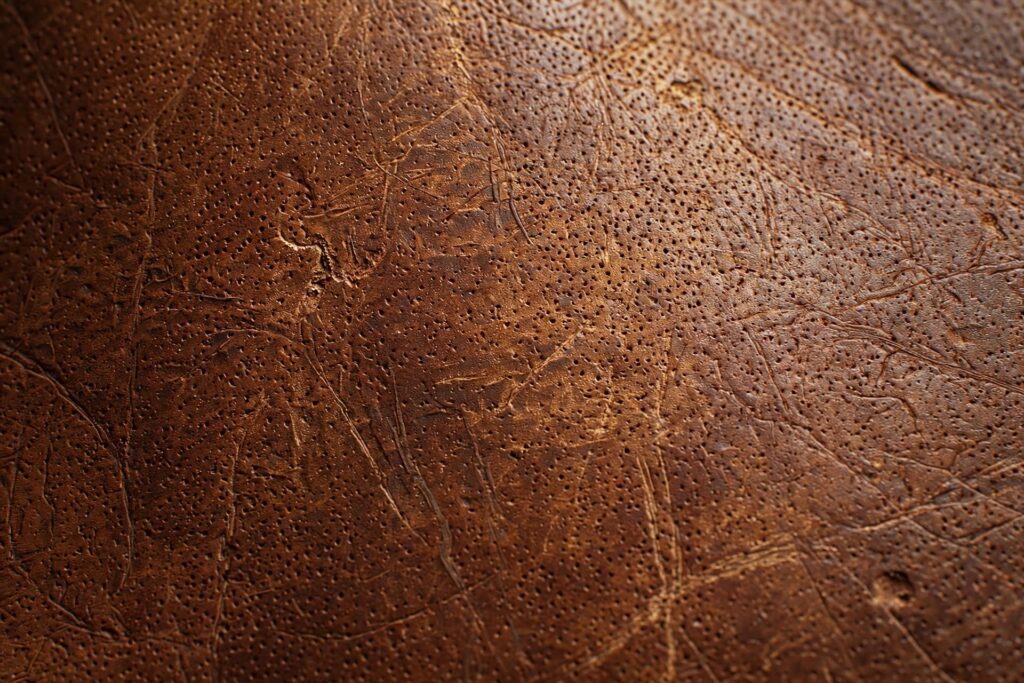
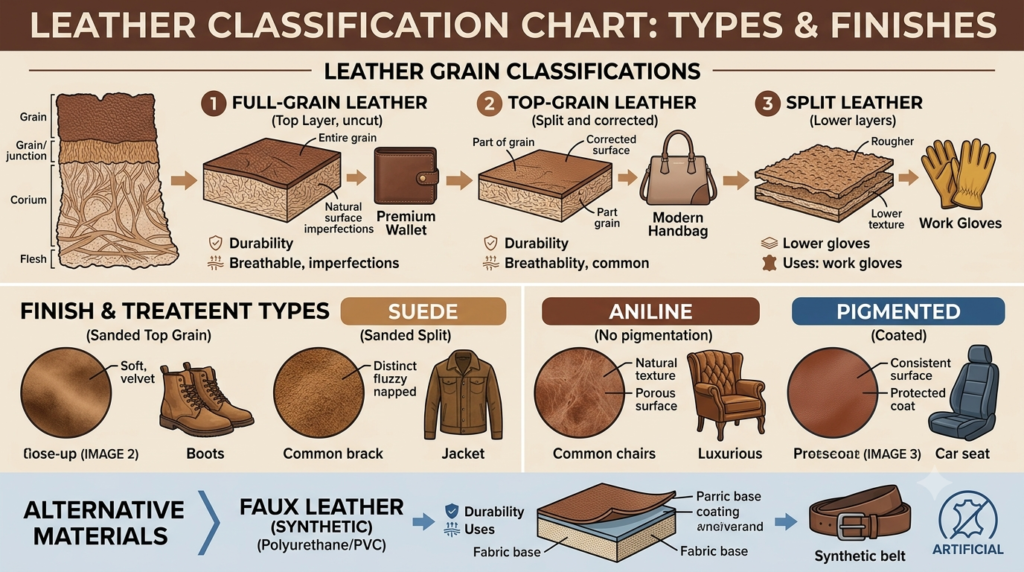
Full-Grain Leather
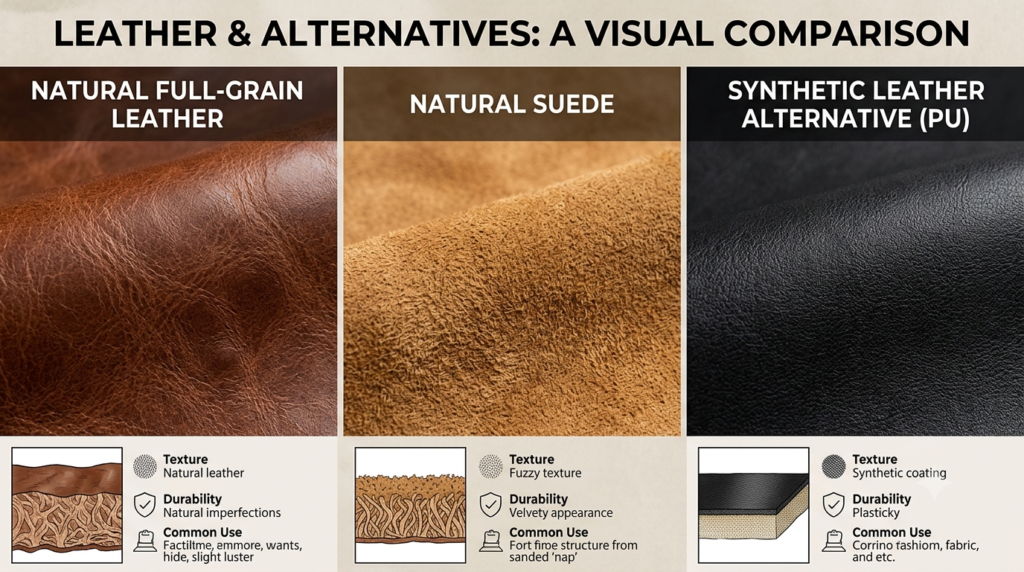
Full-grain leather retains the natural grain surface of the hide.
Because the surface remains largely intact, natural markings, pores and variations can remain visible. This gives full-grain leather a distinctive appearance and allows it to develop character with use.
Top-Grain Leather
Top-grain refers broadly to leather made from the upper portion of the hide.
The surface may be lightly corrected or treated to create a more consistent appearance.
Top-grain and full-grain are therefore related terms, but they should not automatically be treated as interchangeable.
Corrected-Grain Leather
Corrected-grain leather has undergone surface treatment to reduce the visibility of imperfections.
Buffing, sanding, embossing or pigmentation may be used to produce a more uniform finish.
This does not necessarily make the material unsuitable. In many applications, a consistent surface is exactly what the manufacturer wants.
Split Leather
When a hide is separated into layers, the lower portion is known as split leather.
Split leather can be finished in different ways and may be used for footwear, furniture, accessories and other applications.
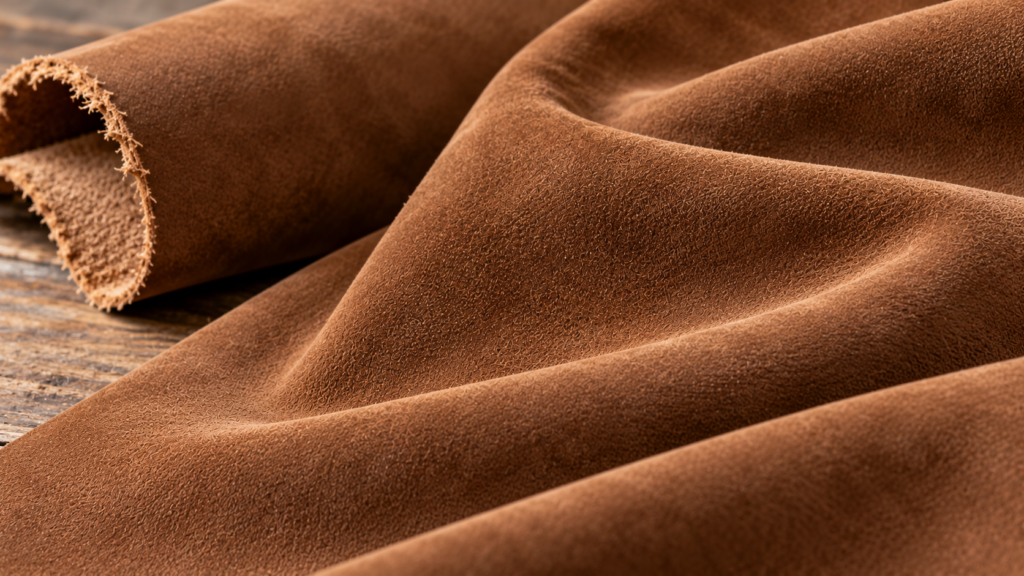
Nubuck
Nubuck is produced by lightly sanding or buffing the grain side of leather to create a fine, soft surface.
It has a characteristic velvety appearance while retaining the underlying grain structure.
Suede
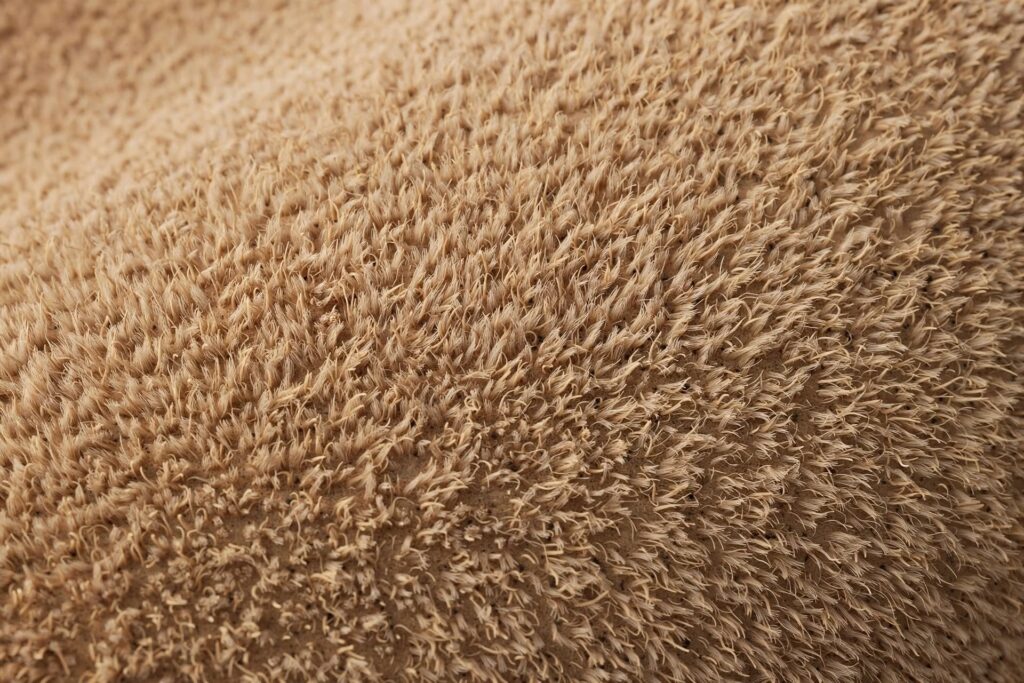
Suede has a soft, napped surface.
It is commonly associated with the flesh side or split portion of a hide and has a more visibly fibrous appearance than smooth leather.
Aniline Leather
Aniline leather is finished in a way that allows much of the natural character of the hide to remain visible.
Because the surface is less heavily covered, variations and natural marks can be more apparent.
Semi-Aniline Leather
Semi-aniline leather receives a light protective or pigmented finish while retaining a relatively natural appearance.
It offers a balance between visible grain character and additional surface protection.
Pigmented Leather
Pigmented leather receives a surface finish containing pigments.
This creates a more consistent color and can improve resistance to certain forms of everyday wear.
Patent Leather
Patent leather has a distinctive high-gloss surface produced through specialized finishing.
It is commonly associated with formal footwear, accessories and fashion products.
Bonded or Reconstituted Leather
Bonded or reconstituted leather is made using leather fibers or fragments that are processed and formed into a sheet, generally with binding materials.
It is fundamentally different from a continuous hide and should not be assumed to have the same characteristics as full-grain leather.
Faux or Imitation Leather
Faux leather is not animal leather.
It is produced using non-animal materials and can be designed to imitate the appearance and feel of leather. Common examples include polyurethane-based and PVC-based materials, although newer alternatives also exist.
8. How Does Leather Fabric Impact the Environment?
Leather’s environmental impact is more complicated than simply asking whether the material is natural or synthetic.
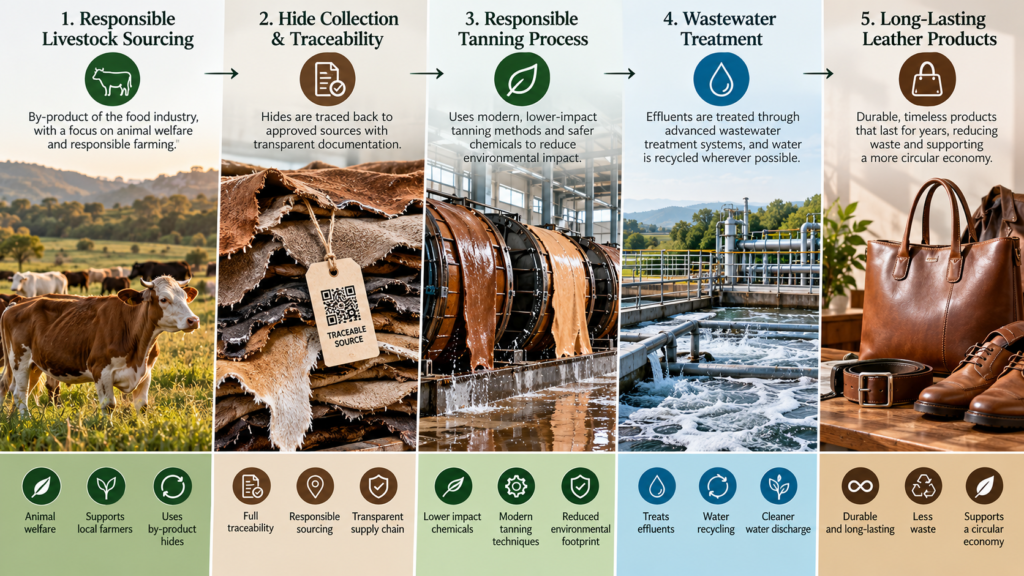
The first consideration is the animal-production stage. Most conventional leather comes from animals raised primarily for food, so environmental impacts associated with livestock production can form an important part of leather’s overall footprint.
These can include land use, greenhouse-gas emissions, feed requirements, water use and other agricultural impacts.
The tanning stage creates a different set of considerations.
Tanning and Chemical Management
Leather manufacturing uses water, energy and chemical inputs.
Poorly controlled tanning operations can create wastewater and solid waste problems, making chemical handling, wastewater treatment and resource efficiency important parts of responsible production.
Modern environmental assessments increasingly examine the complete production chain rather than focusing only on tanning.
Chrome Tanning
Chrome tanning is widespread because it is efficient and can produce consistent leather.
The use of trivalent chromium in a controlled tanning process should not be confused with hexavalent chromium, which is a different chemical form and an undesirable contaminant.
Proper chemical management and wastewater treatment are therefore important in chrome-tanned leather production.
Vegetable Tanning
Vegetable tanning uses plant-derived tannins and has a long history in leather production.
However, it would be too simplistic to describe all vegetable-tanned leather as automatically sustainable. The environmental profile still depends on factors such as raw-material sourcing, water use, energy, waste management and the rest of the manufacturing process.
Traceability
Where hides originate can also matter.
Responsible sourcing increasingly considers issues such as supply-chain transparency, deforestation risks, animal welfare and manufacturing conditions.
For this reason, environmental claims about leather should ideally be evaluated across the entire supply chain rather than based on one characteristic such as tanning method.
9. Leather Fabric Certifications Available
There is no single certification that answers every question about leather.
Different standards focus on different parts of the production process.
Leather Working Group
The Leather Working Group is one of the best-known systems for evaluating leather manufacturing facilities.
Its assessment framework covers areas such as:
- Environmental management
- Chemical management
- Resource efficiency
- Waste management
- Traceability
- Social responsibility
- Health and safety
- Supply-chain due diligence
An LWG-related certification or audit should therefore be understood as information about production practices and facility performance, rather than simply a statement that a particular piece of leather is “sustainable.”
Textile Exchange Standards and Benchmarks
Textile Exchange provides frameworks and benchmarks relevant to environmental and social performance in leather production.
These can help brands assess areas such as environmental management, chemicals, energy, water, waste and social considerations.
OEKO-TEX
Certain OEKO-TEX standards can also be relevant to leather products, particularly where chemical safety and harmful-substance testing are concerned.
The important point is to check exactly what is certified – the tannery, raw material, finished product or a particular production claim.
10. Frequently Asked Questions
Is leather a fabric?
Leather is commonly described as a fabric or textile material in fashion, but technically it is a tanned animal hide or skin rather than a woven or knitted fabric.
What is leather fabric made from?
Traditional leather is made from animal hides or skins that have been processed and tanned to stabilize their natural collagen structure.
Is leather natural or synthetic?
Traditional leather is animal-derived. Synthetic or faux leather is made from non-animal materials.
What is the difference between full-grain and top-grain leather?
Full-grain leather retains the natural grain surface of the hide. Top-grain is a broader term for leather from the upper part of the hide and may include material whose surface has been lightly corrected.
Is suede real leather?
Yes. Suede is a type of leather characterized by its soft, napped surface.
Is nubuck the same as suede?
No. Both have soft, napped surfaces, but nubuck is generally made by buffing the grain side, while suede is commonly associated with the flesh side or split portion.
Is genuine leather good quality?
The phrase “genuine leather” by itself does not tell you enough about quality. It is better to look at the leather’s construction, grain, thickness, tanning method and finish.
Is vegetable-tanned leather better?
Not automatically. Vegetable tanning has different characteristics from chrome tanning, but the overall environmental performance depends on the complete production process.
Is leather waterproof?
Leather is generally not completely waterproof. Some types can be treated to improve water resistance, but performance depends heavily on the leather type and finish.
Does leather last a long time?
High-quality leather can be extremely durable when properly selected, manufactured and maintained. Longevity varies considerably between different leather types and finishes.
Can leather be recycled?
Some leather waste can be mechanically processed and incorporated into reconstituted or bonded materials. Recycling possibilities depend on the type of leather, coatings, construction and available processing technology.
What should I look for when buying leather?
Look at the type of leather, grain classification, thickness, finish, intended use, manufacturing quality and available information about sourcing and production. A label simply saying “leather” does not provide the full picture.