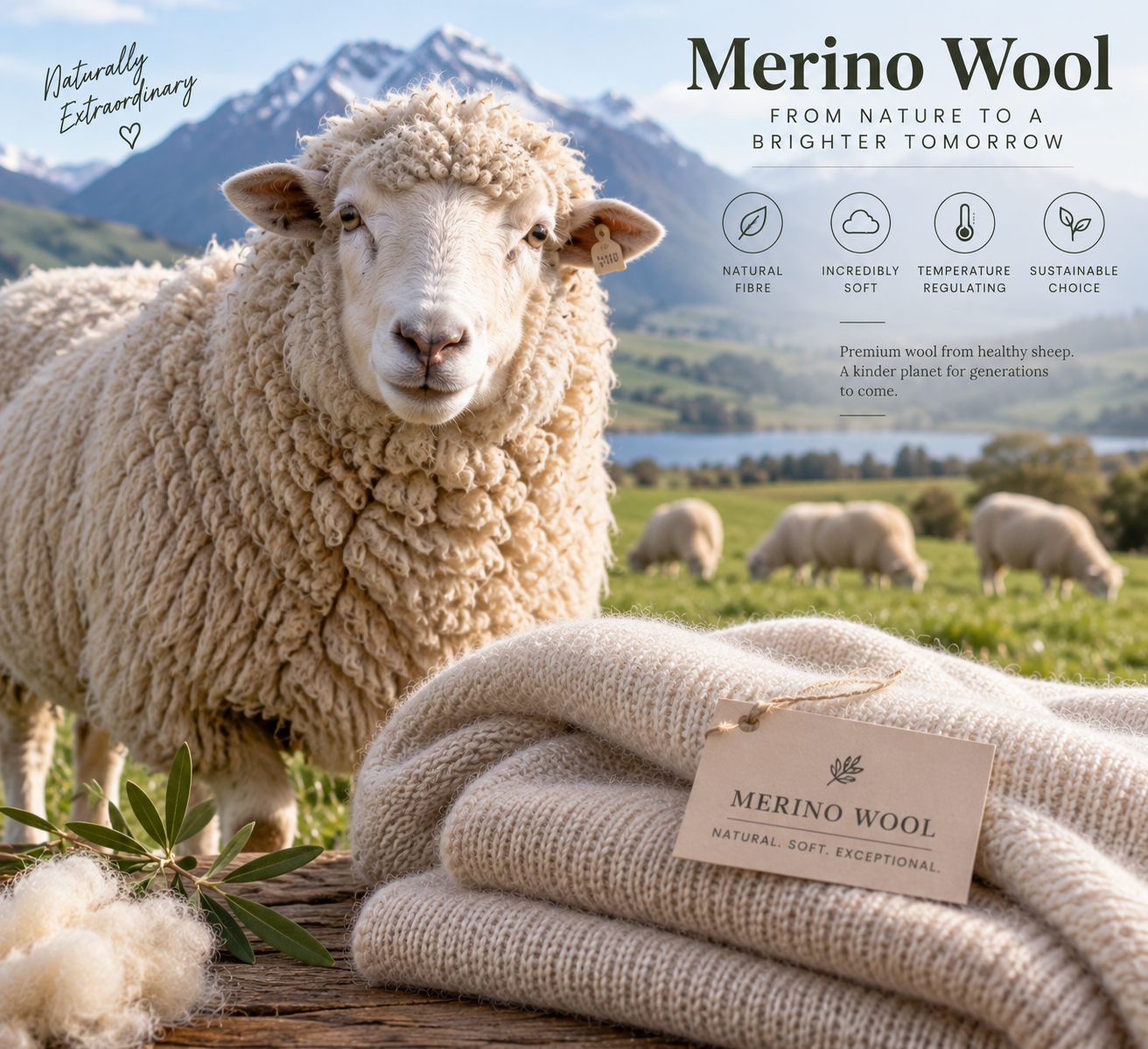
Merino wool is a natural animal-based textile made from the fleece of Merino sheep. It is valued for its softness, warmth, durability, moisture absorption, and ability to regulate body temperature. Unlike many traditional wool fabrics, fine merino wool can feel comfortable against the skin and is widely used in base layers, sweaters, socks, sportswear, and lightweight clothing.
Merino wool is available in several grades. The finer the fibers, the softer and more luxurious the fabric tends to be. The finest grades can be blended with materials such as silk or cashmere.
Quick Facts About Merino Wool Fabric
| Feature | Details |
|---|---|
| Fabric name | Merino wool |
| Also known as | Spanish wool |
| Composition | Carded and spun fibers from Merino sheep |
| Fiber type | Natural animal-hair fiber |
| Breathability | Medium |
| Moisture-wicking ability | High |
| Heat retention | High |
| Stretchability | Medium |
| Pilling tendency | Can be high, depending on the fabric and finish |
| Origin | Spain |
| Largest producer/exporter | Australia |
| Common uses | Sweaters, socks, shirts, base layers, hoodies, dresses, trousers, underwear, blankets |
| Recommended washing | Cold, cool, or warm water, depending on care instructions |
What Is Merino Wool Fabric?
Merino wool fabric is produced from the fleece of Merino sheep, a breed originally developed in Spain. Like other wool fabrics, it is naturally absorbent, insulating, water-resistant, and flame-resistant.
One of its main advantages is its ability to manage moisture. Merino wool can absorb water vapor from the body while still helping the wearer remain warm and comfortable. This makes it especially useful for base layers and clothing worn during outdoor activities.
Merino wool is available in different fiber grades. Coarser varieties are more durable but may feel slightly rough against the skin. Fine, superfine, and ultrafine merino wool are much softer and are often used in garments worn directly against the body.
Although wool is sometimes associated with itchiness, fine merino fibers can be soft enough for shirts, underwear, socks, and lightweight sweaters.
History of Merino Wool
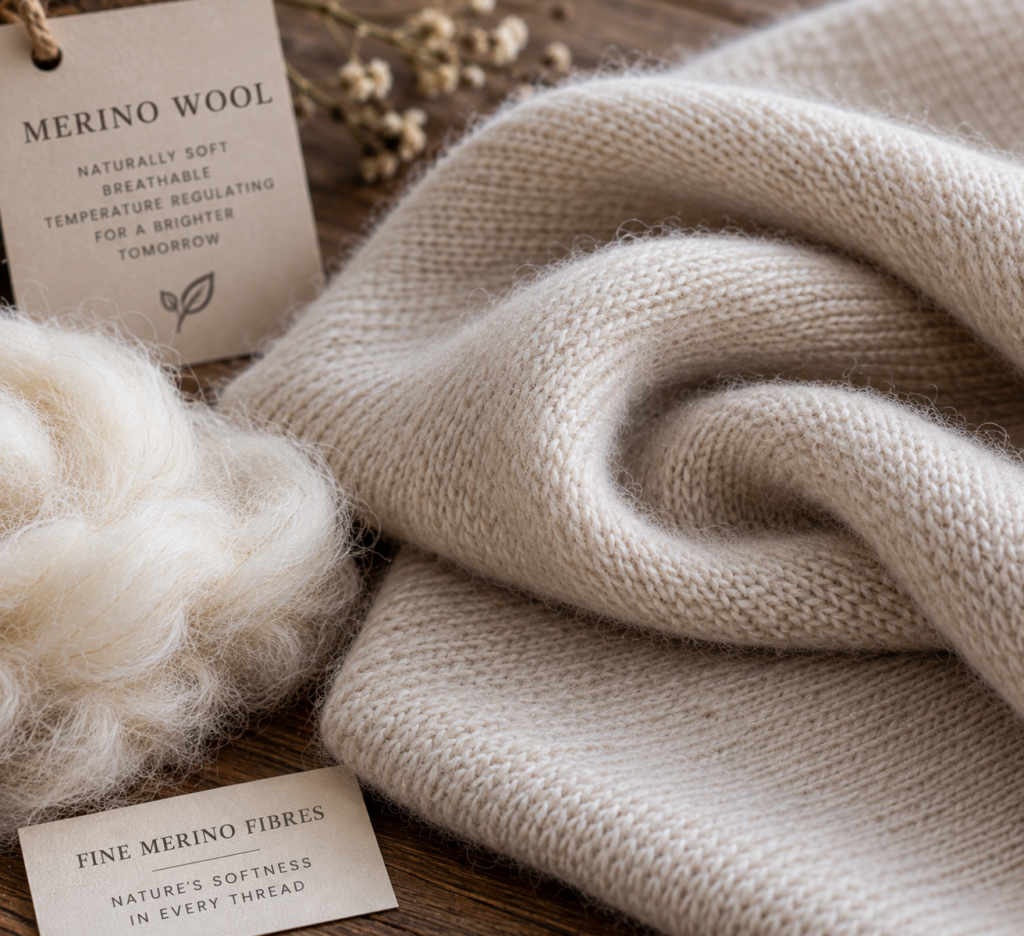
Merino sheep appeared in southern Spain during the 12th or 13th century. Their exact origins remain debated. Some historians believe they were introduced from Morocco, while others suggest that Spanish sheep were selectively bred with North African rams.
The breed developed a reputation for producing exceptionally fine wool. By the end of the 15th century, Merino wool had helped Spain become a major competitor to England in the European wool market.
During the 16th century, Spanish merchants gained strong control over the European wool trade. Merino sheep were moved seasonally across Spain, and wool exports became an important part of the Spanish economy.
For many years, exporting live Merino sheep from Spain was prohibited. This changed in the 18th century when small numbers were sent to Sweden and later to Britain. From there, Merino sheep spread to other European countries and British colonies.
The Development of Australian Merino Wool
The Napoleonic Wars severely damaged Spain’s Merino wool industry. However, the breed had already been introduced to places such as Australia and South Africa.
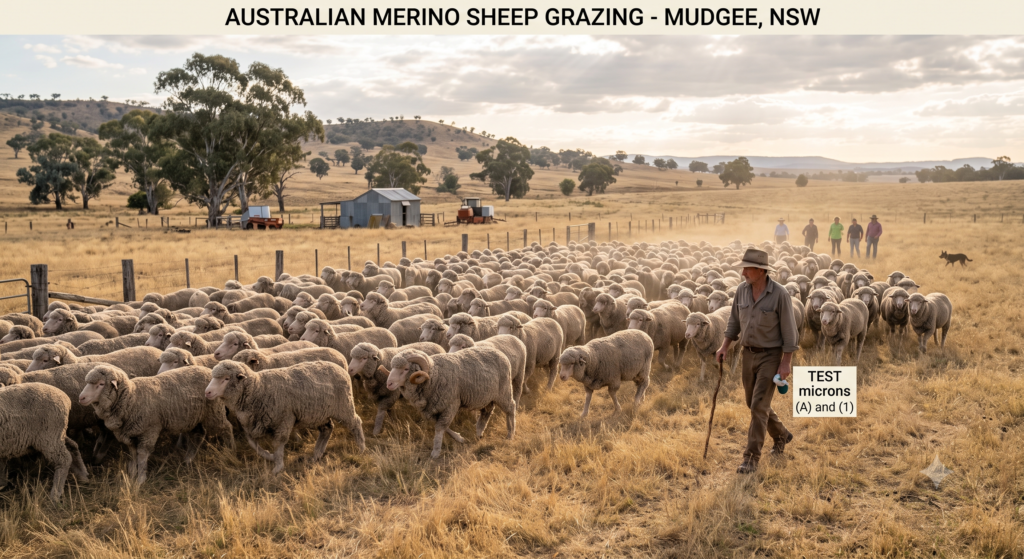
Australia became especially important to Merino wool production. The sheep adapted well to the country’s subtropical and semi-arid regions, and their population grew rapidly. Today, Australia produces a large share of the world’s Merino wool and remains the leading exporter of this fiber.
Merino Wool Today
Merino sheep are now raised in several countries, including Australia, the United States, and South Africa. Australia remains the dominant producer, with most of the world’s Merino wool originating there.
Modern uses have also changed. Merino wool is less commonly used for formal clothing than it was in the past. It is now more closely associated with casualwear, sportswear, outdoor clothing, thermal layers, and comfortable everyday garments.
How Is Merino Wool Fabric Made?
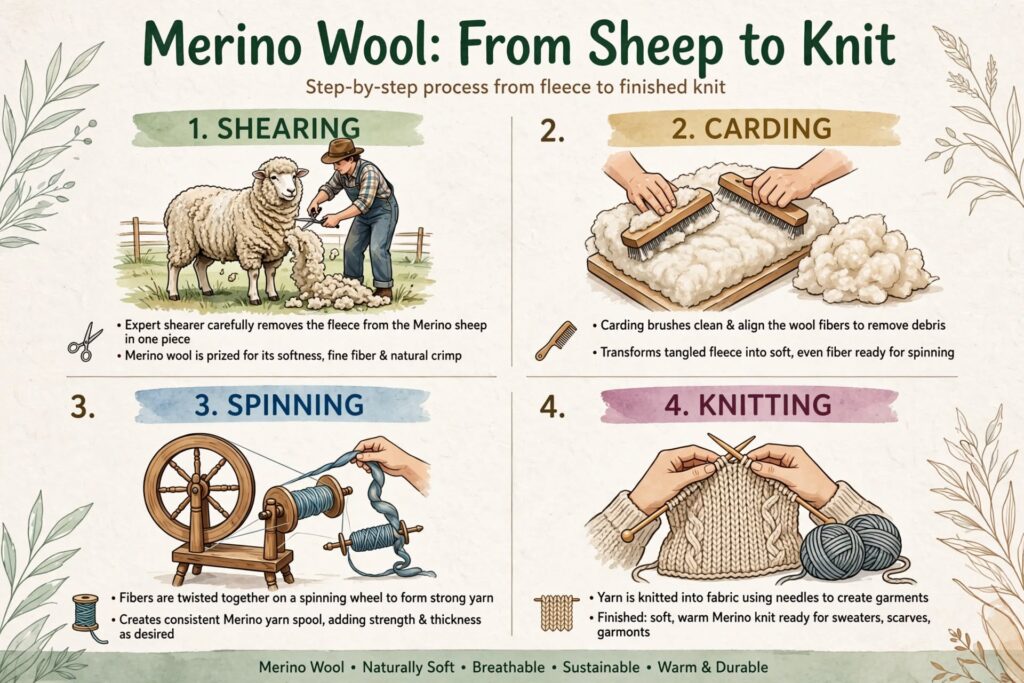
The production of merino wool fabric involves several stages, from shearing the sheep to spinning, weaving, knitting, and finishing the fabric.
1. Shearing
Merino sheep are shorn when their fleece is ready. Depending on the breed and farming conditions, some sheep may be shorn every two or three months, while others are shorn approximately twice a year.
A Merino sheep can produce around 3 to 18 kilograms of wool annually. Freshly removed wool is often called “greasy wool” because it still contains natural oils from the sheep’s skin.
2. Cleaning and Carding
The greasy wool is washed to remove dirt, sweat, plant material, and excess oils. It is then sorted according to fiber quality and thickness.
During carding, the fibers are separated and aligned into long, soft strands. These strands are called slivers and are prepared for spinning.
3. Spinning
Different grades of Merino wool are generally spun separately. The prepared fibers are twisted into yarn, which is then wound onto reels or cones for further processing.
The thickness and twist of the yarn influence the final fabric’s weight, softness, strength, and appearance.
4. Weaving or Knitting
Merino wool yarn can be woven or knitted. Common woven structures include plain weave and twill weave. Knitted Merino wool is frequently used for sweaters, socks, base layers, and other stretchable garments.
When a fabric requires multiple colors, the yarn may be dyed before it is woven or knitted. This is known as yarn dyeing.
5. Dyeing and Finishing
Single-color fabrics may be dyed after weaving or knitting. Additional finishing processes can improve softness, appearance, shrink resistance, or durability.
Merino wool naturally resists flames, so it usually does not require the same flame-retardant treatments used for some synthetic fabrics. In certain cases, wool may receive water-resistant or other chemical treatments.
How Is Merino Wool Fabric Used?
Merino wool is primarily used for apparel, although it also has some applications in home textiles.
Uses in Apparel
Fine Merino wool is soft enough to be worn directly against the skin. It is commonly used for:
- Sweaters and pullovers
- T-shirts and shirts
- Blouses and tank tops
- Socks
- Thermal underwear
- Base layers
- Long underwear
- Hoodies
- Dresses and skirts
- Trousers
- Casual jackets and blazers
- Sportswear and outdoor clothing
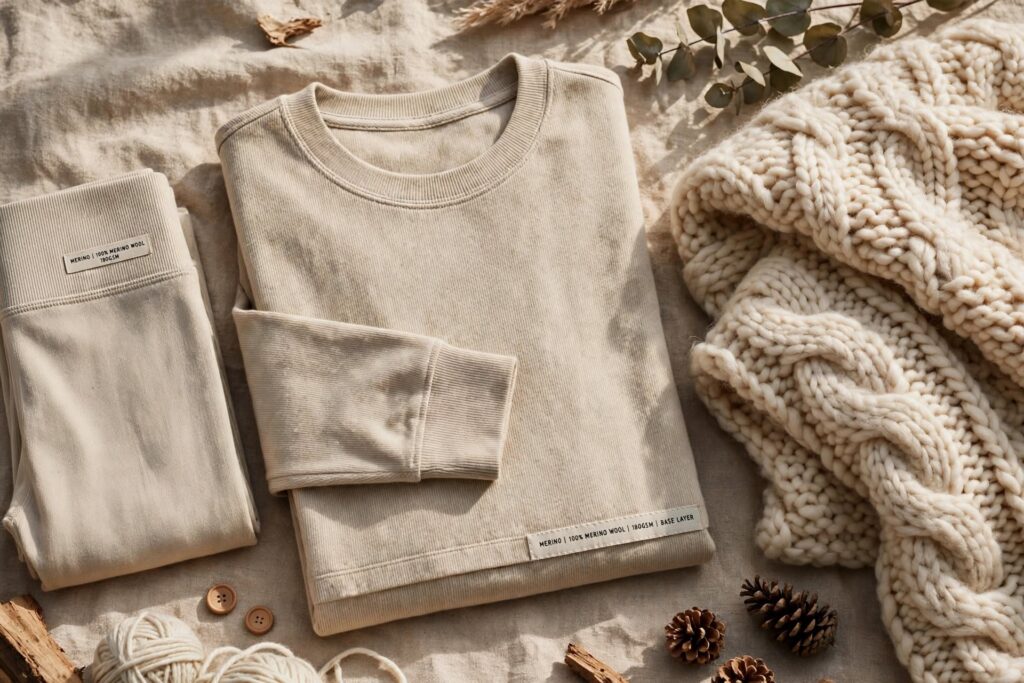
Merino wool is particularly useful for base layers because it combines warmth, moisture management, softness, and durability. It can help keep the wearer warm in cold conditions without becoming excessively heavy.
Coarser grades may be used for outerwear, jackets, and garments where the fabric does not need to sit directly against the skin.
Uses in Home Textiles
Merino wool is also used for:
- Blankets
- Throw blankets
- Bedding layers
- Warm home accessories
Its insulating properties make it suitable for blankets placed between sheets and comforters. Its softness also makes it popular for decorative throws.
Where Is Merino Wool Fabric Produced?
Merino wool originated in Spain, but Australia is now the world’s leading producer and exporter. Australia produces hundreds of millions of kilograms of wool annually and has the largest population of Merino sheep.
Merino wool is also produced in countries such as:
- United States
- South Africa
- New Zealand
- Argentina
- Uruguay
- Other European and wool-producing regions
It is important to distinguish between wool production and fabric manufacturing. The fleece may be collected in one country, spun into yarn in another, and woven or knitted into fabric elsewhere.
How Much Does Merino Wool Fabric Cost?
Merino wool is often less expensive than other luxury wool fibers, such as cashmere, mohair, and angora. Its relatively large supply, especially from Australia, helps keep many grades reasonably affordable.
However, prices vary depending on:
- Fiber fineness
- Wool grade
- Fabric weight
- Yarn quality
- Weaving or knitting method
- Finishing treatments
- Organic certification
- Country of origin
- Brand reputation
- Order quantity
Basic Merino wool may sometimes be priced similarly to premium cotton. Fine, superfine, ultrafine, and organic Merino wool generally cost more because they are softer, less common, or more carefully produced.
What Different Types of Merino Wool Fabric Are There?
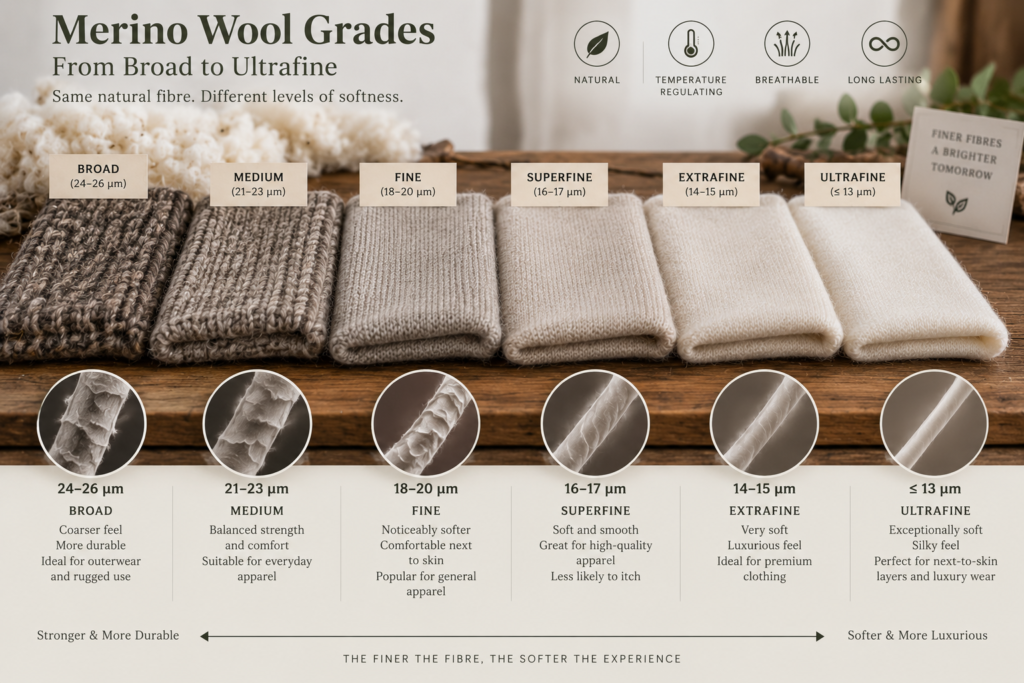
Merino wool is mainly classified according to fiber diameter, measured in microns. A lower micron count generally means a finer and softer fiber.
1. Broad Merino Wool: 23–24.5 Microns
Broad Merino wool, also called strong Merino wool, is the coarsest and most durable grade. It is commonly used for:
- Outerwear
- Heavy fabrics
- Blankets
- Industrial textiles
- Products that do not touch the skin
Because of its rougher texture, it is not usually blended with delicate fibers such as silk or fine cotton.
2. Medium Merino Wool: 19.6–22.9 Microns
Medium Merino wool offers a balance between softness and durability. It may be used for clothing, but it is more commonly found in:
- Blazers
- Blankets
- Medium-weight sweaters
- Outer garments
Some medium-grade fabrics can be worn next to the skin, depending on the construction and the wearer’s sensitivity.
3. Fine Merino Wool: 18.6–19.5 Microns
Fine Merino wool is one of the most widely used grades in commercial clothing. It is soft, comfortable, and relatively affordable.
It is commonly used for:
- Sweaters
- Shirts
- Socks
- Base layers
- Lightweight knitwear
Fine Merino wool can provide a luxurious feel without the high price of some other premium animal fibers.
4. Superfine Merino Wool: 15–18.5 Microns
Superfine Merino wool is softer and more delicate than fine Merino wool. It begins to compete with cashmere and other luxury fibers in terms of comfort.
Because it is produced in smaller quantities, superfine Merino wool is usually more expensive.
5. Ultrafine Merino Wool: 11.5–15 Microns
Ultrafine Merino wool is the rarest and most luxurious grade. It is exceptionally soft and may be used in premium clothing and high-end blends.
Its softness and limited availability make it one of the most expensive types of Merino wool. It can be comparable to cashmere, angora, and other fine luxury fibers.
How Does Merino Wool Fabric Impact the Environment?
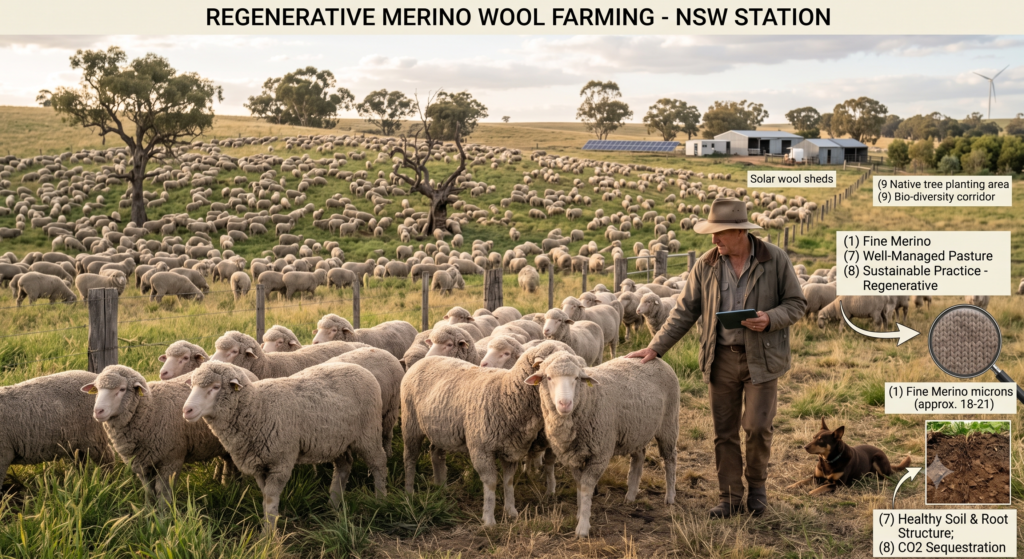
Merino wool has several environmental advantages. It is a natural, renewable, and biodegradable fiber. Unlike synthetic fabrics, it does not directly contribute to long-term plastic pollution through its basic composition.
Merino wool also has natural flame-resistant properties, which can reduce the need for certain chemical flame-retardant treatments.
However, Merino wool is not impact-free. Its environmental effects depend on farming, land management, animal welfare, processing, and transportation.
Land and Soil Impact
Poorly managed grazing can lead to overgrazing, soil erosion, loss of vegetation, and land degradation. Responsible grazing practices are therefore important for protecting soil and surrounding ecosystems.
Animal Welfare
Animal welfare is another important consideration. One controversial practice associated with some Merino sheep farming is mulesing. This involves removing skin around the rear of sheep to reduce the risk of flystrike, a painful condition caused by fly larvae.
Supporters argue that the practice can prevent serious animal suffering from flystrike. Critics consider the procedure painful and advocate for alternatives. Buyers who are concerned about animal welfare should look for wool sourced from farms with clear welfare standards and non-mulesed policies.
Responsible Production
The environmental and ethical performance of Merino wool depends on how it is produced. Responsible farming, careful land management, animal welfare protections, efficient processing, and longer garment use can reduce its overall impact.
Merino Wool Fabric Certifications
Several certifications and standards may help buyers identify responsibly produced or tested Merino wool products.
Woolmark
The Woolmark brand is widely associated with wool quality and fiber authenticity. Products carrying the mark must meet specific standards relating to wool content and performance. Buyers should check the exact certification requirements associated with the product.
Organic Certifications
Merino wool produced under approved organic systems may qualify for organic certification in regions such as the United States or European Union. Organic standards generally address farming practices, chemical use, and production requirements.
OEKO-TEX
OEKO-TEX certification may be available for Merino wool textiles that have been tested for certain harmful substances. This certification focuses mainly on the safety of the finished textile rather than proving that the wool was produced organically.
When purchasing Merino wool, it is useful to check the specific certification, the organization issuing it, and what the certification actually covers.
Frequently Asked Questions
Is Merino wool a natural fabric?
Yes. Merino wool is a natural animal-based fiber obtained from Merino sheep.
Is Merino wool soft?
Fine, superfine, and ultrafine Merino wool can be very soft. Coarser grades may feel rougher and are often used for outerwear or blankets.
Is Merino wool breathable?
Merino wool offers moderate breathability and can help regulate body temperature by absorbing moisture vapor from the skin.
Does Merino wool keep you warm?
Yes. Its natural fiber structure traps air and provides insulation, making it suitable for cold-weather clothing and thermal base layers.
Is Merino wool expensive?
Many Merino wool fabrics are reasonably priced compared with cashmere and other luxury fibers. However, superfine, ultrafine, and organic grades are usually more expensive.
Does Merino wool shrink?
Merino wool can shrink when exposed to high heat, strong agitation, or unsuitable washing conditions. Always follow the garment’s care instructions.
Is Merino wool biodegradable?
Yes. Merino wool is a natural protein fiber and can biodegrade under suitable environmental conditions.
Is Merino wool suitable for sensitive skin?
Fine Merino wool is often more comfortable than traditional coarse wool. However, individual sensitivity varies, so some people may still prefer a blend or a different fabric.
What is the difference between Merino wool and regular wool?
Merino wool comes specifically from Merino sheep and is generally finer and softer than many conventional wool types. Regular wool may refer to wool from other sheep breeds with thicker fibers.
Is Merino wool sustainable?
Merino wool can be a relatively durable and biodegradable textile, but its sustainability depends on grazing practices, animal welfare, processing, and the product’s overall lifespan.