What Is Cashmere Fabric?
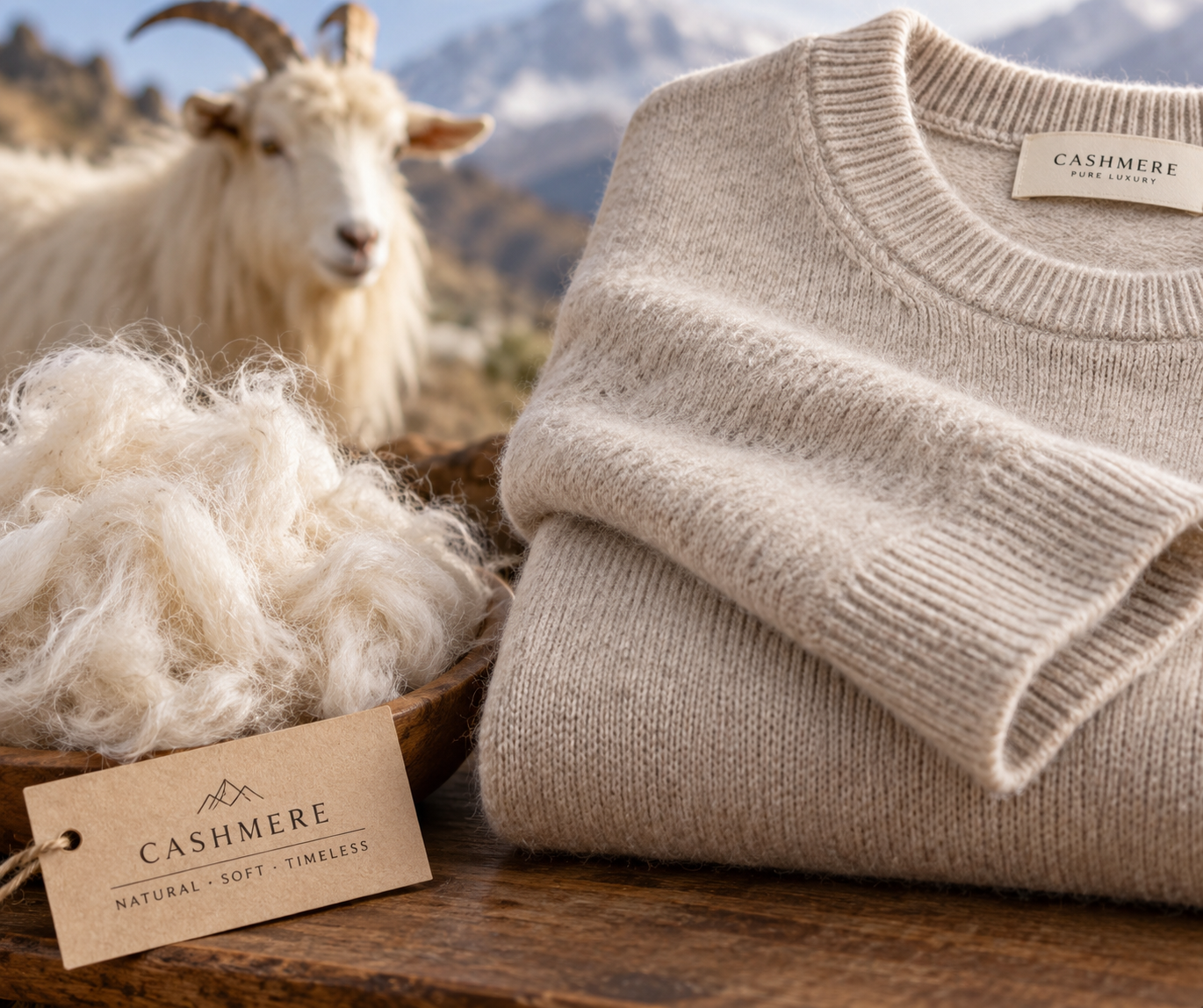
Cashmere is a type of animal fiber obtained from the fine undercoat of cashmere or pashmina goats. The goats are primarily associated with the Gobi Desert, Mongolia, Central Asia, and the Kashmir region.
Known for its exceptional softness, light weight, and luxurious feel, cashmere is considered one of the finest types of wool. It is commonly used to make sweaters, scarves, dresses, shirts, gloves, socks, and other cold-weather clothing.
Cashmere is generally finer and softer than traditional sheep’s wool. Although it does not provide quite as much insulation as heavier wool, its fine fibers can be woven or knitted into lightweight fabrics that remain comfortable when worn directly against the skin. This makes cashmere suitable for products such as underwear and undershirts as well as outer layers.
Cashmere also has good breathability and moisture-wicking properties. However, its fine fibers can make it more susceptible to pilling, particularly when the fabric experiences repeated friction.
History of Cashmere Fabric
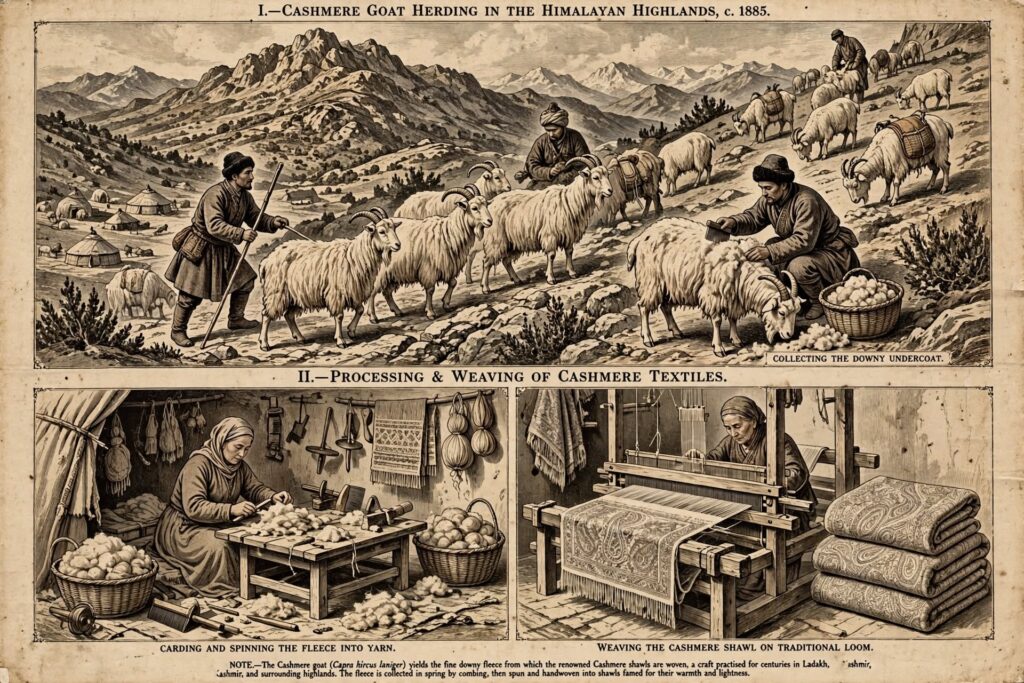
Cashmere goat breeding in Mongolia and the Kashmir region dates back to before recorded history. References to cashmere can be traced to at least the 3rd century BC, although production is believed to have existed much earlier.
Cashmere eventually reached the Middle East through trade with Turkestan. From there, historic trade routes carried the fiber into Europe, where it became particularly popular among wealthy consumers and European nobility.
France became an important market for cashmere, and merchants traveled long and difficult trade routes to bring the material into Europe. By the 19th century, cashmere production and trade had developed into a significant industry.
The trade continues to provide an important source of income for traditional goat herders in Central Asia, while cashmere remains highly valued around the world.
Cashmere Fabric Today
China is currently the world’s largest producer and exporter of cashmere. Traditional and smaller-scale cashmere production also continues throughout Central Asia.
The global cashmere industry has expanded alongside population growth and rising consumer demand. Although concerns exist around animal welfare and textile production practices, responsible and ethical cashmere production is possible.
Growing interest in fair trade, sustainable sourcing, animal welfare, and improved production standards has also encouraged the development of more responsible cashmere supply chains.
How Is Cashmere Fabric Made?
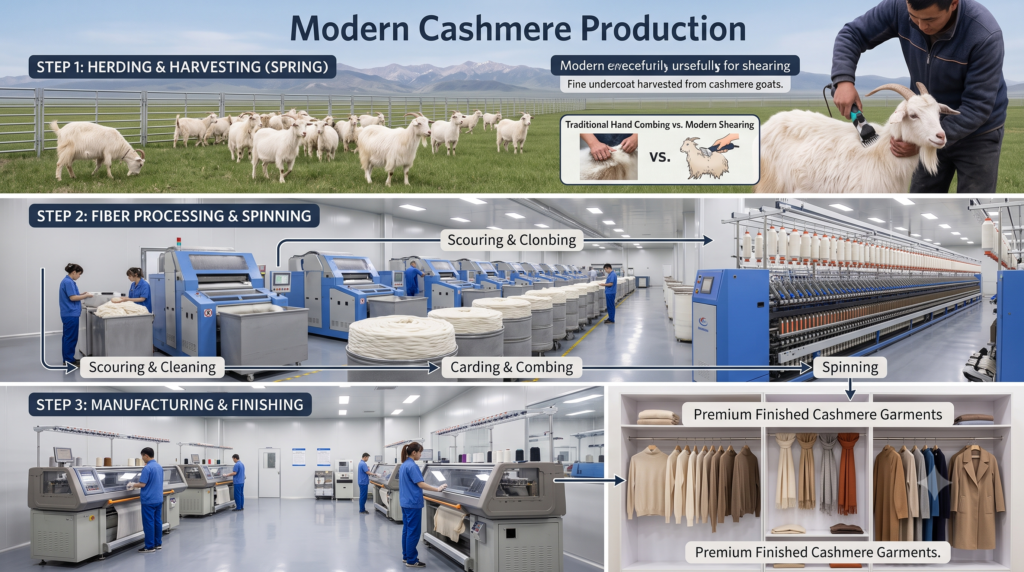
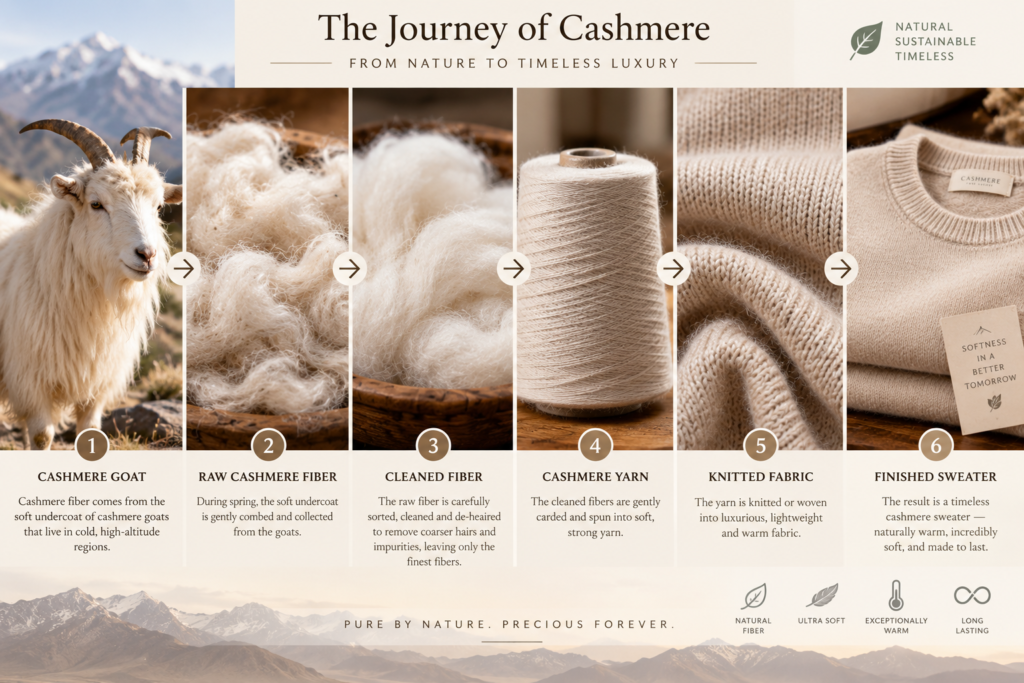
Cashmere production combines traditional practices that have existed for centuries with modern textile manufacturing. The basic process remains similar: the goats’ fibers are collected, cleaned, combed, spun into yarn, and turned into fabric.
1. Shearing
Cashmere goats are allowed to develop their full winter coats before the fiber is collected. The hair can be removed through shearing or other methods.
Responsible producers can collect the fiber without causing unnecessary harm to the animals.
Image suggestion: Ethical cashmere goat fiber collection or shearing.
2. Cleaning
The raw fiber contains dirt, plant matter, and other impurities. These unwanted materials are removed before the fibers are processed further.
3. Combing
The fibers are combed and separated so that they become aligned. They are then carded into loose groups of fibers that are ready for spinning.
Image suggestion: Close-up of cashmere fibers being combed and separated.
4. Spinning
The prepared fibers are spun into yarn. The thickness of the yarn depends on the intended final product. Fine yarn can be used for lightweight garments, while thicker yarn is suitable for heavier sweaters and other products.
5. Cleaning and Dyeing
The yarn may be cleaned again before being dyed. Some manufacturers dye the yarn, while others prefer to dye the finished garment.
6. Weaving or Knitting
The cashmere yarn is turned into fabric through weaving or knitting. Common products include sweaters, scarves, vests, and other garments.
7. Final Treatments
Some cashmere products may receive additional finishing treatments before they leave the manufacturing facility. These can include treatments intended to improve specific performance characteristics.
Wool is naturally flame-resistant, so additional flame-retardant treatments are not necessarily required for every product.
8. Packaging and Fulfillment
Once production and finishing are complete, the cashmere products are inspected, packaged, branded, and prepared for distribution.
How Is Cashmere Fabric Used?
Cashmere is primarily used in premium clothing and accessories where softness, comfort, warmth, and a luxurious appearance are important.
Common applications include:
- Sweaters
- Dresses
- Shirts
- Scarves
- Hats
- Gloves
- Socks
- Underwear
- Thermal clothing
- Hosiery
- Blazers
- Vests
- Shawls
Cashmere has historically been associated with formal and luxury clothing, and that reputation continues today.
Although cashmere provides warmth, it is relatively lightweight and delicate compared with heavier wool fabrics. For this reason, it is more commonly used for lightweight sweaters and refined garments than for rugged outdoor clothing.
It is generally not the first choice for heavy trench coats, pea coats, or other garments that require substantial abrasion resistance.
Cashmere’s softness also makes it suitable for garments worn directly against the skin.

Where Is Cashmere Fabric Produced?
China is currently the world’s largest producer and exporter of cashmere. Much of China’s production is concentrated around regions connected to the Gobi Desert and other areas suitable for cashmere goat herding.
Cashmere is also produced throughout Mongolia and other Central Asian countries. The Kashmir region has historical importance because the textile has been associated with the area for centuries.
The industry includes both large-scale commercial production and smaller traditional operations.
How Much Does Cashmere Fabric Cost?
Cashmere can vary significantly in price. The cost is influenced by the quality of the fiber, its grade, production method, origin, and manufacturing process.
Low-grade cashmere can be relatively affordable, while premium cashmere can be extremely expensive. Traditionally produced cashmere may command a higher price because of its softness, fiber quality, craftsmanship, and limited availability.
Fiber diameter is particularly important. Generally, finer cashmere fibers are more valuable because they produce a softer and more luxurious finished material.
The final price of a cashmere garment also depends on the yarn construction, fabric weight, design, brand, and manufacturing process.

What Different Types of Cashmere Fabric Are There?
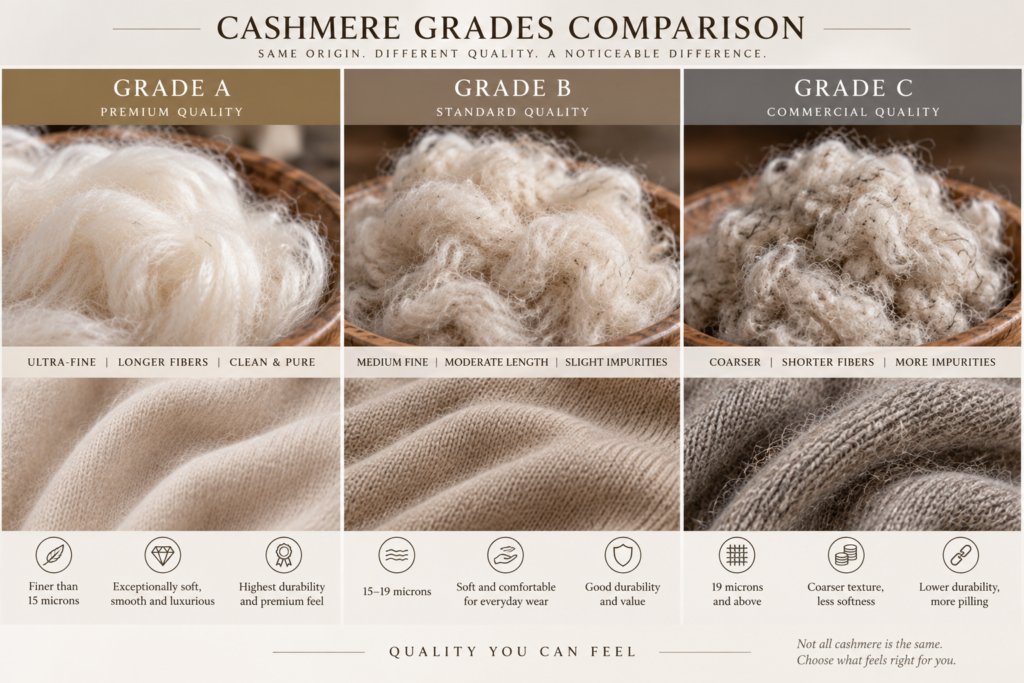
Cashmere can be categorized by its source and by the quality grade of the fiber.
1. Cashmere Wool
Cashmere wool comes from cashmere goats associated with the Gobi Desert, Kashmir, and Central Asia.
It is exceptionally fine and soft while still providing good strength. Its combination of softness, lightness, and warmth makes it one of the most valued animal fibers.
2. Pashmina Wool
Pashmina comes from a closely related type of goat and produces fibers that are extremely similar to cashmere.
Because the characteristics of pashmina and cashmere overlap considerably, the two terms are sometimes used interchangeably, although they can refer to different fiber sources and traditional production regions.
3. Grade C Cashmere
Grade C is the coarsest of the commonly referenced cashmere grades. It contains thicker fibers and is generally the least expensive.
Because it can feel rougher against the skin, Grade C cashmere may be better suited to products where direct skin contact is limited.
4. Grade B Cashmere
Grade B is finer than Grade C but is still not as soft as premium cashmere.
The quality and price of Grade B products can vary considerably depending on the specific fiber and manufacturing process.
5. Grade A Cashmere
Grade A represents the finest and softest of these commonly used cashmere grades. The fibers are thinner and generally provide a noticeably smoother feel.
High-grade cashmere is usually much more expensive because fine fibers are more difficult to obtain and process.
How Does Cashmere Fabric Impact the Environment?
Cashmere has both potential environmental benefits and important sustainability concerns.
Positive Impacts
Cashmere is a natural animal fiber and is biodegradable under suitable conditions. Unlike petroleum-based synthetic fibers such as polyester and nylon, natural animal fibers do not depend directly on fossil-fuel feedstocks and can eventually break down in the environment.
Cashmere production also does not require the pesticides and synthetic fertilizers associated with many plant-based textile crops.
Using natural fibers instead of synthetic materials can therefore reduce dependence on fossil-fuel-based textiles.
However, the environmental performance of cashmere depends heavily on how goats are managed and how the fiber is processed.
Negative Impacts
One of the biggest concerns surrounding cashmere is the treatment of goats and the environmental effects of large-scale grazing.
Poorly managed cashmere production can place pressure on grasslands because large goat populations may consume vegetation faster than ecosystems can recover. Responsible herd management and protection of grazing land are therefore important.
Animal welfare is another consideration. Cashmere producers can follow very different standards, so the conditions in which goats are raised and their fibers collected matter when assessing a product.
Choosing cashmere from responsible producers and certified supply chains can help support better animal management, grassland conservation, and working conditions.
Cashmere Fabric Certifications Available
Several standards and certification systems can help buyers identify more responsible or recycled cashmere products.
Sustainable Fibre Alliance (SFA) Sustainable Cashmere Standard
The Sustainable Fibre Alliance Sustainable Cashmere Standard focuses on responsible cashmere production, including animal welfare, grassland health, and sustainable fiber sourcing.
Products that meet the applicable requirements can carry the SFA designation.
Kering Standard on Cashmere
The Kering Standard provides guidance for responsible sourcing and production of cashmere and other animal fibers.
It focuses on areas such as sourcing information and responsible production practices.
Recycled Claim Standard (RCS)
The Recycled Claim Standard helps verify the use of recycled materials in textile products. It can be relevant to cashmere products containing recycled cashmere fibers.
Global Recycled Standard (GRS)
The Global Recycled Standard is another certification system covering recycled materials. It also considers certain social, environmental, and chemical-processing requirements throughout the supply chain.
When purchasing cashmere, buyers should check the exact certification and what part of the supply chain it covers rather than relying only on general sustainability claims.
Frequently Asked Questions
Is cashmere a type of wool?
Yes. Cashmere is a type of animal fiber classified as wool, but it comes from cashmere or pashmina goats rather than sheep.
Is cashmere warmer than wool?
Cashmere provides good warmth for its weight, but it is not necessarily more insulating than every type of sheep’s wool. Its major advantage is its exceptional softness and lightweight feel.
Is cashmere soft?
Yes. Cashmere is particularly valued for its fine, smooth, and soft fibers. High-grade cashmere is considerably softer than lower grades.
Is cashmere breathable?
Yes. Cashmere has good breathability and moisture-wicking properties, making it comfortable in garments worn close to the skin.
Is cashmere durable?
Cashmere can be strong despite its softness, but its fine fibers are more delicate than many heavier wool fabrics. Frequent friction can cause pilling.
Why is cashmere expensive?
Cashmere is expensive because fine fibers are relatively limited, difficult to collect and process, and highly valued for their softness. Higher grades with thinner fibers generally command higher prices.
What is the difference between cashmere and pashmina?
Both come from closely related goats and produce extremely fine fibers. Pashmina is traditionally associated with specific goat breeds and regions, while cashmere is the broader term commonly used for this type of goat fiber.
Is cashmere environmentally friendly?
Cashmere is a natural and biodegradable fiber, but its environmental impact depends on goat management, grazing pressure, animal welfare, processing, and sourcing practices. Responsible certification can help identify better-managed supply chains.
How should cashmere fabric be washed?
Cashmere generally benefits from gentle care. Cold or cool water is typically recommended, along with mild handling and avoidance of excessive heat.
Does cashmere pill?
Yes. Cashmere is relatively prone to pilling, particularly in areas exposed to repeated friction. Higher-quality fibers and careful garment care can help reduce the problem.