
Cupro is a smooth, lightweight regenerated cellulose fiber known for its silky appearance, fluid drape and comfortable feel against the skin. It is made from cellulose using a cuprammonium process, in which copper and ammonia are used to dissolve the cellulose before it is regenerated into extremely fine filaments.
The fiber is particularly valued as a textile for linings, blouses, dresses, trousers, scarves and other garments where a smooth surface and elegant movement are desirable.
Cupro is sometimes called cuprammonium rayon, cupra or ammonia silk. These terms can refer to the same general fiber category, although commercial naming varies by market.
One of the best-known cupro fibers is Bemberg™, a branded cupro fiber produced by Asahi Kasei. Bemberg™ is made from cotton linter, a short cellulose-rich fiber remaining around cotton seeds after cotton processing. Asahi Kasei has manufactured Bemberg™ since 1931 and currently describes itself as the world’s only cupro fiber manufacturer.
Unlike cotton, cupro is not a natural fiber that can be spun directly from the plant. The cellulose is chemically dissolved and regenerated, placing cupro within the broader family of man-made or regenerated cellulosic fibers.
Quick Facts About Cupro Fabric
| Feature | Details |
|---|---|
| Fabric name | Cupro |
| Technical name | Cuprammonium rayon |
| Common alternative names | Cupra, ammonia silk |
| Fiber category | Regenerated cellulose |
| Common raw material | Cotton linter |
| Typical feel | Smooth, soft and silky |
| Appearance | Subtle lustre with an elegant drape |
| Moisture management | Good |
| Breathability | Depends on fabric construction |
| Fiber fineness | Very fine |
| Common uses | Linings, blouses, dresses, trousers, scarves, lingerie |
| Best-known branded fiber | Bemberg™ |
| Major current producer | Japan |
| Typical care | Follow the garment care label; gentle care is generally preferred |
What Is Cupro Fabric?
Cupro is a regenerated cellulose fiber made through the cuprammonium rayon process.
Its cellulose can come from cotton linter or other suitable cellulose sources. In the case of Bemberg™, Asahi Kasei uses cotton linter obtained as a by-product of cottonseed oil production. This makes Bemberg™ different from the common perception that cupro is simply made from discarded cotton garments.
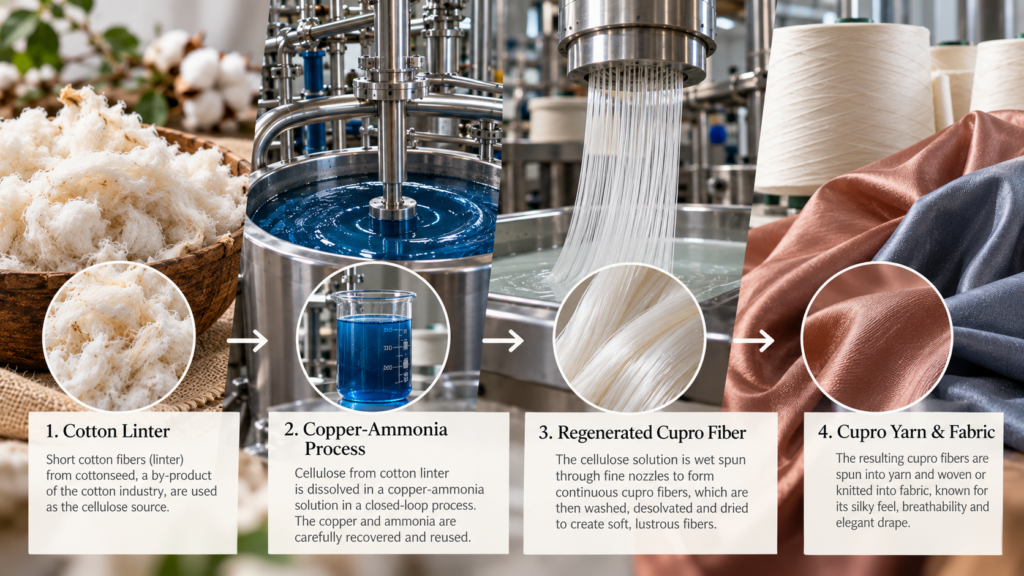
The cellulose is dissolved using a copper-ammonia solution and then converted into very fine filaments. After regeneration and washing, the resulting fiber can be spun into yarn and woven or knitted into fabric.
Cupro is particularly distinctive because the resulting filaments can be extremely fine. This contributes to its smooth hand and the fluid movement that makes it popular as a silk alternative.
What Does Cupro Fabric Feel Like?
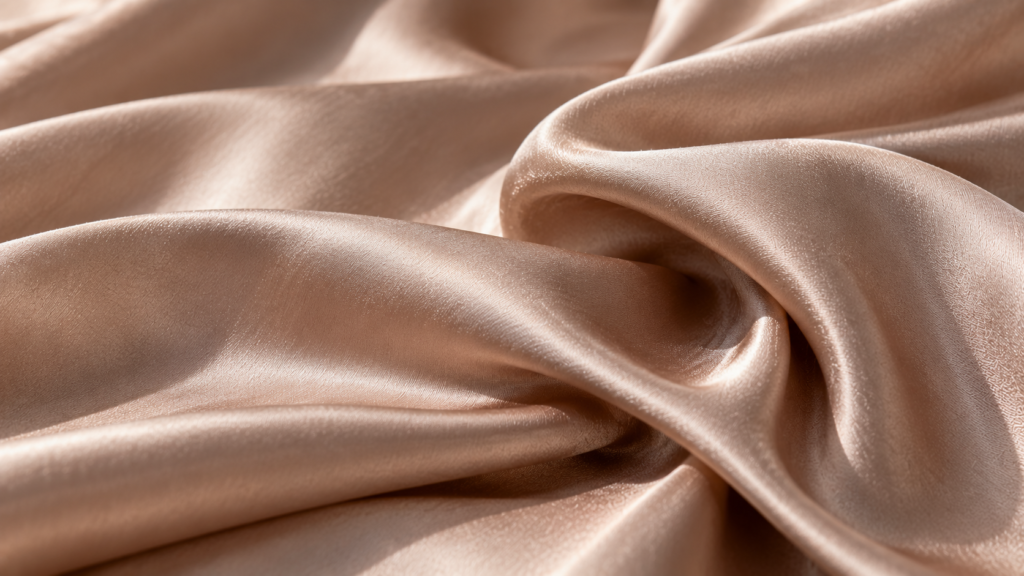
Cupro generally feels smooth, cool and soft against the skin.
Its surface can have a subtle sheen, but it usually looks less glossy and more understated than highly lustrous synthetic satin. Lightweight cupro can move fluidly around the body, giving garments an elegant drape.
It is particularly well suited to fabrics where designers want the visual qualities of silk without using actual silk.
Is Cupro a Natural or Synthetic Fabric?
Cupro is best described as a regenerated cellulose fiber.
Its raw material can originate from a natural plant source, but the cellulose undergoes significant chemical processing before it becomes textile fiber. It is therefore neither a conventional natural fiber like cotton nor a petroleum-based synthetic fiber like polyester.
History of Cupro Fabric
Cupro belongs to the early history of regenerated cellulose textiles.
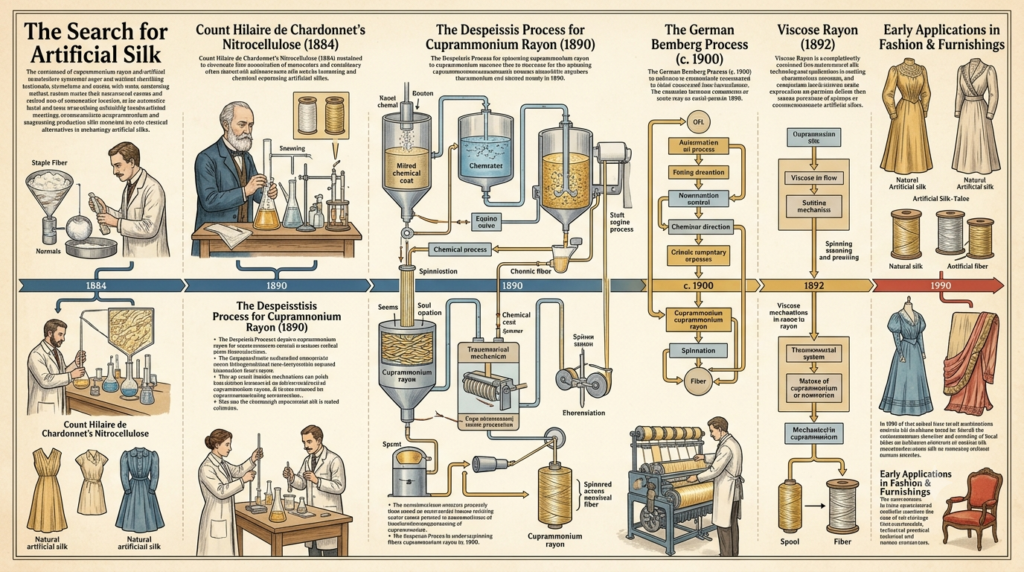
The cuprammonium process was developed during the late 19th century as researchers looked for ways to transform cellulose into fine artificial fibers. The technology became particularly important because it could produce exceptionally fine filaments capable of imitating some of silk’s desirable qualities.
The name Bemberg has a long connection with cupro. The J. P. Bemberg company became associated with cuprammonium rayon production, and the Bemberg name eventually became one of the best-known commercial names for the fiber.
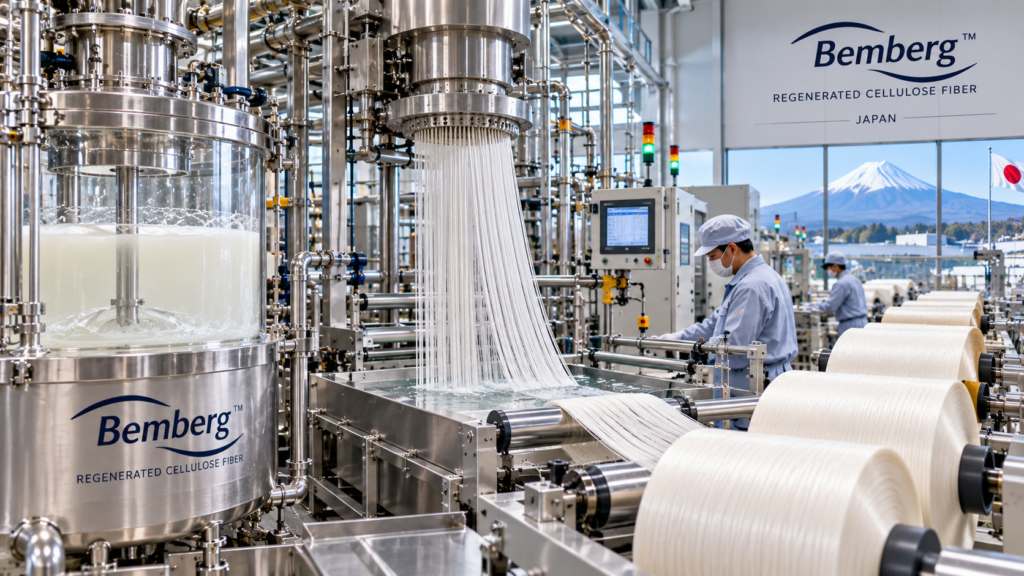
Asahi Kasei began producing Bemberg™ in Japan in 1931. The company continues to manufacture the fiber at its Nobeoka plant in Miyazaki Prefecture, where production has continued for more than nine decades.
Cupro has maintained a particularly strong position in fashion because of its use as a lining material. Its smooth surface allows garments to slide comfortably over other clothing, while its drape and moisture-management properties also make it suitable for visible outerwear.
In India, Bemberg™ has also become established in traditional and contemporary clothing. Asahi Kasei notes that the fiber has been used in Indian traditional garments for decades, including saris and dupattas.
How Is Cupro Fabric Made?
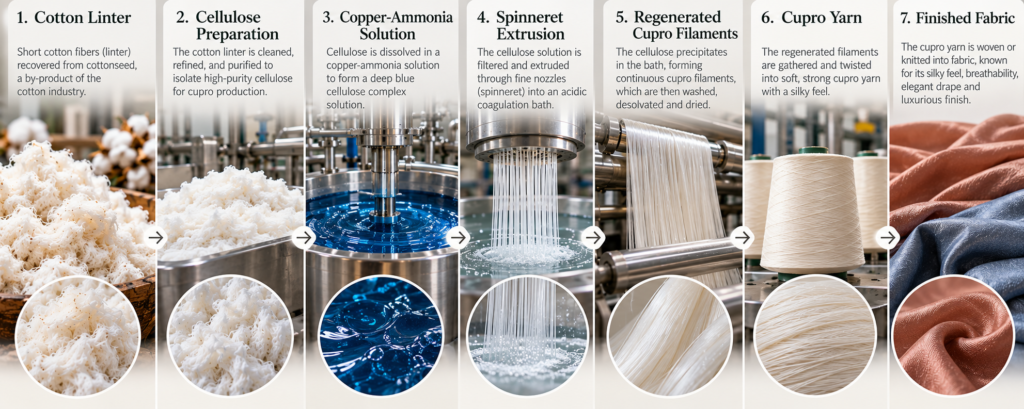
Cupro’s manufacturing process is distinctive because copper and ammonia form part of the system used to dissolve the cellulose.
The process is different from both conventional viscose and lyocell production.
1. Cellulose Is Prepared
The process begins with a suitable cellulose source.
For Bemberg™, the raw material is cotton linter—short fibers remaining around cotton seeds during cotton processing. These fibers are rich in cellulose and can be used as a feedstock for regenerated fiber production.
The cellulose is purified and prepared for the next stage.
2. Cellulose Is Dissolved in a Copper-Ammonia System
The prepared cellulose is treated with a solution containing copper and ammonia.
Under controlled conditions, this system allows the cellulose to form a solution that can be spun into extremely fine filaments.
This is the defining chemical feature of the cuprammonium process.
3. The Solution Is Extruded
The cellulose solution is passed through a spinneret containing very small openings.
The solution emerges as fine continuous filaments.
The ability to produce exceptionally fine filaments is one of the reasons cupro has historically been valued for silk-like textiles.
4. The Cellulose Is Regenerated
The emerging filaments enter a coagulation or regeneration bath.
The cellulose is converted back into an insoluble fiber, while copper and ammonia are removed from the fiber during subsequent processing.
5. Chemicals Are Recovered and the Fiber Is Washed
Modern industrial production can incorporate recovery systems for process chemicals.
Asahi Kasei states that its Bemberg™ production uses a closed-loop system that recovers and reuses copper and ammonia.
The regenerated fibers are washed and further processed to achieve the required physical characteristics.
6. Fiber Becomes Yarn and Fabric
The finished fiber can be processed into yarn and then woven or knitted.
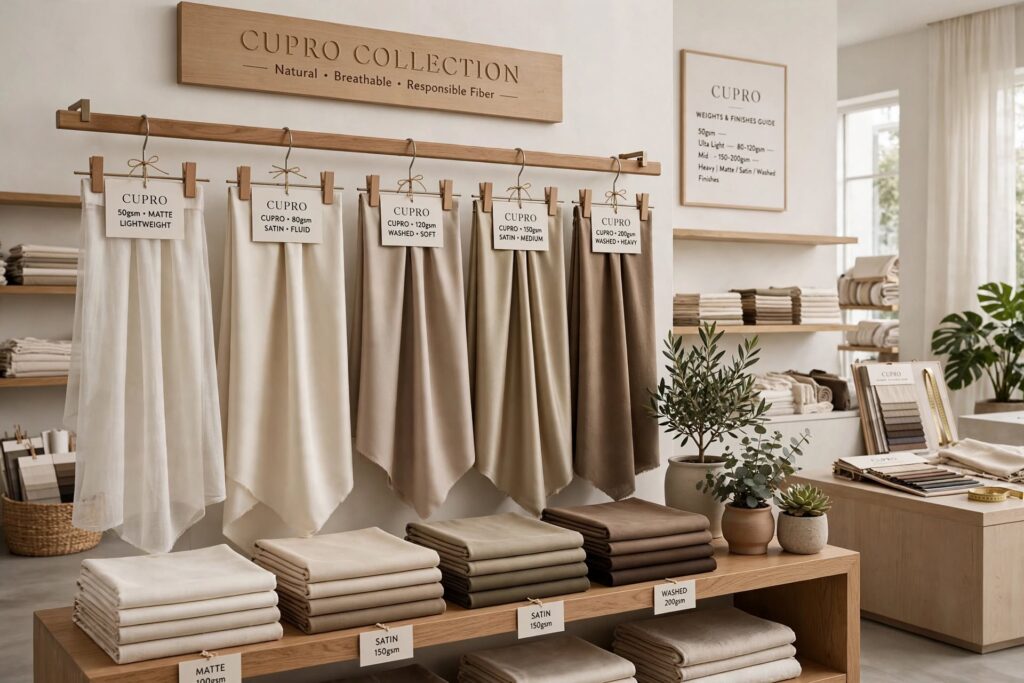
The final fabric may be lightweight and sheer or more substantial, depending on the yarn count, construction and finishing.
How Is Cupro Fabric Used?
Cupro is especially useful where a designer wants softness, fluid movement and a smooth surface.
Garment Linings
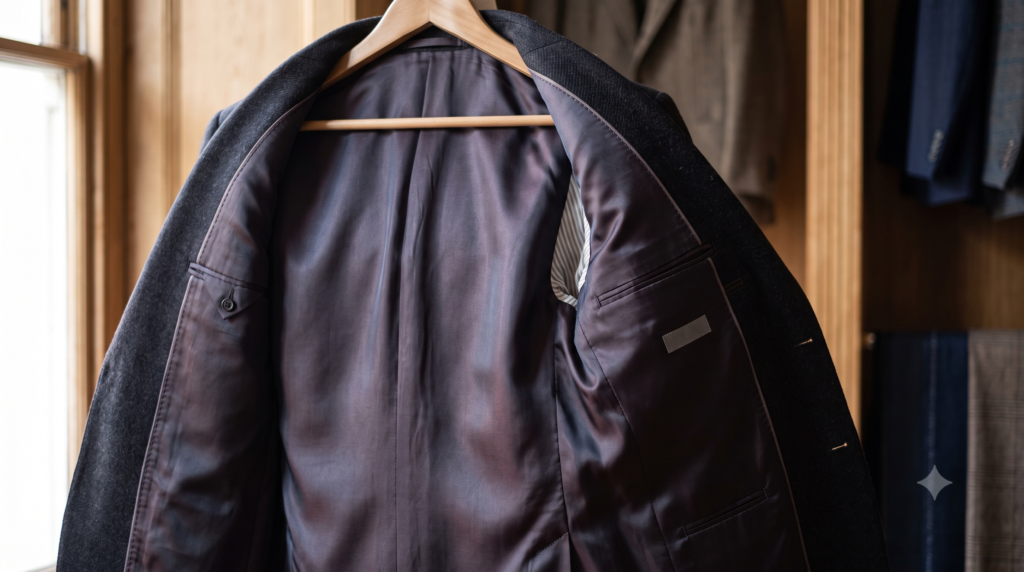
One of cupro’s most established applications is clothing linings.
A smooth cupro lining can allow a jacket, coat, skirt or pair of trousers to move comfortably over an underlayer. Its breathability and moisture-management characteristics can also make it more comfortable than some conventional synthetic lining materials.
Bemberg™ is widely used for lining applications.
Dresses and Blouses
Lightweight cupro can create elegant drape, making it suitable for dresses, blouses and relaxed shirts.
Its subtle sheen can provide a refined appearance without the high gloss of some satin fabrics.
Trousers and Tailoring
Heavier cupro constructions can be used for trousers, jackets and contemporary tailoring.
The fabric’s fluid movement can soften structured silhouettes.
Lingerie and Intimate Apparel
Cupro’s fine fibers and smooth hand make it suitable for selected lingerie and intimate garments.
Scarves and Accessories
Lightweight cupro can also be woven into scarves and other accessories where softness and drape are important.
Traditional and Occasion Wear
Bemberg™ has a particularly established presence in Indian traditional clothing. Asahi Kasei reports applications in saris and dupattas, where the fiber’s smooth texture, color performance and drape are valued.

Where Is Cupro Fabric Produced?
Modern cupro production is unusually concentrated.
Asahi Kasei currently identifies its Nobeoka, Miyazaki Prefecture, Japan facility as the world’s only cupro fiber manufacturing plant. The company has operated the facility since 1931.
This is an important distinction from Sewport’s current description, which identifies China as the world’s major cupro producer. The current primary manufacturer information from Asahi Kasei indicates that commercial Bemberg™ cupro fiber production is concentrated in Japan.
Finished cupro fabrics and garments can, of course, be woven, knitted, dyed, cut and sewn in many different countries. The location where a garment is manufactured does not necessarily indicate where its cupro fiber was produced.
India is an important market for Bemberg™. Asahi Kasei reports that the fiber has been used in India for almost 50 years and has applications ranging from traditional wear to contemporary fashion.
How Much Does Cupro Fabric Cost?
Cupro is generally positioned as a premium textile material, particularly when compared with commodity viscose or polyester.
Its price can vary considerably depending on:
- Fiber producer
- Branded versus generic fiber
- Fabric weight
- Yarn fineness
- Weave or knit structure
- Dyeing
- Finishing
- Certification
- Order volume
- Country of textile production
Bemberg™ cupro is a specialized branded fiber, so fabrics made from it can occupy a premium position.
Cupro’s cost is also influenced by its relatively specialized production infrastructure compared with mass-market fibers such as polyester and conventional viscose.
For finished garments, the fiber is only one part of the retail price. Design, manufacturing, tailoring, finishing, branding and distribution can have a much larger effect.
What Different Types of Cupro Fabric Are There?
Cupro does not have a large family of unrelated generic fiber types. Most of the terminology refers to the same basic cuprammonium cellulose technology or to specific commercial names.
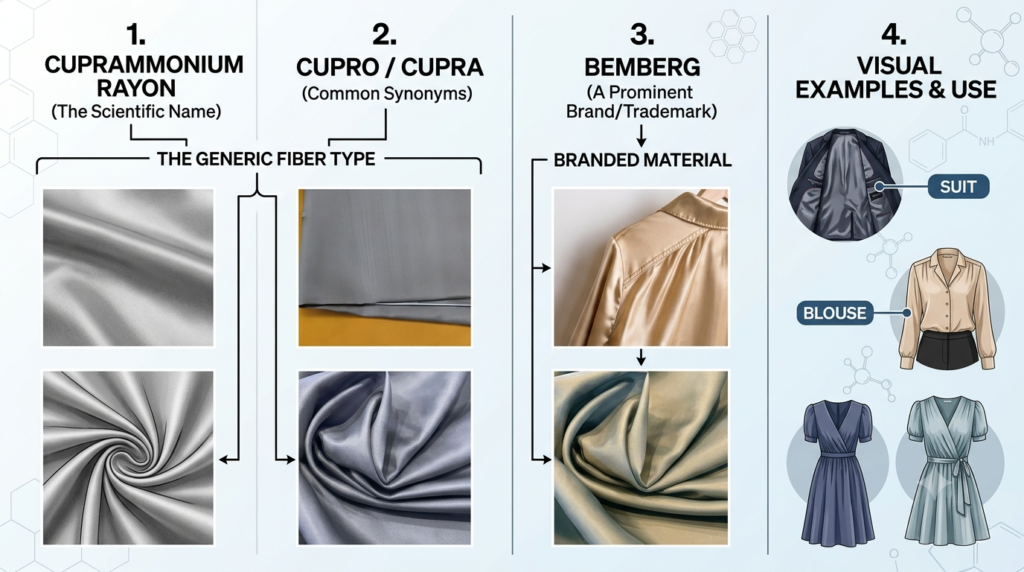
Cuprammonium Rayon
This is the technical description for the regenerated cellulose fiber produced through the cuprammonium process.
It is the most useful generic term when discussing cupro from a textile-science perspective.
Cupro / Cupra
“Cupro” and “cupra” are commonly used commercial names for cuprammonium rayon.
The exact terminology varies between textile markets and suppliers.
Ammonia Silk
“Ammonia silk” is an informal trade term sometimes used to describe cupro because of its silk-like hand and appearance.
It does not mean that the material contains silk.
Bemberg™
Bemberg™ is a brand of cupro fiber produced by Asahi Kasei.
It is therefore incorrect to use Bemberg™ as a generic name for every cupro textile. Asahi Kasei explicitly identifies Bemberg™ as its brand of cupro regenerated cellulose fiber.
Bemberg™ is made from cotton linter and is produced by Asahi Kasei in Japan.
How Does Cupro Fabric Impact the Environment?
Cupro requires a more nuanced environmental assessment than simply labeling it either “eco-friendly” or “polluting.”
Its environmental profile depends on the cellulose source, chemical management, solvent recovery, energy, water use, manufacturing controls and end-of-life conditions.
The Raw Material Can Be a By-Product
One potential advantage of Bemberg™ is its use of cotton linter.
Cotton linter is a short cellulose fiber associated with cottonseed processing and is not the same thing as post-consumer cotton clothing. Asahi Kasei describes it as a pre-consumer material obtained during cottonseed oil production.
Using this material as a cellulose feedstock can give value to a part of the cotton-processing stream that would otherwise have a different use.
However, it would be inaccurate to describe all cupro as “recycled clothing.” The actual feedstock depends on the producer.
Copper and Ammonia Require Careful Management
The cuprammonium process relies on copper and ammonia.
These substances require controlled handling because poorly managed releases can create environmental and occupational risks.
This is one of the main reasons modern cupro manufacturing needs effective recovery and wastewater-management systems.
Closed-Loop Production
Modern Bemberg™ production uses a closed-loop system designed to recover and reuse copper and ammonia.
Asahi Kasei states that it strictly controls the chemicals used in production and has introduced a closed-loop system for recovering and reusing these materials.
This is an important distinction between the chemistry of the fiber process and the environmental performance of a particular factory. The presence of copper and ammonia in the process does not by itself tell us how much of those materials are released.
Biodegradability
Asahi Kasei states that Bemberg™ is biodegradable and compostable and cites third-party certification for these characteristics.
However, the end-of-life behavior of a finished garment depends on the complete product. Dyes, finishes, elastane, polyester and other blended materials can affect biodegradation.
Is Cupro Sustainable?
Some cupro production systems have meaningful environmental advantages, particularly when they use a by-product cellulose source and recover process chemicals.
But “cupro” alone should not be treated as a universal sustainability certification.
The most useful approach is to examine the specific fiber producer, raw material and manufacturing system behind the fabric.
Cupro Fabric Certifications Available
Cupro itself is a generic fiber category, so there is no single certification that automatically applies to every cupro textile.
Certifications and environmental claims should instead be evaluated against the particular fiber and finished product.
OEKO-TEX
OEKO-TEX certifications can address harmful substances in tested textile products.
This is useful for evaluating the finished textile, but it does not by itself prove that the cellulose was responsibly sourced or that the manufacturing process used a particular recovery system.
FSC and PEFC
Forest certifications such as FSC and PEFC can be relevant to wood-derived cellulose fibers, although they are less directly applicable when the cellulose source is cotton linter.
Biodegradability and Compostability Certification
For specific branded cupro fibers, independent testing can verify biodegradability or compostability claims.
Asahi Kasei states that Bemberg™’s biodegradability has been certified by a third-party testing organization.
Check the Specific Fiber
When evaluating a cupro fabric, look for documentation identifying:
- Fiber producer
- Fiber brand
- Cellulose source
- Chemical recovery system
- Finished-product certifications
- Blend composition
- Biodegradability claims
This is much more informative than assuming every fabric labeled “cupro” has identical environmental credentials.
Frequently Asked Questions
Is cupro a natural fabric?
No. Cupro begins with cellulose from a plant-based source but is chemically dissolved and regenerated into fiber. It is therefore classified as a regenerated cellulosic or man-made cellulosic fiber.
Is cupro the same as rayon?
Cupro is a type of regenerated cellulose fiber and is often classified within the broader rayon family. However, it uses a different manufacturing process from conventional viscose rayon.
Is cupro the same as Bemberg™?
No. Bemberg™ is a branded cupro fiber produced by Asahi Kasei. Cupro is the generic fiber category.
What is cupro made from?
Cupro can be made from cellulose, with cotton linter being an important feedstock for Bemberg™. Cotton linter is a short cellulose-rich fiber associated with cottonseed processing.
Does cupro contain copper?
Copper is used during the manufacturing process, but it is not the main structural material of the finished cellulose fiber. Modern production systems recover and reuse process chemicals.
Is cupro breathable?
Cupro can provide good comfort and moisture management, but breathability depends heavily on the fabric’s weight, weave, knit structure and finishing.
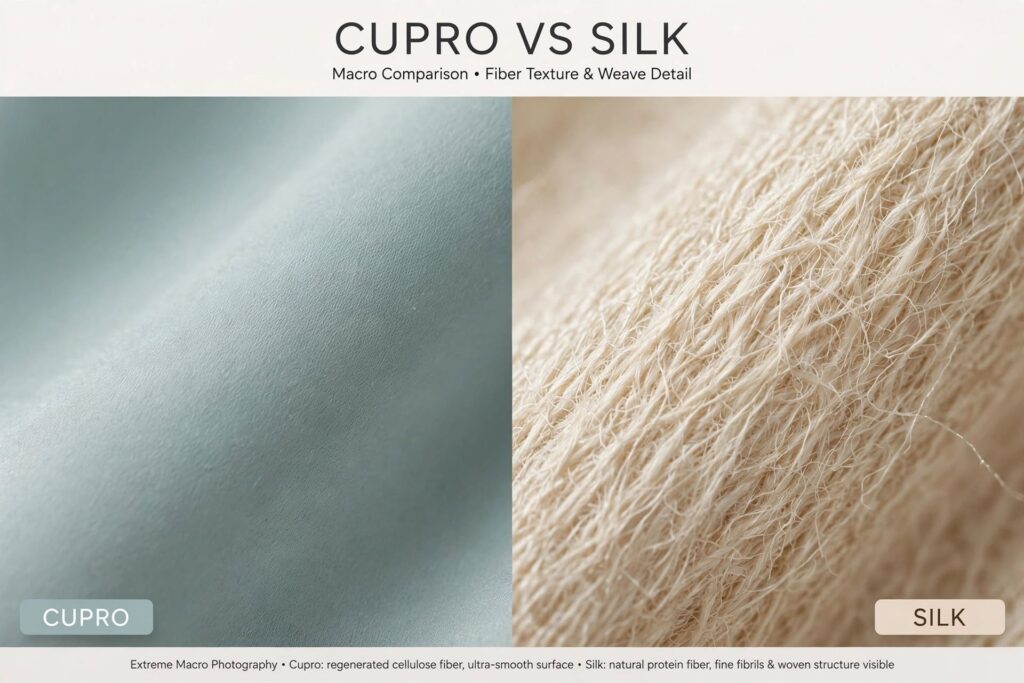
Is cupro like silk?
Cupro is often compared with silk because it can have a smooth surface, subtle lustre and fluid drape. However, cupro and silk are chemically and structurally different fibers.
Is cupro good for summer?
Lightweight cupro can be comfortable in warm weather because of its fluid construction and moisture-management characteristics. The actual performance depends on fabric weight and construction.
Is cupro good for clothing linings?
Yes. Cupro is particularly well known for premium garment linings because its smooth surface allows clothing to move easily over other garments.
Is cupro expensive?
Cupro is generally more specialized and can be more expensive than commodity viscose or polyester. The final price depends on the fiber brand, fabric construction, finishing and garment manufacturing.
Is cupro environmentally friendly?
It depends on how it is produced. Cupro uses chemical processing involving copper and ammonia, but some modern production systems recover and reuse these materials. Bemberg™ production, for example, uses a closed-loop recovery system.
Is cupro biodegradable?
Some cupro fibers, including Bemberg™, are reported and certified as biodegradable under specified conditions. The biodegradability of a finished garment still depends on its full material composition.
Is cupro better than viscose?
Neither is universally better. They are made through different regeneration processes and have different performance characteristics. Cupro is particularly valued for its fine fibers, smooth hand and silk-like drape.
Is cupro better than polyester?
Cupro and polyester have very different fiber structures and manufacturing routes. Cupro can provide a softer, more fluid hand and is cellulose-based, while polyester generally offers greater durability and dimensional stability. The appropriate choice depends on the application.
Does cupro wrinkle?
Lightweight cupro can wrinkle, particularly in loosely constructed fabrics. Finishing and fabric structure can influence how readily it creases.
How should cupro fabric be washed?
Care instructions vary by fabric and garment. Gentle washing, cool or moderate temperatures and avoiding excessive heat are generally safer approaches, but the garment’s care label should always take priority.