MicroModal is an exceptionally fine form of modal fiber designed to produce fabrics with a particularly soft, smooth and lightweight feel. It belongs to the broader family of regenerated cellulosic fibers, meaning that its cellulose comes from a natural source such as wood but is transformed through an industrial process before becoming textile fiber.
MicroModal is especially associated with Lenzing, the Austrian fiber manufacturer that developed and commercialized fine-denier modal technologies. The name MicroModal has also been used as a Lenzing trademark in textile markets.
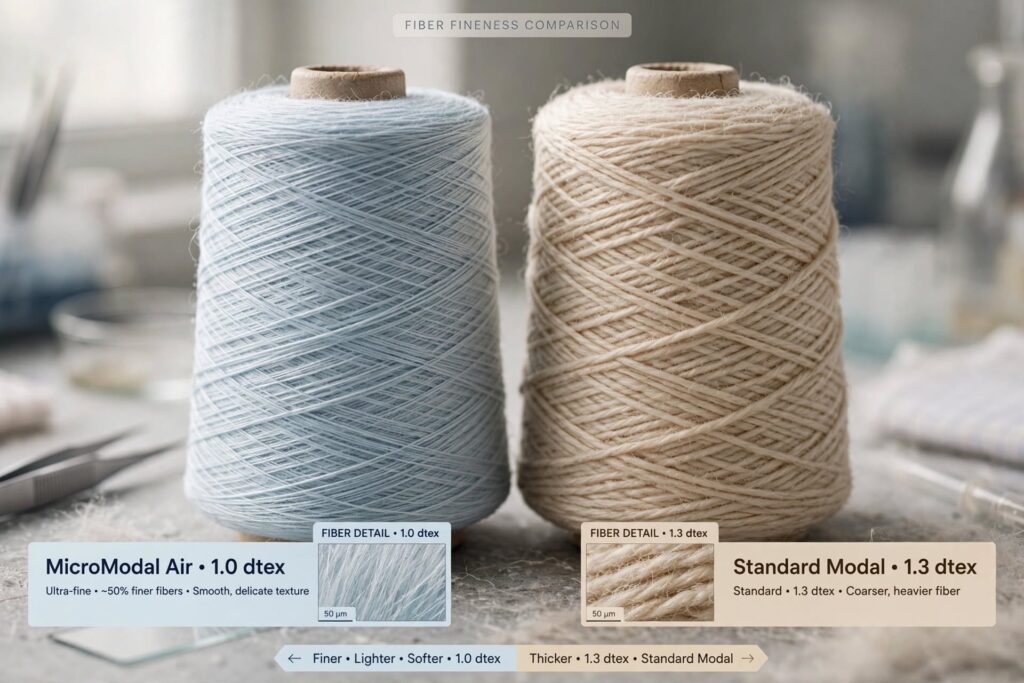
The defining characteristic is the fineness of the fiber. Compared with standard modal, very fine fibers can create a smoother surface and a softer hand when converted into yarn and fabric. This makes MicroModal particularly popular in underwear, sleepwear, loungewear and other garments designed for close contact with the skin.
MicroModal should not be confused with a completely different cellulose family such as lyocell. It is fundamentally connected to modal and shares the characteristics of regenerated cellulose.
Quick Facts About MicroModal Fabric
| Feature | Details |
|---|---|
| Fabric name | MicroModal |
| Fiber family | Modal / regenerated cellulose |
| Raw material | Cellulose, generally wood-derived |
| Best-known characteristic | Extremely fine, soft fibers |
| Typical feel | Very soft, smooth and lightweight |
| Breathability | Generally high |
| Moisture management | Good |
| Drape | Soft and fluid |
| Common applications | Underwear, T-shirts, sleepwear, loungewear, bedding |
| Stretch | Depends mainly on fabric construction and blends |
| Major association | Lenzing |
| Typical care | Follow the garment care label |
What Is MicroModal Fabric?
MicroModal is a fine-fiber version of modal, a regenerated cellulosic fiber related to viscose rayon.
Modal itself was developed to improve the performance of conventional viscose, particularly its behavior when wet. MicroModal takes the concept further by using particularly fine fibers to create an exceptionally smooth textile surface.
This difference is important. MicroModal is not simply “softer modal” because of a finishing treatment. Its characteristics are connected to the fineness of the fibers used to make the yarn and fabric.
Lenzing currently describes its Micro technology as producing the finest fibers within its TENCEL™ portfolio, with the finer structure intended to increase softness and comfort.
Why Is MicroModal So Soft?
Fiber fineness has a major influence on how a textile feels against the skin.
When very fine fibers are assembled into yarn, the resulting fabric can have a smooth surface with less noticeable fiber coarseness. This makes MicroModal particularly suitable for underwear, sleepwear and other next-to-skin clothing.
However, softness is not determined by fiber diameter alone. Yarn construction, knitting, fabric weight, finishing and fiber blends also affect the final hand feel.
History of MicroModal Fabric
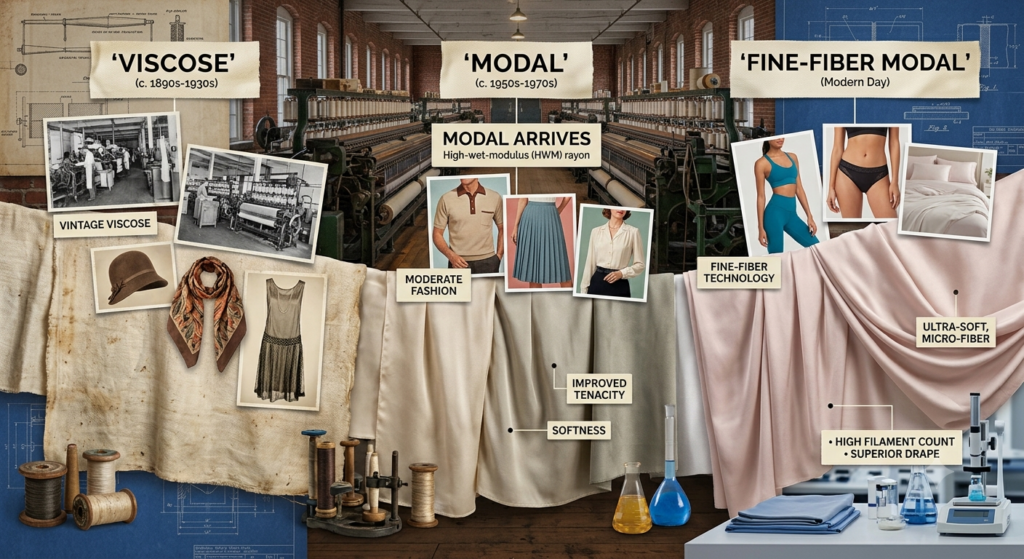
MicroModal emerged from the continued development of regenerated cellulose fibers, particularly the evolution of modal.
Modal itself was developed in Japan during the early 1950s as a higher-wet-modulus form of rayon. Lenzing began selling modal fibers commercially in 1964 and later developed integrated pulp-to-fiber production technology.
The development of finer modal fibers followed the broader textile industry’s demand for softer materials suitable for intimate apparel and other close-to-skin products.
Lenzing’s MicroModal technology became particularly associated with premium underwear and lightweight apparel. Historical Lenzing material from the 2010s describes MicroModal as being used in close-to-skin applications such as lingerie, nightwear and lightweight clothing.
Today, fine modal technologies remain focused on the same basic advantage: producing a regenerated cellulosic fiber that can deliver a very soft textile experience.
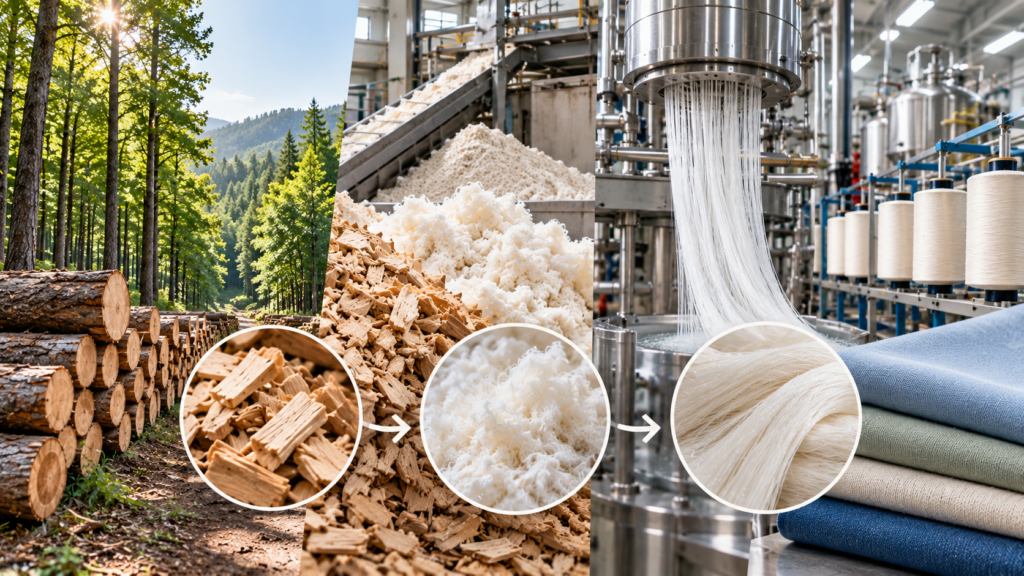
How Is MicroModal Fabric Made?
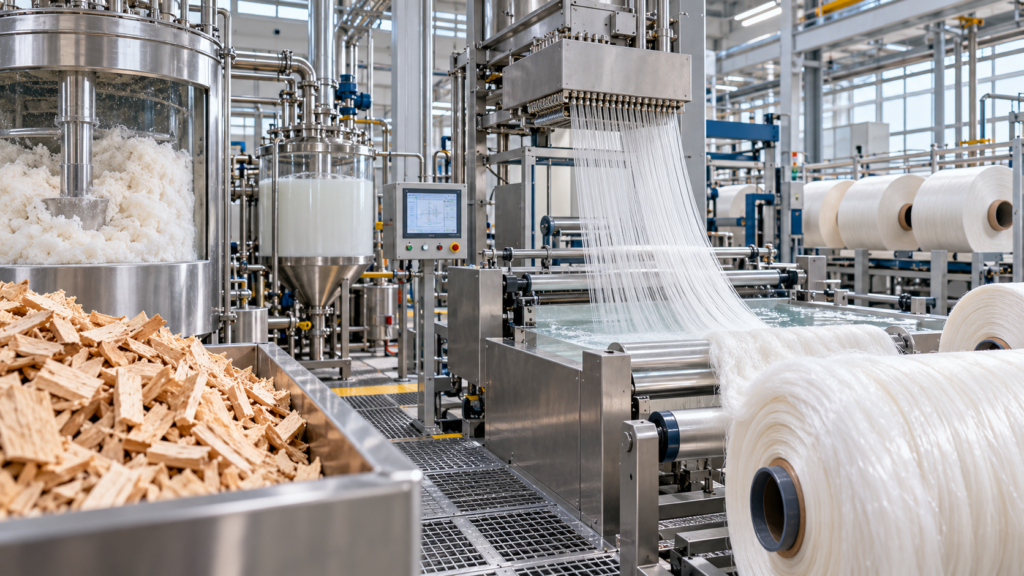
MicroModal follows the general manufacturing principles used for modal. The key distinction is the engineering of the fiber itself rather than an entirely separate raw material.
1. Cellulose Is Obtained From Wood
Production normally begins with cellulose-rich wood pulp.
Wood is processed to separate cellulose from lignin and other plant components. The resulting dissolving pulp must meet the specifications required for regenerated-cellulose fiber production.
The environmental quality of this stage depends partly on the sourcing and management of the forests supplying the wood.
2. The Cellulose Is Prepared for Regeneration
The purified cellulose undergoes chemical treatment to make it suitable for conversion into a spinning solution.
Modal uses a modified rayon process designed to produce fibers with high wet modulus and other desirable performance characteristics. Textile Exchange identifies modal as a second-generation regenerated cellulosic fiber and a variation of rayon.
3. A Spinning Solution Is Created
The chemically prepared cellulose is converted into a solution that can be extruded through a spinneret.
The exact chemistry, concentration and processing conditions vary between manufacturers and technologies.
4. Very Fine Filaments Are Formed
The spinning solution passes through extremely small openings to form regenerated cellulose filaments.
For MicroModal-type fine-fiber technology, controlling the fiber dimensions is particularly important because the resulting fine fibers contribute to the fabric’s characteristic softness.
5. The Fibers Are Washed and Finished
After regeneration, the fibers are washed and processed to remove residual chemicals and achieve the required physical properties.
They can then be prepared as staple fibers or processed into yarn according to the intended textile application.
6. Yarn Becomes Fabric
The finished fiber is spun into yarn and knitted or woven into fabric.
MicroModal is particularly common in lightweight knitted fabrics because knit structures can take advantage of the fiber’s softness, stretch potential and comfortable drape.
How Is MicroModal Fabric Used?
MicroModal is particularly useful where softness, lightweight construction and next-to-skin comfort are more important than heavy structure.
Underwear
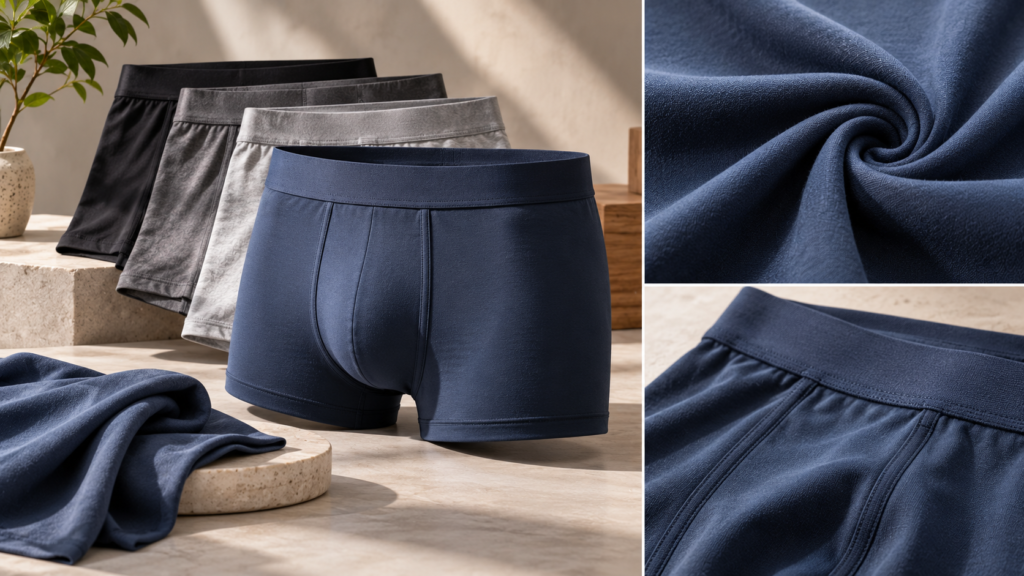
Underwear is one of the best-known applications for MicroModal.
The fine fibers can create a smooth surface that feels comfortable against the body, while the material’s moisture-management properties can help maintain comfort during extended wear.
T-Shirts
MicroModal is frequently used in lightweight T-shirts and undershirts.
It can provide a softer alternative to conventional cotton jersey, particularly when the goal is a smooth, fluid drape.
Sleepwear
MicroModal is well suited to pajamas, sleep tops and lightweight sleep trousers because of its softness and low-weight construction.

Loungewear
The soft hand and flexible drape of MicroModal work well for relaxed garments such as lounge pants, hoodies, lightweight robes and casual sets.
Bedding
Fine modal fibers can also be used in sheets and other bedding products.
The appeal comes primarily from the combination of softness, smoothness and moisture-management characteristics.
Active and Leisure Clothing
MicroModal can be incorporated into lightweight sports and leisure garments. However, it is important not to assume that every MicroModal product offers the same technical performance as purpose-built synthetic performance fibers.
For demanding high-intensity sports, fabric construction, blend composition and moisture transport become especially important.

Where Is MicroModal Fabric Produced?
MicroModal has historically been strongly associated with Lenzing’s production of fine modal fibers in Europe.
Lenzing is an Austrian fiber manufacturer and remains the company most closely associated with the MicroModal name. The MICROMODAL trademark has been registered to Lenzing in multiple markets.
However, it is important not to turn this into a blanket claim that every fabric sold by a supplier under the informal description “micromodal” necessarily comes from one particular factory or country.
The name can be used inconsistently in textile commerce. Buyers who require genuine branded fiber should verify the fiber’s provenance and documentation rather than relying only on a fabric listing.
Lenzing’s current portfolio also describes its Micro technology as producing its finest modal fibers, showing that the underlying concept remains part of its modern fiber technology.
How Much Does MicroModal Fabric Cost?
MicroModal is generally positioned above basic modal and commodity rayon fabrics because producing and processing very fine fibers can involve more specialized technology.
However, there is no universal price premium.
The final cost depends on:
- Fiber producer
- Fiber specification
- Fabric weight
- Yarn construction
- Knit or weave structure
- Fiber blend
- Dyeing and finishing
- Certification
- Order quantity
- Country of manufacture
A MicroModal garment may therefore range from moderately priced to premium depending on the brand and construction.
The fiber itself is only one part of the finished garment’s cost. Manufacturing, cutting, sewing, dyeing, finishing, logistics and retail margins can all have a larger influence on the final price.
What Different Types of MicroModal Fabric Are There?
MicroModal is best understood as a fine-fiber modal technology, rather than a large family of unrelated fiber types.
There are, however, several related materials worth distinguishing.
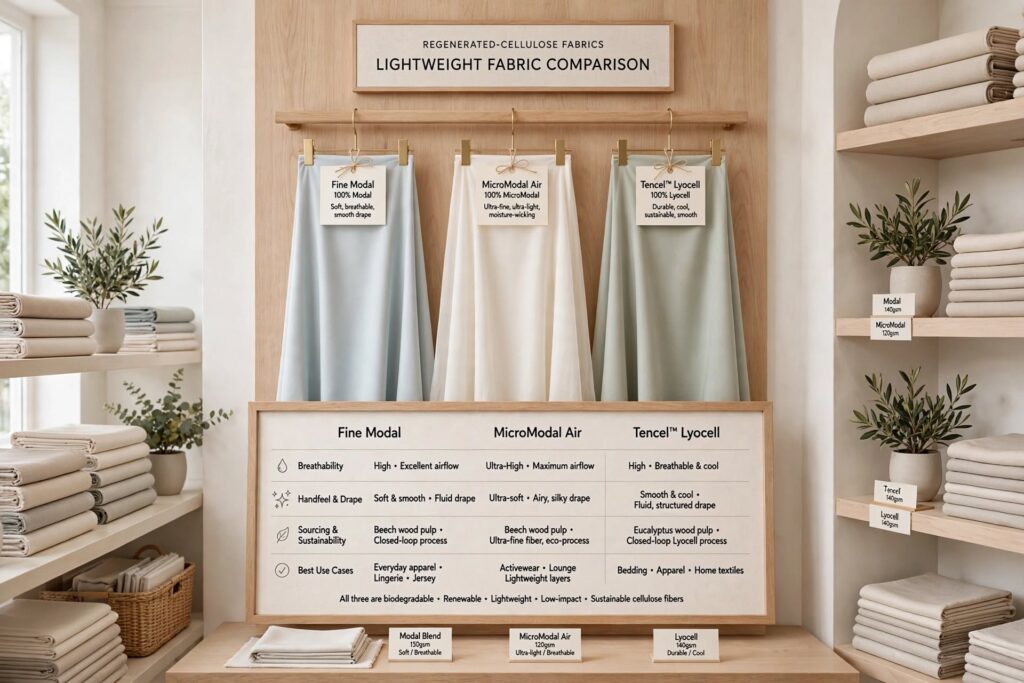
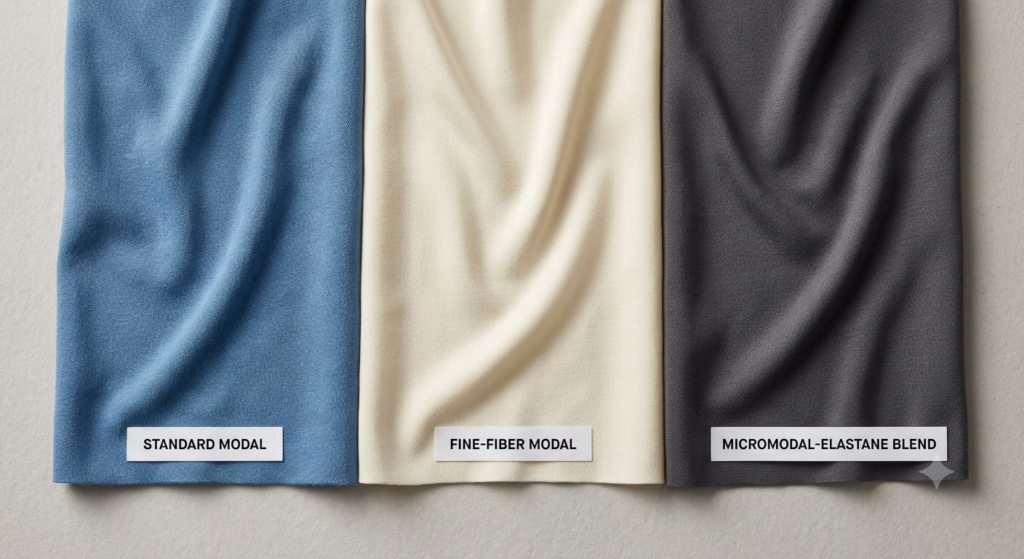
Standard Modal
Standard modal is a regenerated cellulosic fiber developed as a higher-wet-modulus form of rayon.
It is generally thicker than MicroModal fibers and is used across apparel, underwear, bedding and home textiles.
MicroModal
MicroModal uses particularly fine modal fibers to emphasize softness and next-to-skin comfort.
The finer construction is what gives the material its distinctive position within the modal family.
MicroModal Air
MicroModal Air is associated with an even lighter fine-fiber textile concept developed by Lenzing. The name has been used as a Lenzing trademark for cellulose-based textile fibers and garments.
Its purpose is to emphasize lightweight construction and softness rather than representing a completely different cellulose family.
TENCEL™ Modal With Micro Technology
Lenzing’s current portfolio describes Micro technology as producing the finest fibers within its TENCEL™ portfolio. In this context, it is more accurate to describe the material as a fine-fiber technology within branded modal rather than treating “MicroModal” and “TENCEL™ Modal” as unrelated generic fibers.
MicroModal Blends
MicroModal can be blended with other fibers such as:
- Elastane
- Cotton
- Polyester
- Nylon
- Other regenerated cellulosic fibers
Blends are often used to introduce stretch, improve recovery or change durability.
How Does MicroModal Fabric Impact the Environment?
MicroModal’s environmental profile deserves a balanced explanation.
It is tempting to describe the material as automatically sustainable because its cellulose originates from trees. That is too simplistic.
Its environmental impact depends on wood sourcing, pulp production, chemical processing, energy use, emissions, water management and the particular manufacturer.
Wood Sourcing
Wood is the primary source of cellulose for many modal fibers, so responsible forestry is an important consideration.
Textile Exchange notes that Lenzing’s TENCEL™ branded modal fibers use beech wood from PEFC-certified European forests.
Certification or controlled sourcing can provide greater traceability than an unspecified wood-based fiber.
Chemical Processing
Modal is a regenerated cellulosic fiber rather than a mechanically extracted natural fiber.
Its production uses chemical processing, and conventional modal production involves substances such as sodium hydroxide and carbon disulfide. The environmental and occupational-health risks therefore depend heavily on how the chemicals are handled, recovered and controlled.
This is why it would be inaccurate to describe all MicroModal as inherently low-impact.
Fine Fibers and Resource Efficiency
Fine-fiber production can deliver a high level of softness and performance from relatively lightweight fabrics. However, that does not by itself prove a lower overall environmental footprint.
The full supply chain remains more important than the softness of the finished material.
Branded Production Systems
Lenzing reports that its TENCEL™ Modal fibers are manufactured using technology with high chemical-recovery rates and responsibly sourced wood. The company reports at least 50% lower carbon emissions and water consumption compared with generic modal under its stated methodology. These figures are specific to Lenzing’s branded fiber and comparison methodology, and should not be generalized to every product marketed as MicroModal or modal.
Lenzing also reports significantly lower environmental impacts for its branded modal compared with generic modal in several categories under the Higg Materials Sustainability Index methodology.
MicroModal Fabric Certifications Available
Certification can help evaluate specific aspects of MicroModal’s supply chain, but no single certificate automatically proves that a fabric is environmentally superior in every respect.
FSC and PEFC
Forest certification is particularly relevant because wood is the starting material for most modal fibers.
Lenzing states that the wood used for its fibers comes from certified or controlled sources meeting FSC or PEFC requirements.
EU Ecolabel
The EU Ecolabel evaluates environmental criteria across relevant stages of a product’s life cycle.
Lenzing reports EU Ecolabel certification for qualifying LENZING™ fibers and products.
OEKO-TEX STANDARD 100
OEKO-TEX STANDARD 100 focuses on harmful substances in textile products.
It can therefore provide useful information about the tested textile, but it is not a forest-management certification.
Biodegradability Certifications
Lenzing reports TÜV AUSTRIA certifications for the biodegradability and compostability characteristics of its standard modal fibers under specified test conditions.
This should not be interpreted as meaning that every garment containing modal will biodegrade in the same way. Blends, dyes, finishes and garment construction can affect end-of-life behavior.
What Should Buyers Check?
When evaluating MicroModal, look for evidence covering:
- Fiber identity
- Fiber producer
- Wood source
- Forest certification
- Chemical-management practices
- Finished-product certification
- Blend composition
A fabric label saying “MicroModal” by itself does not provide all of this information.
Frequently Asked Questions
Is MicroModal the same as modal?
MicroModal is a fine-fiber form of modal. The key difference is the fineness of the fibers used to create the textile. Finer fibers can produce an especially smooth and soft fabric.
Is MicroModal a natural fabric?
No. MicroModal begins with natural cellulose, usually from wood, but the cellulose is chemically processed and regenerated into textile fiber. It is therefore classified as a regenerated or man-made cellulosic fiber.
Is MicroModal the same as TENCEL™?
Not exactly. TENCEL™ is Lenzing’s brand name for its lyocell and modal fibers, while MicroModal is a specific fine-fiber modal technology/name associated with Lenzing.
Is MicroModal softer than regular modal?
MicroModal is designed around finer fibers, which can produce a smoother and softer hand than standard modal. The final difference also depends on yarn construction, fabric weight and finishing.
Is MicroModal breathable?
Yes. Lightweight MicroModal fabrics can be highly breathable, particularly when knitted into open or lightweight structures. Fabric construction remains an important factor.
Is MicroModal good for underwear?
Yes. Underwear is one of its most established applications because the fine fibers provide a smooth, soft surface and comfortable drape.
Is MicroModal good for sleeping?
It can be. MicroModal is particularly suited to sleepwear because of its softness, lightweight construction and moisture-management characteristics.
Is MicroModal better than cotton?
Neither is universally better. MicroModal is particularly strong in softness and smoothness, while cotton offers different advantages in fiber character, durability, price and widespread availability.
Is MicroModal better than viscose?
MicroModal is a type of modal and therefore belongs to the same broader regenerated-cellulose family as viscose. It is engineered for different performance characteristics, particularly softness and wet strength. It should not simply be described as “better” for every application.
Does MicroModal shrink?
It can shrink or change shape if incorrectly washed or dried. Follow the garment’s care instructions, particularly for lightweight knitted fabrics.
Does MicroModal pill?
MicroModal can resist pilling reasonably well, but no fiber is completely immune to pilling. Fabric construction, yarn quality, friction, washing and blending all influence pilling.
Is MicroModal durable?
MicroModal is generally valued more for softness and comfort than for maximum abrasion resistance. Its durability depends on the specific fabric construction and blend.
Is MicroModal environmentally friendly?
It can have environmental advantages when produced with responsibly sourced wood and well-controlled manufacturing, but the word MicroModal alone is not proof of sustainability. The producer, raw-material sourcing and production technology should be considered.
Is MicroModal biodegradable?
Some branded modal fibers are certified or tested as biodegradable under specified conditions. However, the behavior of a finished MicroModal garment depends on its complete composition, including elastane, polyester, dyes and finishes.
Why is MicroModal expensive?
The fine fibers and specialized production can place MicroModal above basic modal or commodity rayon in price. However, the finished garment’s price also depends heavily on the brand, manufacturing, construction and retail positioning.
Can MicroModal be blended with elastane?
Yes. MicroModal-elastane blends are common in underwear, fitted T-shirts and other garments where softness and stretch are both desirable.
Is MicroModal good for summer?
Yes. Lightweight MicroModal can be comfortable in warm conditions because it is soft, lightweight and capable of managing moisture. The actual performance depends on the fabric’s weight and construction.