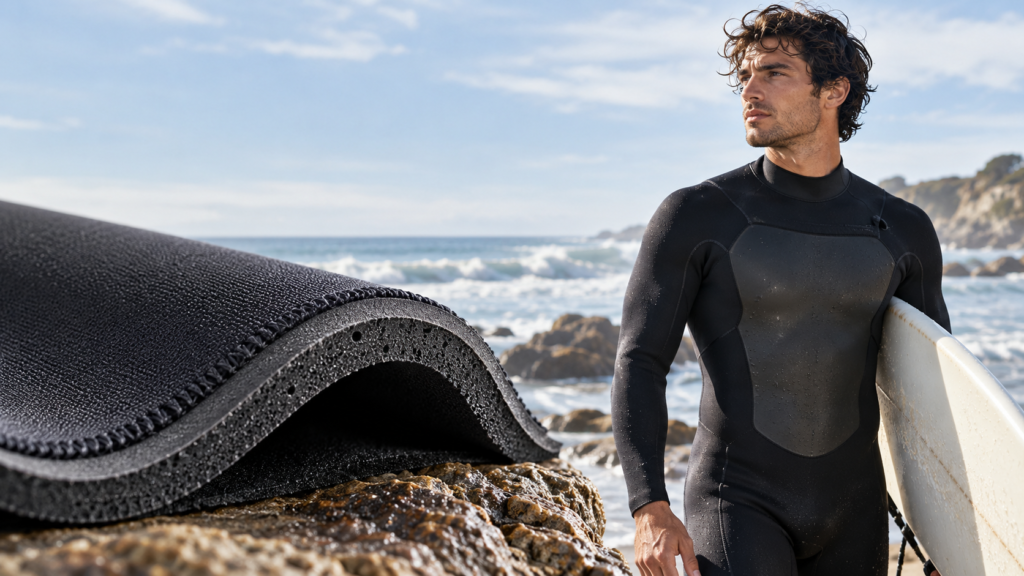
Lyocell is a regenerated cellulosic fiber made by dissolving cellulose, usually obtained from wood pulp, and turning it back into textile fiber. It is known for its softness, moisture absorption, strength and smooth drape, making it popular in everything from everyday clothing and denim to home textiles and hygiene products.
Although lyocell is often associated with the name TENCEL™, the two terms are not exactly interchangeable. Lyocell is the generic fiber category, while TENCEL™ is a registered brand used by Lenzing for specific lyocell and modal fibers.
Lyocell belongs to the broader family of man-made cellulosic fibers (MMCFs), alongside viscose, modal and other regenerated cellulose fibers. What distinguishes lyocell is its solvent-spinning manufacturing method, particularly the use of a direct solvent system that can be operated in a closed loop.

Quick Facts About Lyocell Fabric
| Feature | Details |
|---|---|
| Fabric name | Lyocell |
| Common commercial name | TENCEL™ for Lenzing-branded fibers |
| Fiber category | Regenerated cellulosic / man-made cellulosic |
| Primary raw material | Cellulose, commonly from wood pulp |
| Typical feel | Soft, smooth and cool |
| Breathability | Generally high |
| Moisture absorption | High |
| Strength | High, including good strength when wet |
| Drape | Smooth and fluid |
| Stretch | Naturally limited; depends on fabric construction |
| Common uses | Apparel, denim, underwear, home textiles, nonwovens |
| Main production regions | Asia and Europe |
| Typical care | Follow the garment’s care label |
What Is Lyocell Fabric?
Lyocell is a textile fiber made from regenerated cellulose. The starting material is usually wood-derived cellulose, although alternative cellulose sources can also be used.
The manufacturing process does not simply turn wood directly into fabric. Instead, cellulose is dissolved in a solvent to create a spinning solution. That solution is then pushed through very fine openings to form continuous filaments, which are washed, finished and converted into the fibers used to make yarn and fabric.
This distinction explains why lyocell sits between traditional natural and synthetic fibers in textile classification. Its raw material can come from renewable biological sources, but the final fiber is manufactured through an industrial regeneration process.
Textile Exchange describes lyocell as a regenerated fiber made from treated wood pulp and identifies it as one of the major man-made cellulosic fibers used in modern textiles.
What Does Lyocell Feel Like?
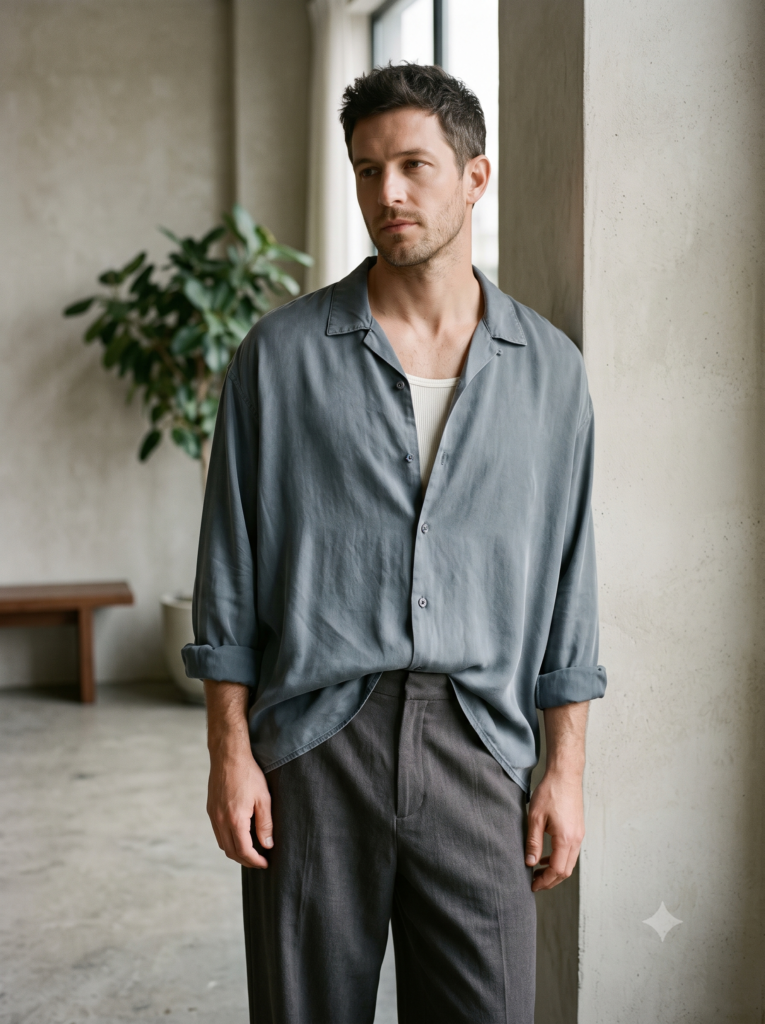
Lyocell is usually soft and smooth against the skin. Its combination of moisture absorption and relatively high fiber strength makes it suitable for garments that need both comfort and durability.
The fabric can have a clean, elegant drape in lightweight constructions, while heavier lyocell fabrics can provide more structure. Denim made with lyocell blends, for example, can have a softer hand than conventional rigid denim.
History of Lyocell Fabric
Lyocell emerged from research into new ways of producing regenerated cellulose fibers during the second half of the 20th century.
One of the important developments came from American Enka, which investigated the technology in the 1970s. The early work did not immediately become a major commercial textile fiber. Later research and industrial development in the United Kingdom helped turn the concept into a commercially viable material.
The fiber became strongly associated with Tencel, developed and commercialized by Courtaulds. Lenzing later acquired the Tencel business and developed it into one of the best-known branded lyocell fibers in the global textile market.
Today, TENCEL™ is a brand rather than the generic name for every lyocell fiber. Lenzing markets its branded lyocell using a proprietary production system based on solvent spinning and closed-loop recovery.
The wider lyocell category has since expanded beyond one company, with manufacturers producing lyocell fibers for apparel, home textiles, nonwovens and other applications.
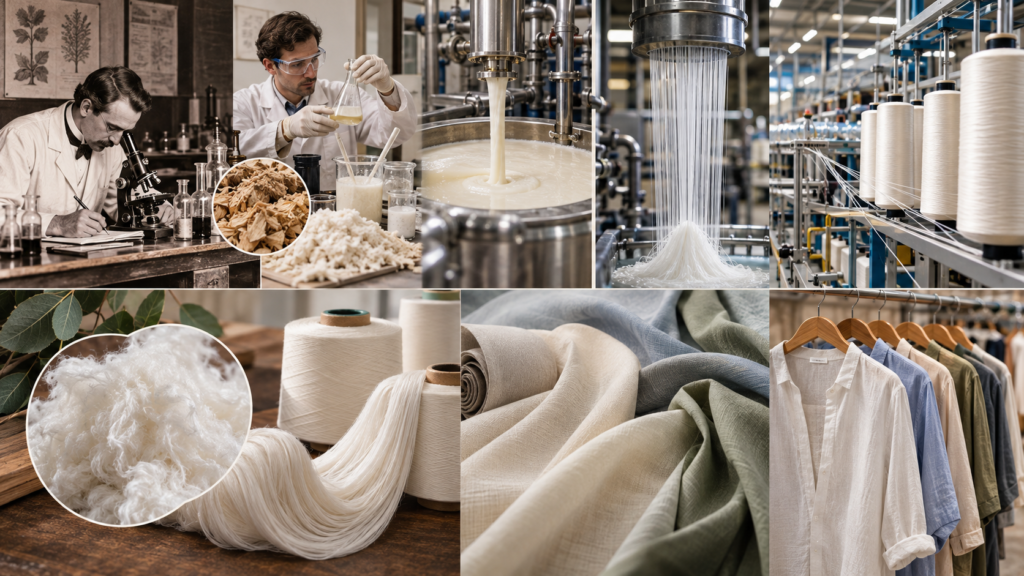
How Is Lyocell Fabric Made?
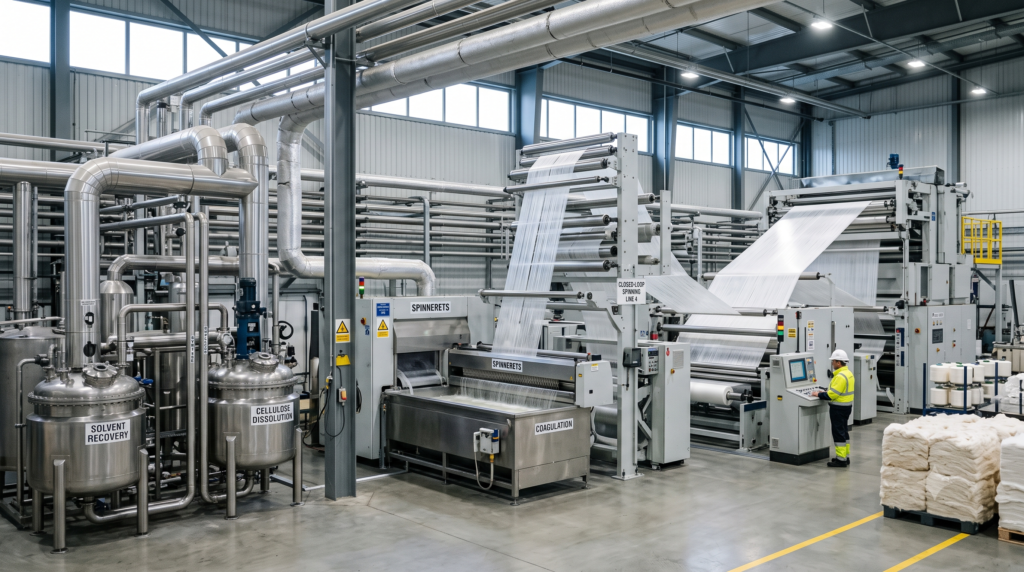
The defining feature of lyocell is its solvent-spinning process.
Unlike conventional viscose production, where cellulose undergoes several chemical transformations before being regenerated, lyocell uses a direct dissolution approach. Cellulose is dissolved in a solvent, turned into a spinning solution and then regenerated as fiber.
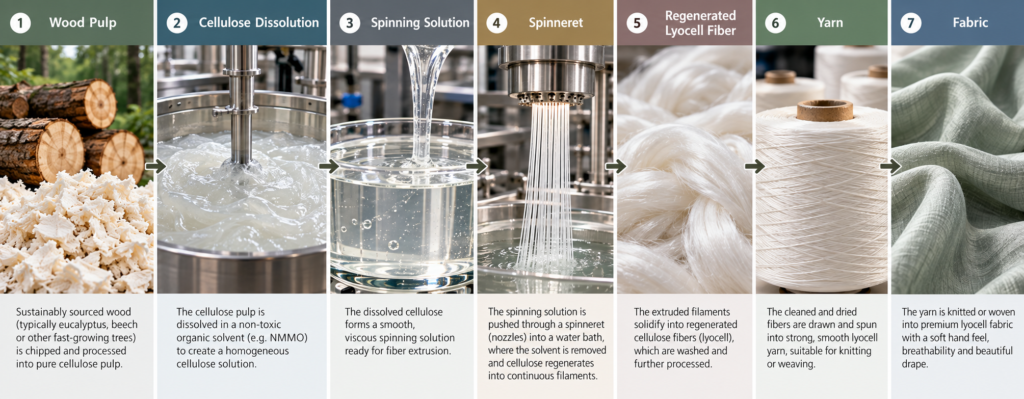
1. Obtaining Cellulose
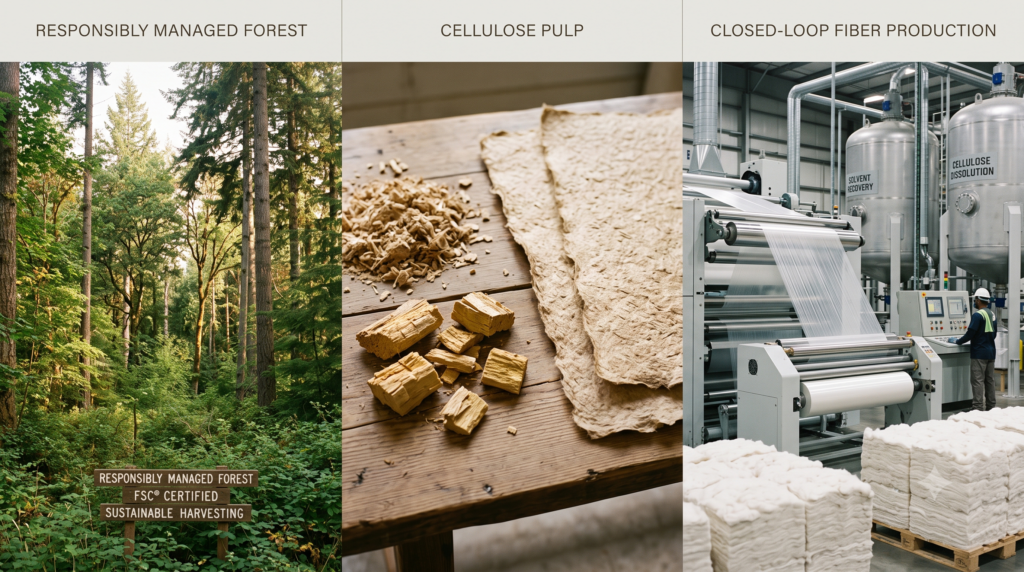
The process begins with cellulose-rich raw material, most commonly dissolving wood pulp.
The wood source is an important part of the supply chain. Responsible sourcing systems can help reduce risks associated with deforestation, habitat loss and poor forest management.
2. Preparing the Pulp
Wood is processed into pulp and purified so that it contains cellulose suitable for fiber production.
The cellulose is then prepared for dissolution rather than being spun in its original plant form.
3. Dissolving the Cellulose
In the commonly used lyocell process, cellulose is dissolved in N-methylmorpholine N-oxide (NMMO).
The cellulose and solvent are processed under controlled conditions until a uniform spinning solution is produced.
Lenzing describes its lyocell technology as dissolving cellulose in NMMO and notes that the raw material can come from wood-based cellulose as well as certain alternative cellulose sources.
4. Spinning the Fiber
The cellulose solution is filtered and forced through a spinneret containing extremely small openings.
As the solution leaves the spinneret, it forms continuous filaments. The filaments are then washed to remove the solvent and processed into the required fiber form.
5. Recovering the Solvent
One of the major technological advantages of the lyocell process is the possibility of operating the solvent system as a closed loop.
Instead of continuously discarding the solvent, it can be recovered, purified and returned to production. Lenzing reports recovery of more than 99.8% of the solvent in its TENCEL™ lyocell process.
6. Finishing the Fiber
After washing, the fibers are dried and finished. Depending on the intended application, they may remain as continuous filaments or be cut into staple fibers.
The finished fibers are then spun into yarn and converted into woven or knitted fabrics.
How Is Lyocell Fabric Used?
Lyocell is versatile enough to be used in both fashion and technical textile applications.
Clothing
Lyocell is widely used in:
- Shirts
- T-shirts
- Dresses
- Trousers
- Skirts
- Underwear
- Sleepwear
- Sportswear
- Jackets
- Denim
- Lightweight outerwear
Its softness and moisture absorption make it particularly useful in garments worn close to the body.
Denim
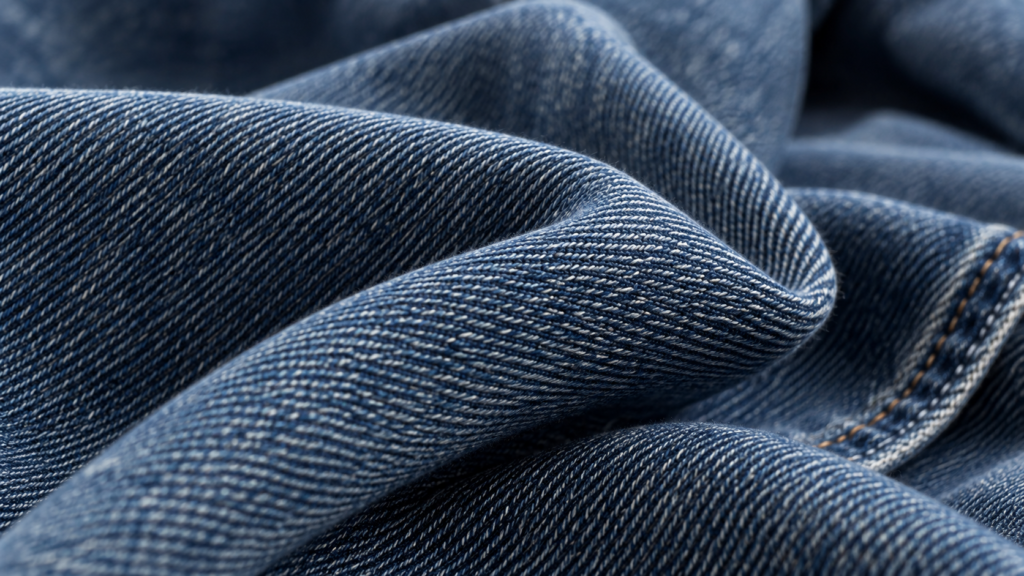
Lyocell is increasingly used in denim blends.
Adding lyocell to denim can soften the fabric and change its drape and hand feel while maintaining much of the practical character expected from denim.
Home Textiles
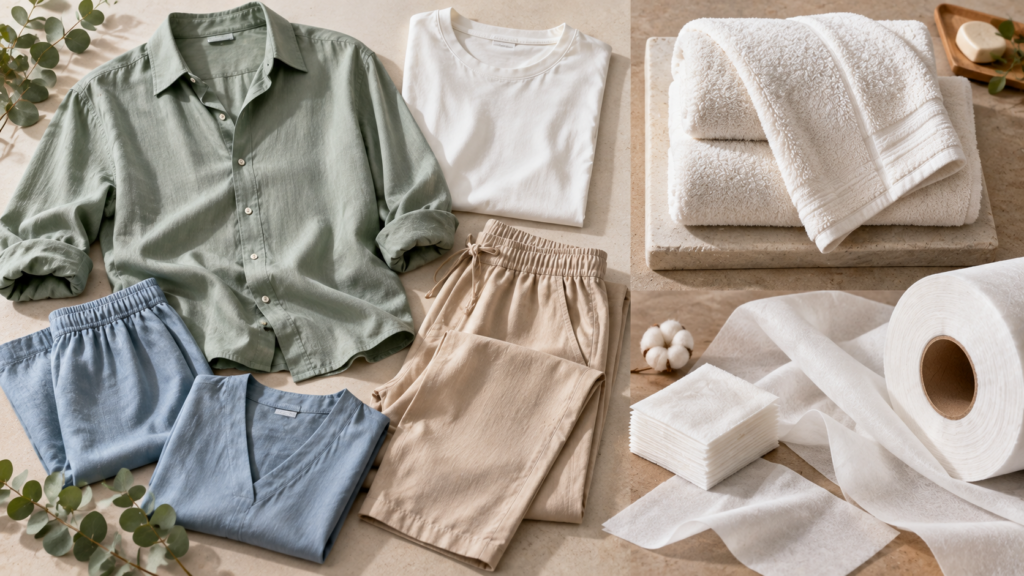
Lyocell can also be used for selected bedding, towels and other household textiles where softness and absorbency are desirable.
Nonwoven and Technical Applications
Lyocell fibers are used beyond conventional clothing. Their strength and absorbency make them suitable for certain nonwoven products, including hygiene and medical-related materials.
Textile Exchange notes lyocell’s use in apparel such as underwear and denim, while Lenzing also identifies applications in home textiles and hygiene products.
Where Is Lyocell Fabric Produced?
Lyocell production has developed into a global industry, with important manufacturing capacity in Europe and Asia.
The exact production landscape changes as companies build, expand or relocate fiber manufacturing facilities. China has become particularly important in the wider regenerated-cellulose industry, while European producers remain significant in specialized and branded lyocell production.
Lenzing, one of the best-known lyocell producers, operates production facilities across several countries and markets its fibers under the TENCEL™ and VEOCEL™ brands.
Lyocell is also a relatively small segment of the wider man-made cellulosic market. Textile Exchange estimated global lyocell production at approximately 0.4 million tonnes in 2024, representing about 5% of total MMCF production.
How Much Does Lyocell Fabric Cost?
Lyocell is generally positioned above basic commodity fabrics in price, although the actual cost varies considerably.
Factors affecting price include:
- Fiber quality
- Producer and brand
- Fabric weight
- Yarn construction
- Weave or knit
- Dyeing and finishing
- Certification
- Whether the fabric is blended
- Order quantity
Generic lyocell and branded fibers should not automatically be treated as equivalent products. A fabric carrying the TENCEL™ name, for example, uses a Lenzing-branded fiber and therefore has different sourcing and production specifications from an unspecified lyocell fiber.
In retail clothing, lyocell can appear in both moderately priced and premium garments.
Its higher material cost can be justified where manufacturers value its combination of softness, moisture management, drape and strength.
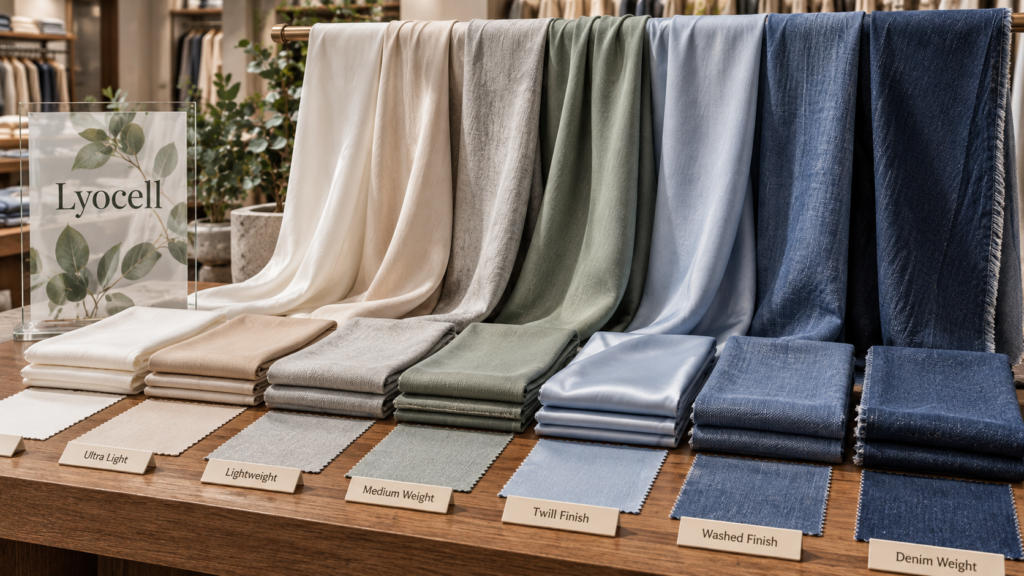
What Different Types of Lyocell Fabric Are There?
Strictly speaking, lyocell is a generic fiber category rather than a collection of completely different fiber types.
Differences between commercial lyocell products can come from the producer, raw material, fiber cross-section, processing conditions, finishing and intended application.
Standard Lyocell
Standard lyocell is a regenerated cellulose fiber produced using a solvent-spinning method.
It can be manufactured as staple fiber or filament and used in a wide variety of textile constructions.
TENCEL™ Lyocell
TENCEL™ Lyocell is Lenzing’s branded lyocell fiber. It is not a separate generic fiber category; rather, it is a specific branded version of lyocell produced according to Lenzing’s specifications.
Lenzing states that its TENCEL™ Lyocell uses wood from certified or controlled sources and a closed-loop process with more than 99.8% solvent recovery.
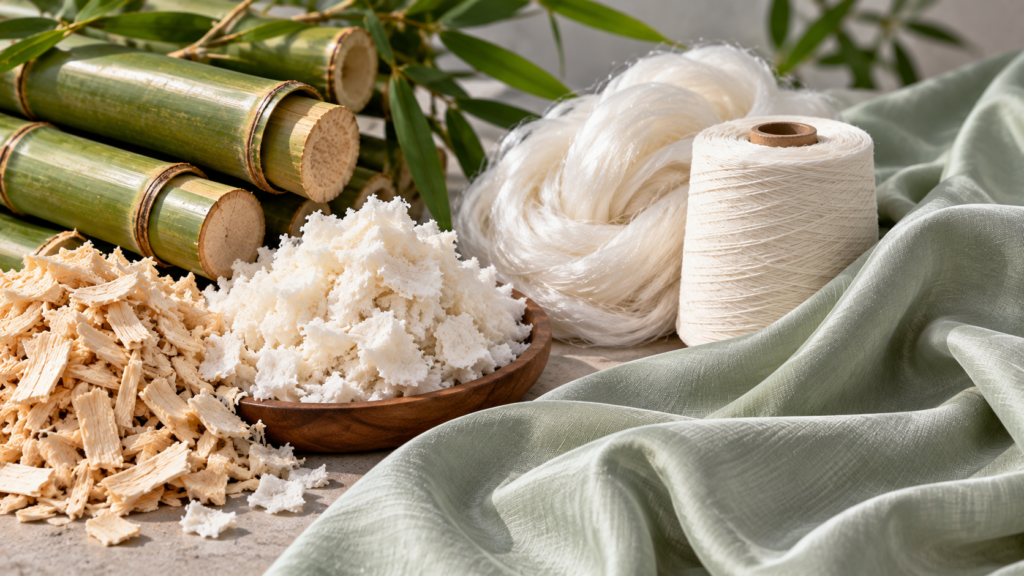
Bamboo Lyocell
The term bamboo lyocell generally refers to lyocell fibers where bamboo is used as the cellulose source.
The important distinction is that bamboo must first be processed into cellulose pulp; the finished textile is not simply mechanically extracted bamboo fiber.
Lyocell Blends
Lyocell is frequently blended with other fibers, including:
- Cotton
- Linen
- Wool
- Polyester
- Elastane
- Nylon
- Silk
Blending can alter stretch, durability, recovery, texture, drape and care requirements.
How Does Lyocell Fabric Impact the Environment?
Lyocell is often presented as a more environmentally responsible alternative to conventional synthetic fibers or some other regenerated cellulose fibers. There is some basis for this reputation, particularly around its solvent-recovery technology, but lyocell should not automatically be considered sustainable simply because it is made from wood.
Its environmental performance depends on the entire production system.
Wood Sourcing Matters
Lyocell begins with cellulose, usually from wood. That makes forestry practices an important part of its environmental footprint.
Poorly managed forest sourcing can contribute to habitat loss, biodiversity impacts and forest degradation. Textile Exchange specifically identifies unsustainable wood sourcing as an ongoing challenge for man-made cellulosic fibers.
Using certified or controlled wood sources can provide stronger traceability. FSC certification, for example, provides chain-of-custody mechanisms for verifying forest-based materials through the supply chain.
Closed-Loop Production Can Reduce Waste
The strongest environmental argument for lyocell is its production technology.
The solvent used to dissolve cellulose can be recovered and reused rather than continually discharged. Textile Exchange describes lyocell as a preferred man-made cellulosic option because its production can use a closed-loop system.
However, this should not be interpreted as meaning that every product labeled “lyocell” has exactly the same environmental footprint.
Production facilities, energy sources, pulp sourcing, water management and process efficiency all matter.
What About TENCEL™ Lyocell?
Lenzing reports that its TENCEL™ Lyocell process recovers more than 99.8% of the solvent and uses wood from certified or controlled sources. The company also reports at least 50% lower carbon emissions and water consumption compared with generic lyocell under its stated methodology. These are company-specific claims for Lenzing’s fibers, not a universal performance claim for every lyocell product.
The most useful way to evaluate lyocell, therefore, is to look beyond the fiber name and examine the actual producer, feedstock, certification and manufacturing system.
Lyocell Fabric Certifications Available
There is no single certification that automatically makes every lyocell fabric sustainable. Different certifications address different parts of the supply chain.
FSC Certification
The Forest Stewardship Council (FSC) can provide verification for responsibly sourced forest materials and chain of custody.
This is particularly relevant to lyocell because wood-derived cellulose is an important raw material for the fiber.
FSC explains that chain-of-custody certification tracks forest-based material through stages of the supply chain, helping verify that certified material remains identifiable through production and distribution.
PEFC
PEFC is another forest certification system that can be relevant to wood-derived textile fibers.
Lenzing, for example, identifies FSC and PEFC-certified or controlled wood sources for relevant TENCEL™ fibers.
EU Ecolabel
Some branded lyocell fibers and textile products can meet the requirements of environmental labeling schemes such as the EU Ecolabel. Certification applies to the specific qualifying product or supply chain rather than to lyocell as a whole.
OEKO-TEX
OEKO-TEX standards can be relevant to the finished textile, particularly regarding harmful substances. However, this should not be confused with forest certification or proof of responsible wood sourcing.
An Important Certification Distinction
A useful way to evaluate a lyocell garment is to ask what exactly has been certified:
- The forest?
- The pulp?
- The fiber?
- The manufacturing process?
- The finished textile?
These are different claims and should not be treated as interchangeable.
Frequently Asked Questions
Is lyocell a natural fabric?
Lyocell is made from cellulose derived from natural sources such as wood, but it is manufactured through an industrial regeneration process. It is therefore classified as a man-made cellulosic or regenerated cellulosic fiber, rather than a conventional natural fiber such as cotton or linen.
Is lyocell the same as TENCEL™?
No. Lyocell is the generic fiber name, while TENCEL™ is a Lenzing brand. TENCEL™ Lyocell is one specific branded type of lyocell fiber.
Is lyocell breathable?
Yes. Lyocell generally has good moisture absorption and can be comfortable in breathable clothing. The final fabric’s breathability also depends on its weight, weave, knit and finishing.
Is lyocell better than cotton?
Neither is universally better. Lyocell offers properties such as high moisture absorption, softness and good fiber strength, while cotton has its own advantages in cost, familiarity, durability and processing. The better choice depends on the intended application and sourcing.
Is lyocell stronger than viscose?
Lyocell generally has higher dry and wet strength than conventional viscose, which is one reason it is valued for durable garments and technical applications.
Does lyocell shrink?
Lyocell can shrink or change shape if it is washed or dried incorrectly. The amount depends on the fabric construction and finishing, so the manufacturer’s care instructions should always take priority.
Is lyocell good for summer?
Yes. Its moisture absorption, softness and relatively cool hand make it suitable for many warm-weather garments. Lightweight lyocell shirts, dresses and trousers can be particularly comfortable.
Is lyocell biodegradable?
Cellulose-based lyocell fibers can be biodegradable under appropriate conditions. However, the biodegradability of a finished garment also depends on dyes, finishes and whether the fabric contains synthetic fibers.
Is lyocell environmentally friendly?
Lyocell can have environmental advantages, particularly when produced with responsible wood sourcing and an efficient closed-loop solvent system. But the term itself is not a guarantee of low environmental impact. Raw-material sourcing, energy, water use and manufacturing practices all matter.
Is bamboo lyocell really made from bamboo?
It can be. Bamboo can be processed into cellulose pulp and then regenerated into lyocell fiber. The finished textile is therefore a regenerated cellulose material rather than a mechanically extracted bamboo fiber.
Why is lyocell more expensive than some fabrics?
Lyocell can cost more because of its production technology, fiber specifications, raw-material sourcing and manufacturing scale. Premium branded fibers and certified supply chains may also command higher prices.
Can lyocell be blended with other fabrics?
Yes. Lyocell is commonly blended with cotton, elastane, wool, linen, polyester and other fibers. Blending can change the fabric’s strength, stretch, drape, texture and care requirements.
Is lyocell good for sensitive skin?
Lyocell is often appreciated for its smooth, soft feel and moisture-management characteristics, which can make it comfortable against the skin. Individual comfort still depends on the fabric construction, dyes, finishes and personal sensitivity.