Microfibre is one of those textile terms that sounds like the name of a specific material but is actually a description of fiber fineness.
A microfibre is an extremely fine fiber, typically defined by a very low linear density. Polyester and polyamide (nylon) are the most common materials used to produce microfibres, although other polymers can also be engineered into fibers at this scale.
Making fibers so fine changes the way a fabric behaves. Microfibres can create exceptionally soft surfaces, dense constructions, strong capillary action and a large surface area relative to their weight. Those characteristics explain why microfibre is used for everything from cleaning cloths and towels to sportswear, upholstery, filtration materials and suede-like textiles.
The finished fabric can feel smooth, brushed, velvety or highly absorbent depending on how the fine fibers are produced and how they are woven, knitted or otherwise assembled.
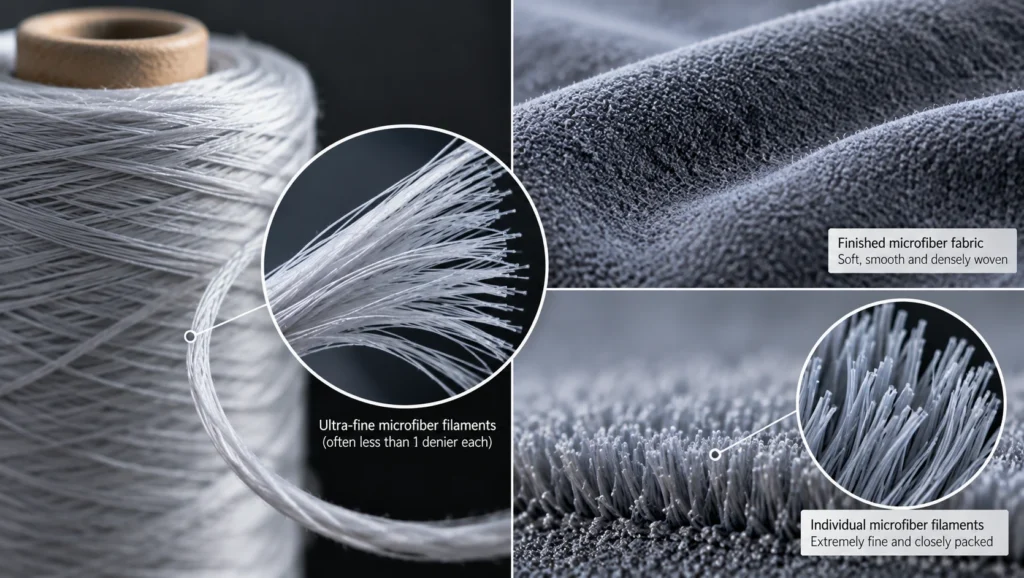
Quick Facts About Microfibre Fabric
| Property | Details |
|---|---|
| Material category | Ultra-fine textile fibers |
| Common materials | Polyester and polyamide; other polymers are also possible |
| Typical fiber fineness | Generally below 1 denier or approximately 1 dtex |
| Texture | Can range from smooth to soft, brushed or suede-like |
| Absorbency | Often high, depending on construction |
| Moisture management | Can be engineered for strong wicking |
| Durability | Generally good for its weight |
| Common uses | Cleaning products, apparel, towels, upholstery and industrial materials |
| Animal-derived? | Usually no |
| Key performance factors | Fiber fineness, cross-section, yarn construction and fabric structure |
1. What Is Microfibre Fabric?
Microfibre fabric is made from extremely fine textile fibers.
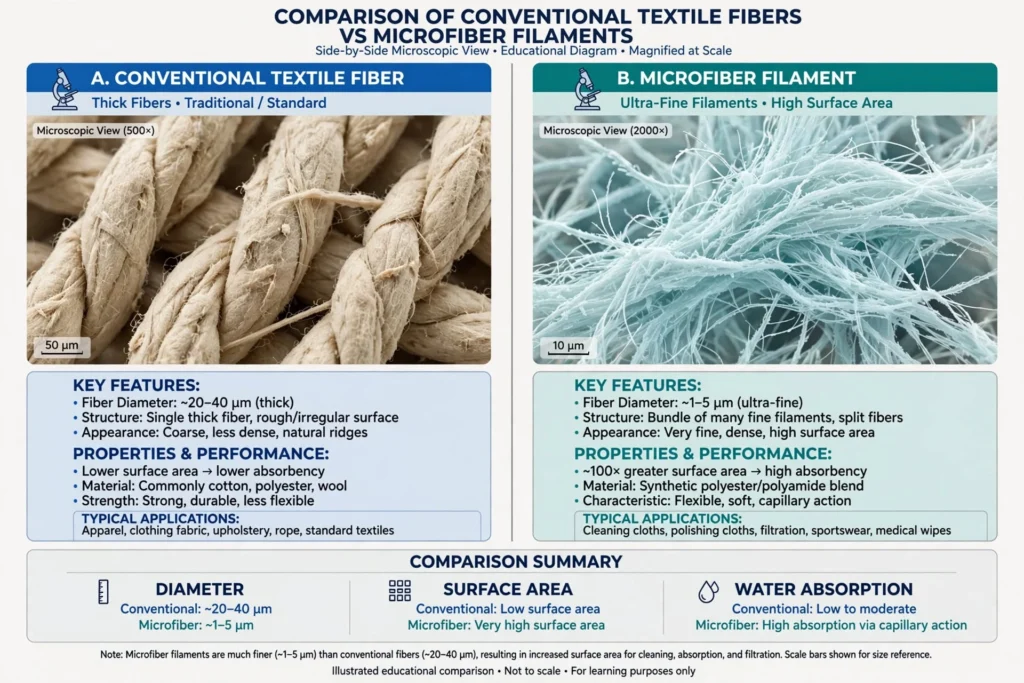
The term does not identify one particular polymer. Instead, it describes the fineness of the fiber. In textile engineering, microfiber is commonly associated with fibers having a linear density of less than approximately one denier or one decitex, although exact definitions can vary by standard and application.
For comparison, ordinary textile fibers are substantially thicker. Reducing the fiber diameter creates a much greater surface area relative to the amount of material being used.
That unusual structure gives microfiber several useful properties.
It can be:
- Very soft
- Lightweight
- Dense
- Strong for its weight
- Highly absorbent
- Fast drying
- Moisture wicking
- Resistant to wrinkling
- Capable of trapping fine particles
However, these characteristics are not guaranteed simply because a product is labeled microfiber. The actual performance depends on the fiber material, shape, yarn construction and final fabric structure.
What Is Microfibre Made From?
The most common microfibres are made from polyester and polyamide.
Polyester contributes strength, durability and dimensional stability, while polyamide can contribute softness, flexibility and absorbency.
Manufacturers can also produce microfibres from other synthetic polymers depending on the intended application.
This means “microfibre” should be thought of as a technical fiber category, rather than the name of one specific fabric.
2. History of Microfibre Fabric
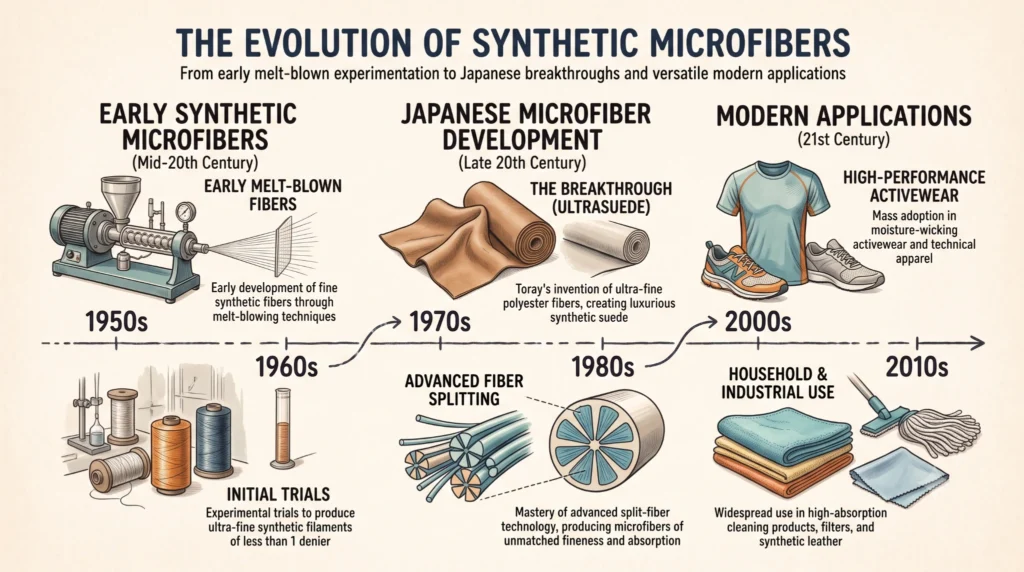
The development of microfiber came from the textile industry’s long-standing effort to manufacture increasingly fine synthetic fibers.
Early attempts to create ultra-fine filaments faced practical problems. Very thin fibers were difficult to produce consistently and could break during processing.
The development of bicomponent or composite spinning techniques helped overcome some of these limitations. By combining different polymers within the same filament, manufacturers could create structures that could later be separated or split into extremely fine fibers.
Japanese textile research played an important role in the commercial development of microfiber during the twentieth century.
Toray is particularly associated with the early development and commercialization of microfiber materials, including the suede-like material that became known as Ultrasuede®. Other manufacturers subsequently developed their own microfiber technologies and expanded the material into apparel, cleaning products, interiors and industrial applications.
By the 1990s and 2000s, microfiber had become widely established in consumer products.
Its popularity was driven less by fashion alone than by its unusual combination of softness, durability, absorbency and cleaning performance.
3. How Is Microfibre Fabric Made?
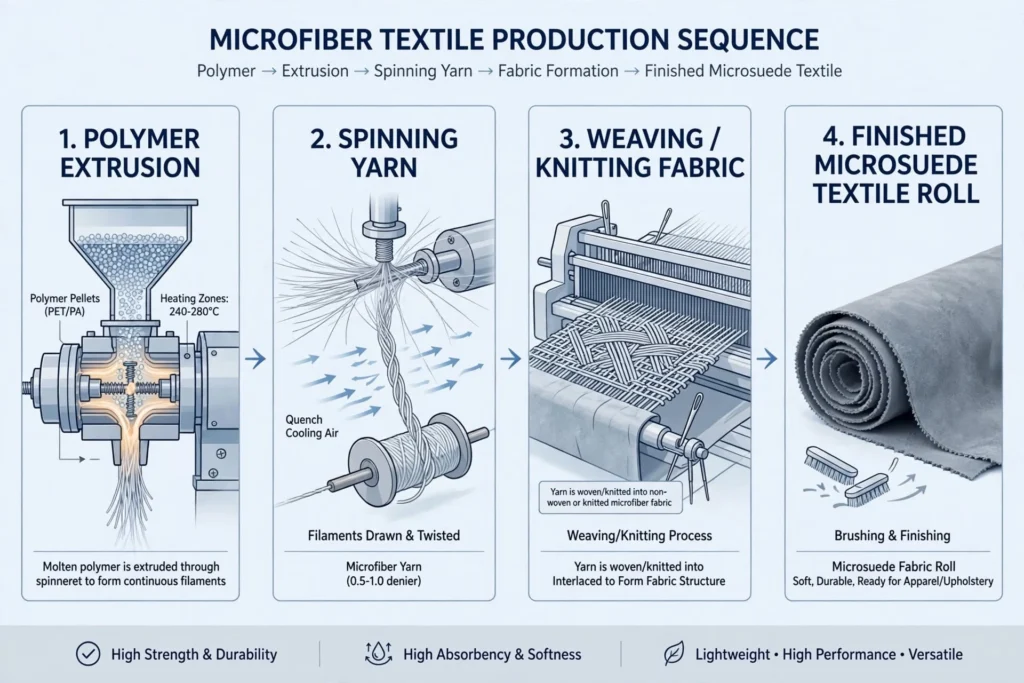
Microfibre production requires specialized techniques because the individual filaments are much finer than ordinary textile fibers.
Step 1: Selecting the Polymer
The manufacturer first selects the material according to the intended performance.
Polyester and polyamide are especially common because they can be engineered into very fine filaments while providing useful combinations of strength, flexibility and moisture behavior.
Step 2: Creating Ultra-Fine Filaments
The polymer is heated and formed into extremely fine continuous filaments.
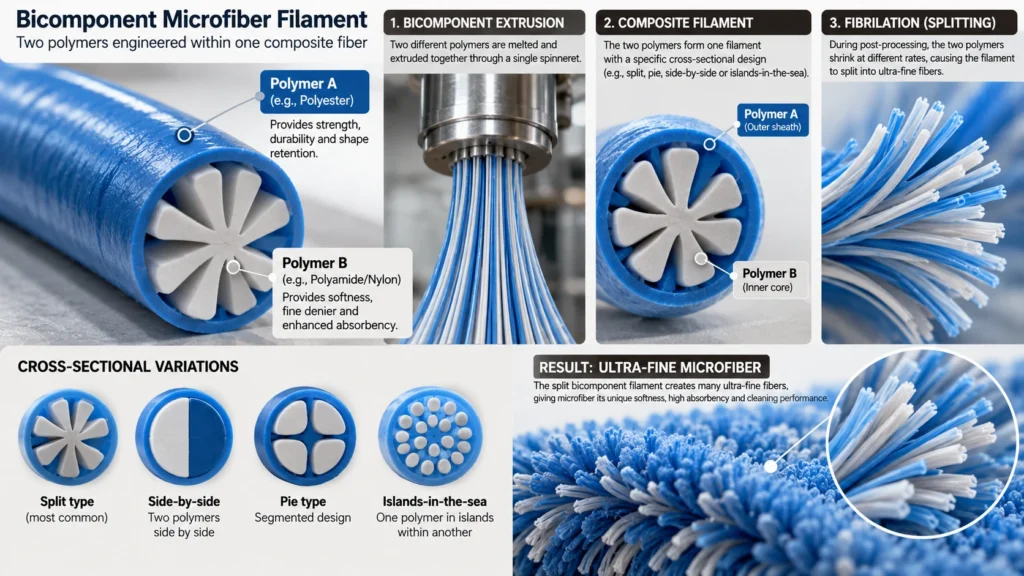
For many microfiber products, manufacturers use bicomponent spinning, in which two different polymers are combined within a single composite filament.
The internal arrangement can take different forms, including configurations that allow one polymer to surround or occupy sections of another.
Step 3: Splitting or Separating the Components
In certain microfiber constructions, the composite filament is subsequently divided into much finer individual filaments.
This can be achieved mechanically or through controlled chemical processing, depending on the technology.
The resulting filaments can be extraordinarily fine compared with ordinary textile fibers.
Step 4: Forming Yarn and Fabric
The fine fibers are converted into yarns or assembled directly into textile structures.
Manufacturers can then use:
- Weaving
- Knitting
- Nonwoven techniques
- Brushing
- Napping
- Specialized surface treatments
The choice of construction has a major effect on the final material.
A microfiber intended for cleaning glass needs different surface characteristics from microfiber designed for sportswear or upholstery.
Step 5: Dyeing and Finishing
Microfiber fabrics can be dyed in a wide range of colors.
Additional finishing treatments may be used to improve:
- Water resistance
- Absorbency
- Softness
- Stain resistance
- Heat resistance
- Abrasion resistance
- Surface texture
The final fabric is then inspected and converted into products such as rolls, garments, towels, cleaning cloths or upholstery.
4. How Is Microfibre Fabric Used?
Microfibre has applications across household, fashion and industrial markets.
Cleaning Products
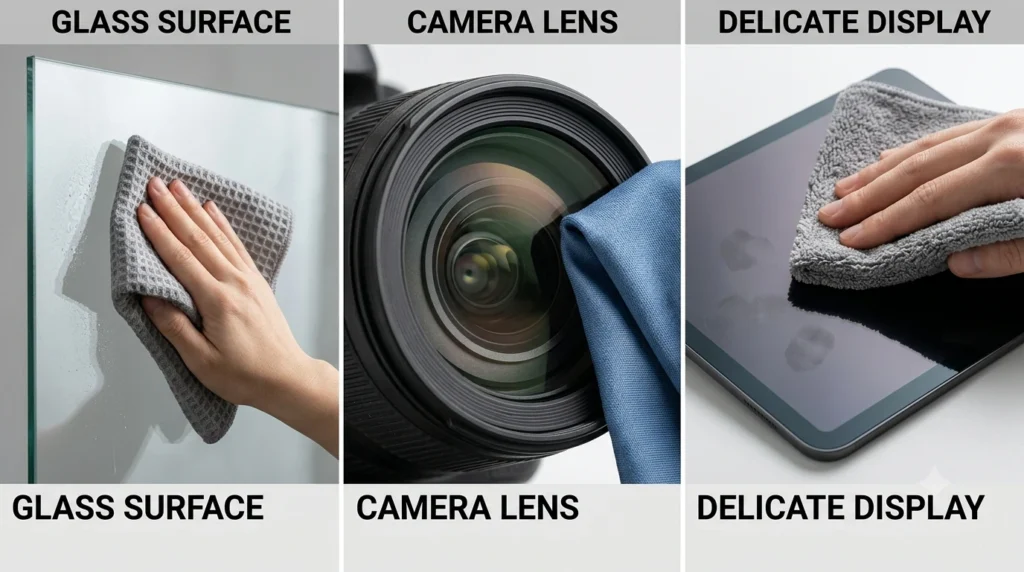
Cleaning is one of the most recognizable uses of microfiber.
Microfiber cleaning cloths can capture dust, oils and small particles because their extremely fine fibers create a large surface area and dense network of spaces.
Different constructions are designed for different jobs.
Some are optimized for glass and screens, while others are made for absorbing liquids or removing heavier dirt.
Towels and Home Textiles
Microfiber is widely used for:
- Bath towels
- Kitchen towels
- Washcloths
- Hair towels
- Blankets
- Bedding
- Mattress covers
Its combination of softness, light weight and drying speed makes it useful in household textiles.
Apparel
Microfiber can be engineered for clothing where softness and moisture management are important.
Applications include:
- Sportswear
- Activewear
- Underwear
- Swimwear
- Jackets
- Jerseys
- Base layers
Fine fibers can produce smooth surfaces and comfortable fabrics while allowing manufacturers to engineer moisture movement and drying characteristics.

Upholstery and Interiors
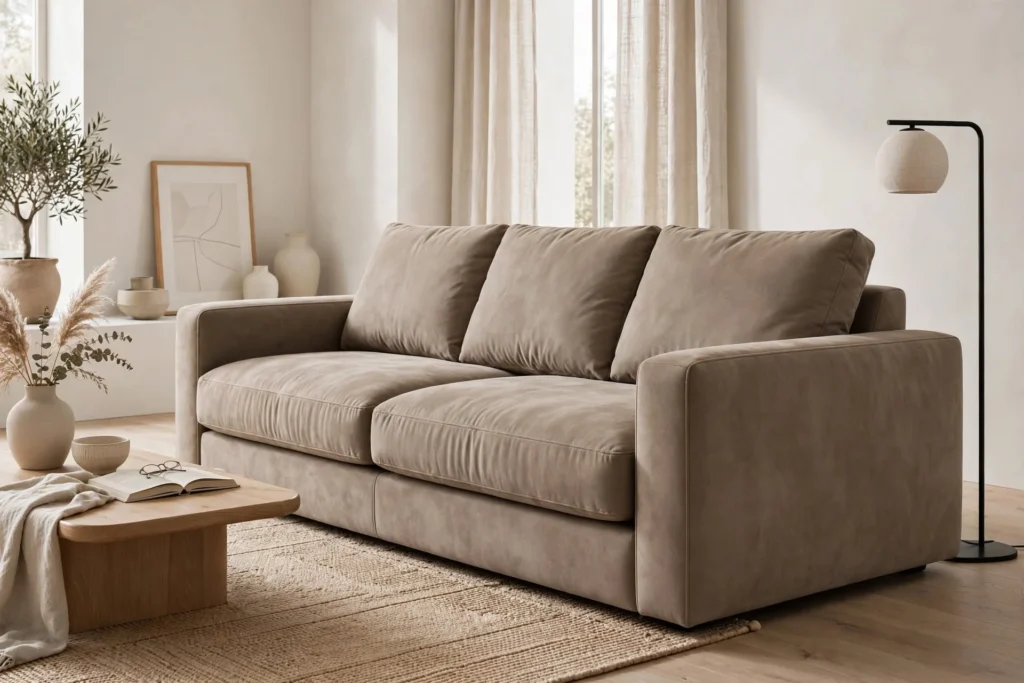
Microfiber is also used for furniture upholstery and interior applications.
Some constructions are designed to resemble suede while offering more consistent color and easier manufacturing.
Microfiber upholstery can be found in:
- Sofas
- Chairs
- Automotive interiors
- Headliners
- Decorative panels
Industrial Applications
The fine fiber structure also makes microfiber useful in technical applications.
Depending on construction, it can be used for:
- Filtration
- Protective materials
- Industrial wipes
- Polishing cloths
- Insulation-related applications
- Specialized cleaning systems
The same fundamental property – the enormous surface area created by very fine fibers – can be useful in applications far beyond clothing.
5. Where Is Microfibre Fabric Produced?
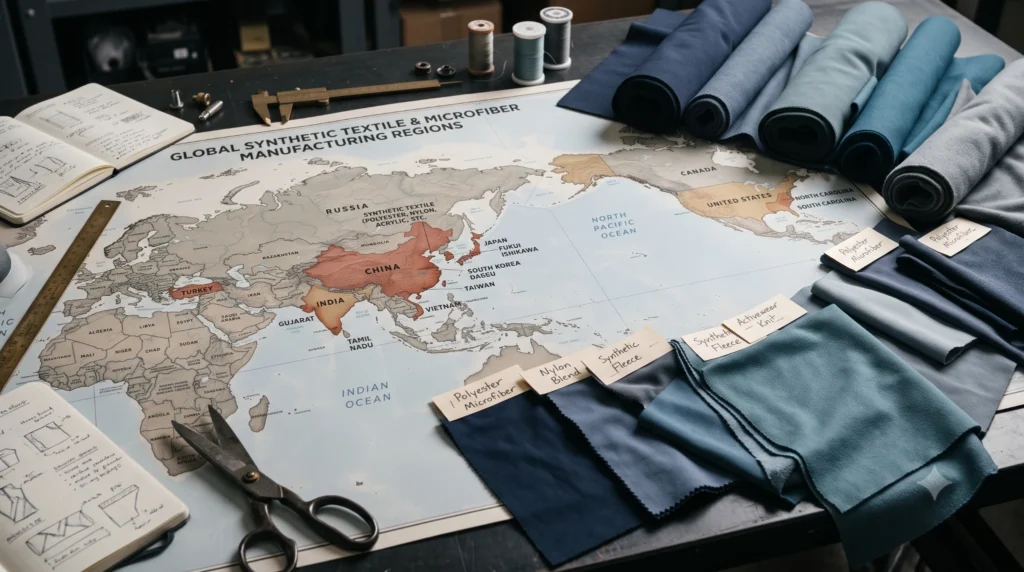
Microfiber is manufactured in many countries with developed synthetic-fiber and textile industries.
China is one of the world’s major producers of synthetic textiles and microfiber products, while significant production and technology development also exist in countries across Asia, Europe and North America.
Production can involve several stages in different locations. Polymer production, filament spinning, fabric formation, dyeing and finished-product manufacturing do not necessarily happen in the same facility.
For buyers, manufacturing location is therefore only one part of the supply chain.
Important factors can include:
- Polymer source
- Fiber technology
- Fabric construction
- Dyeing and finishing
- Quality control
- Recycled content
- Chemical management
- Manufacturing standards
6. How Much Does Microfibre Fabric Cost?
Microfibre is available across a very broad price range.
Basic microfiber cleaning fabrics can be inexpensive because they are produced at large volumes using relatively standardized constructions.
Higher-performance microfiber fabrics can cost considerably more.
Price is influenced by:
- Fiber material
- Fiber fineness
- Yarn construction
- Fabric weight
- Weave or knit
- Surface treatment
- Dyeing
- Performance requirements
- Recycled content
- Order quantity
- Manufacturing location
A microfiber designed for premium automotive upholstery, for example, can have very different specifications from a basic household cleaning cloth.
For apparel, the cost can also increase when the fabric has specialized moisture management, stretch, water resistance or finishing treatments.
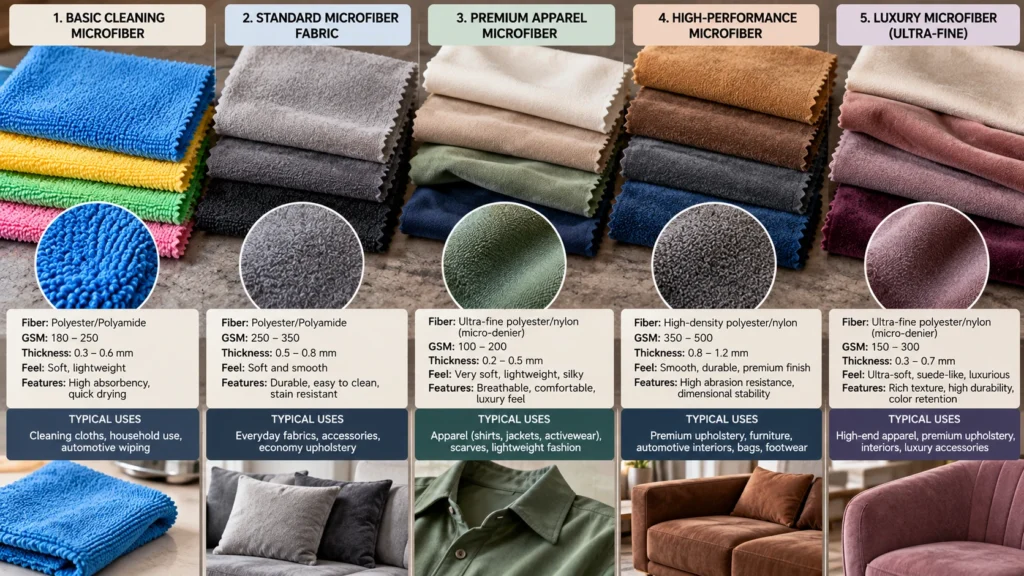
7. What Different Types of Microfibre Fabric Are There?
Because microfiber describes fiber fineness rather than one specific fabric construction, there are many ways to categorize it.
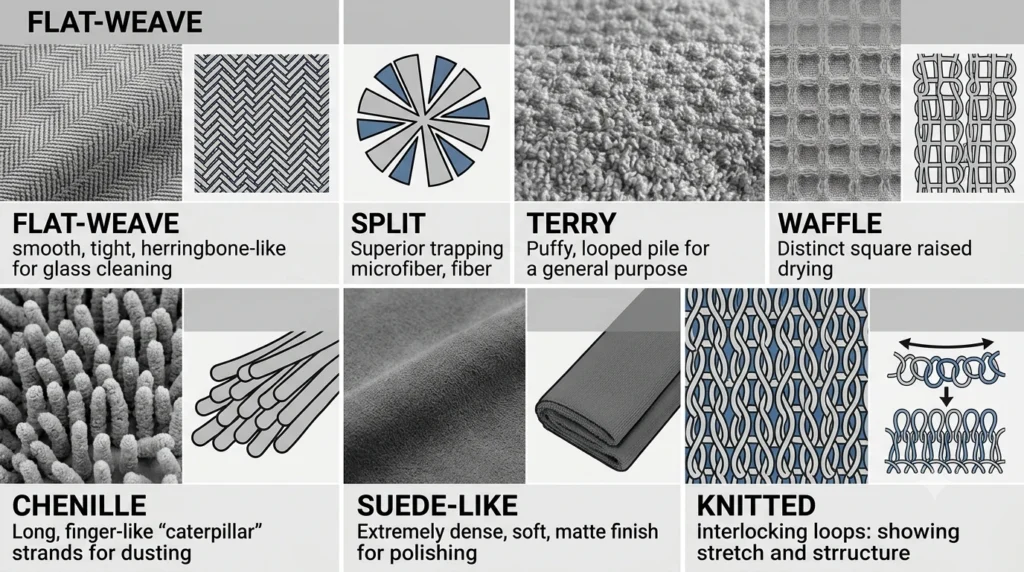
1. Flat-Weave Microfibre
Flat-weave microfiber has a relatively smooth surface.
It is commonly used where durability, low linting and a controlled surface are important.
Some apparel and general-purpose cleaning fabrics use this type of construction.
2. Split Microfibre
Split microfiber is produced by separating composite filaments into extremely fine individual fibers.
This creates a dense structure with a very high surface area.
It is particularly useful for cleaning because the fine filaments can improve particle capture and liquid handling.

3. Terry Microfibre
Terry construction creates loops on the surface of the fabric.
When combined with microfiber, these loops can increase surface area and improve liquid absorption.
This construction is particularly common in towels and cleaning products.
4. Waffle-Weave Microfibre
Waffle-weave microfiber has a raised grid-like surface.
The pattern can improve handling and liquid distribution while providing a useful balance between cleaning performance and glide.
It is frequently used in automotive and household cleaning products.
5. Chenille Microfibre
Chenille microfiber has thicker raised strands or tufts extending from a base fabric.
The resulting surface is highly textured and is commonly used for cleaning mitts, dusting products and specialized cleaning tools.
6. Suede Microfibre
Suede microfiber is engineered to reproduce the soft, matte appearance of natural suede.
It can be used in:
- Apparel
- Footwear
- Handbags
- Furniture
- Automotive interiors
- Accessories
Unlike natural suede, it does not require animal hide.
7. Microfiber Knits
Microfiber can also be knitted rather than woven.
Knitted constructions can provide greater stretch and flexibility, making them useful for sportswear, underwear and fitted garments.
8. Microfiber Nonwovens
Some technical microfiber products are manufactured as nonwoven structures rather than conventional woven or knitted fabrics.
These materials can be engineered for filtration, wiping, insulation and other industrial purposes.
A Note About MicroModal
MicroModal should not simply be treated as another type of conventional synthetic microfiber.
Modal is a regenerated cellulosic fiber, and MicroModal refers to particularly fine modal fibers. It shares the “micro” concept of very fine fiber dimensions, but its raw material and manufacturing chemistry differ fundamentally from polyester or nylon microfiber.
This distinction is important when discussing fiber composition and environmental impact.
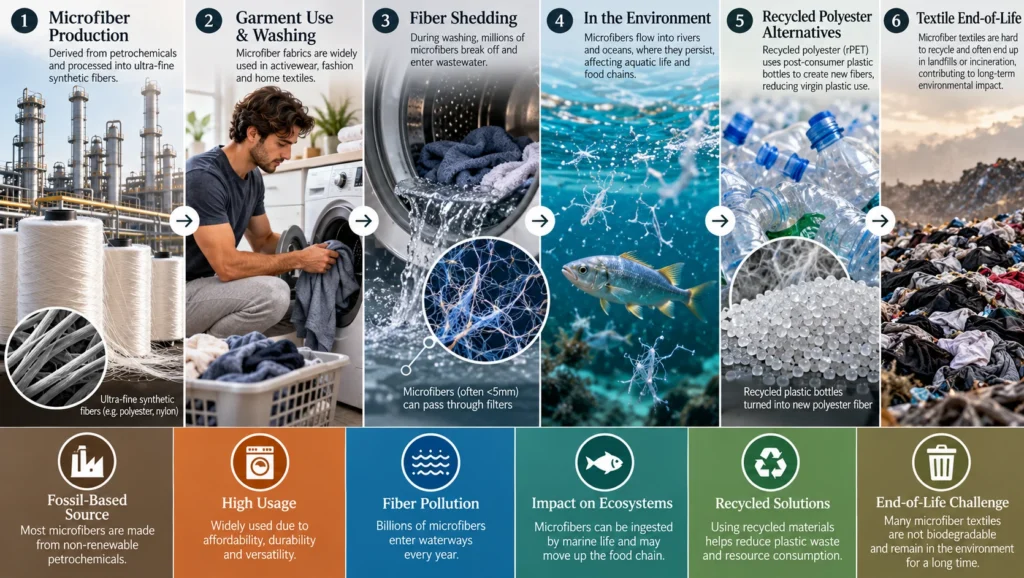
8. How Does Microfibre Fabric Impact the Environment?
Microfiber has both advantages and environmental challenges.
Because most commercial microfiber is made from synthetic polymers, the environmental discussion is closely connected to the production and end-of-life behavior of those polymers.
Fossil-Based Raw Materials
Conventional polyester and polyamide are generally derived from petrochemical feedstocks.
Their production requires energy and raw materials, and manufacturing impacts can vary depending on the polymer, electricity source and production technology.
Using recycled polyester or recycled polyamide can reduce reliance on virgin feedstocks in some applications, although recycling does not eliminate all environmental impacts.
Microfiber Shedding
One of the most discussed environmental concerns surrounding synthetic textiles is the release of microplastic fibers during washing and use.
It is important to distinguish the terms:
Microfiber describes an extremely fine textile fiber.
Microplastic fiber describes a small plastic particle or fiber that enters the environment.
A microfiber made from polyester or nylon can become a microplastic fiber when it is shed into wastewater or the environment.
The amount released depends on factors such as:
- Fiber construction
- Fabric age
- Washing conditions
- Garment design
- Mechanical abrasion
- Finishing
- Wastewater treatment
Therefore, not every microfiber product contributes equally to microfiber pollution.
Durability and Resource Efficiency
Microfiber can be extremely durable relative to its weight.
If a product remains functional for a long time, the material may provide useful resource efficiency because fewer replacement products are required.
This is particularly relevant for cleaning cloths, sportswear, upholstery and technical textiles.
Recycled Microfiber
Recycled polyester and other recycled synthetic fibers can reduce the need for some virgin polymer production.
However, recycled content should be evaluated alongside durability, chemical processing and end-of-life options.
A fabric containing recycled material is not automatically environmentally preferable in every application.
End of Life
Recycling microfiber fabrics can be difficult when they contain blended fibers, coatings, elastane or permanently bonded layers.
Designing products for simpler material compositions can make future recovery easier.
The most useful sustainability assessment therefore considers the entire life cycle, from raw material and fiber production through use, washing and eventual disposal or recycling.
9. Microfibre Fabric Certifications Available
Several certifications can be relevant to microfiber, depending on its composition and intended use.
OEKO-TEX STANDARD 100
OEKO-TEX STANDARD 100 focuses on testing textile products for harmful substances.
For microfiber clothing, towels and other consumer products, certification can provide information about chemical safety within the scope of the relevant product certification.
Global Recycled Standard
The Global Recycled Standard (GRS) can be relevant to microfiber products containing qualifying recycled materials.
It addresses recycled content and supply-chain requirements rather than simply confirming that a fabric is “eco-friendly.”
Recycled Content Certification
Other recognized recycled-content systems can also be used depending on the fiber and market.
When a supplier claims that microfiber is recycled, buyers should look for documentation confirming:
- The percentage of recycled content
- The source of the recycled material
- The certified supply chain
- The applicable product standard
Performance Testing
Microfiber products can also undergo application-specific testing for:
- Abrasion resistance
- Colorfastness
- Absorbency
- Moisture management
- Tensile strength
- Tear resistance
- Dimensional stability
- Chemical resistance
For technical microfiber, performance certification may be just as important as environmental certification.
10. Frequently Asked Questions
What is microfibre fabric made from?
Most microfiber fabrics are made from very fine polyester, polyamide or a combination of the two. Other polymers can also be manufactured into microfiber.
Is microfiber a natural fabric?
Most commercial microfiber is synthetic rather than natural. Polyester and nylon are the most common materials used.
Is microfiber the same as polyester?
No. Polyester is a polymer and fiber material. Microfiber describes the fineness of a fiber. Polyester can be made into microfiber, but not all polyester is microfiber.
Is microfiber the same as nylon?
No. Nylon is a material that can be manufactured into microfiber. “Microfiber” refers to the fiber’s fineness rather than its chemical identity.
Is microfiber fabric soft?
Generally, yes. The extremely fine fibers can produce a very soft surface, although the final feel depends on the yarn and fabric construction.
Is microfiber absorbent?
Many microfiber fabrics are highly absorbent, especially those engineered with split fibers or particular surface constructions. However, absorbency varies between microfiber products.
Is microfiber breathable?
Microfiber can be breathable, but the result depends on fiber density, fabric construction, finishing and garment design. A tightly constructed microfiber upholstery material will behave differently from a lightweight microfiber sports fabric.
Does microfiber keep you warm?
Microfiber itself does not automatically mean high warmth. Insulation depends on fabric weight, density, construction and whether the material traps still air.
Is microfiber good for sportswear?
Yes. Fine synthetic fibers can provide softness, moisture management, quick drying and good shape retention, making microfiber suitable for many athletic and activewear applications.
Is microfiber environmentally friendly?
Not automatically. Synthetic microfiber can involve fossil-derived polymers and can contribute to microfiber pollution through fiber shedding. Recycled materials, durability, manufacturing practices and end-of-life options all influence its overall impact.
Does microfiber shed microplastics?
Synthetic microfiber made from plastics such as polyester or nylon can release fine plastic fibers during washing and use. The amount varies according to the textile and washing conditions.
Can microfiber be recycled?
Some microfiber products can incorporate recycled fibers, but recycling finished microfiber textiles can be difficult, particularly when they contain blends, coatings or other components.
Is microfiber better than cotton?
Neither material is universally better. Microfiber can offer quick drying, softness and durability, while cotton provides a different natural fiber structure and feel. The better choice depends on the intended application.
Can microfiber be used for clothing?
Yes. Microfiber is used in activewear, sportswear, underwear, swimwear, jackets and other garments where softness, moisture management and lightweight construction are desirable.
Is microfiber the same as MicroModal?
No. MicroModal is a very fine form of modal, which is a regenerated cellulosic fiber. Conventional microfiber is most commonly associated with ultra-fine synthetic fibers such as polyester and polyamide.
How should microfiber fabric be washed?
Care instructions vary by product. In general, manufacturers may recommend cool or warm washing and avoiding excessive heat, fabric softeners or harsh chemicals when they can interfere with the fabric’s intended performance.