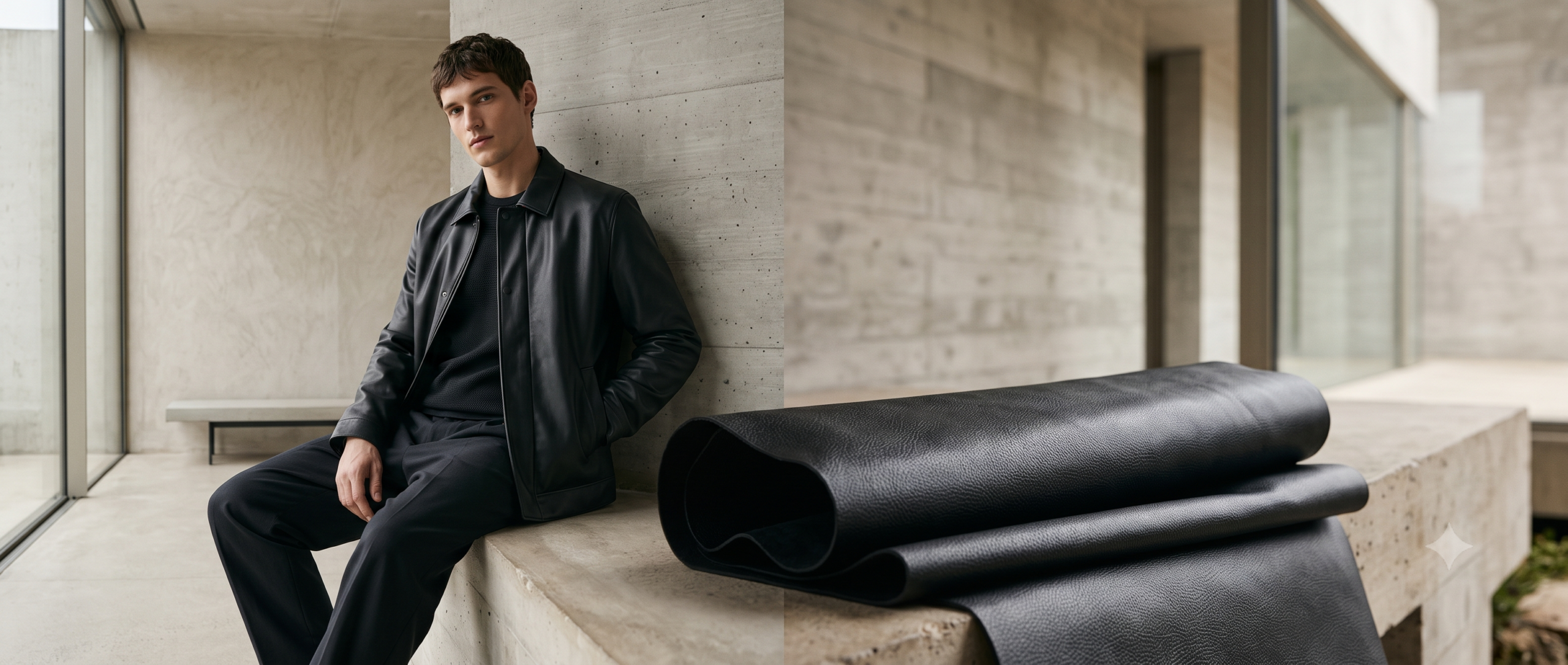
Faux leather is designed to recreate some of the visual and functional qualities of animal leather without using an animal hide. It has become a familiar material in fashion, footwear, furniture, automotive interiors and accessories because it can offer a consistent appearance, relatively predictable performance and a lower material cost than many forms of genuine leather.
But faux leather is not one single material.
The category includes different constructions based on polymers, textile backings and, increasingly, alternative bio-based materials. Polyurethane (PU) and polyvinyl chloride (PVC) remain important traditional forms, while newer materials may incorporate plant-derived feedstocks or other non-animal components.
Understanding how faux leather is constructed is therefore more useful than judging it simply by appearance. Two materials can look almost identical on the surface while behaving very differently in terms of softness, durability, breathability, chemical resistance and end-of-life options.
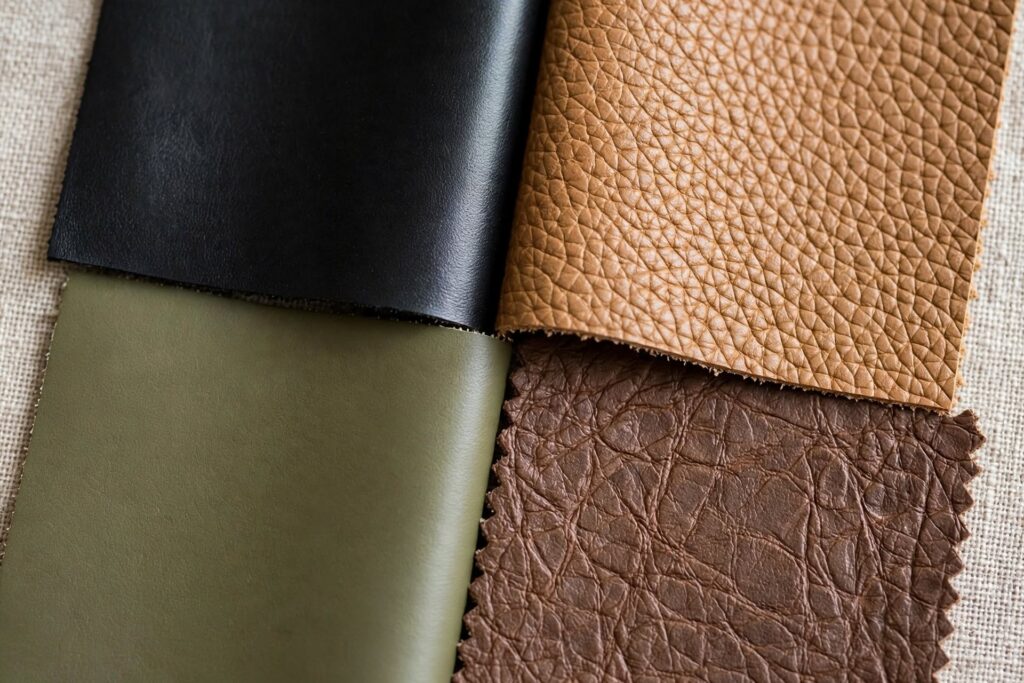
Quick Facts About Faux Leather Fabric
| Property | Details |
|---|---|
| Material type | Man-made leather alternative |
| Common names | Synthetic leather, artificial leather, imitation leather, leatherette |
| Common materials | PU, PVC and other polymer-based coatings |
| Construction | Usually a textile or nonwoven backing with a leather-like surface |
| Typical feel | Smooth, flexible or slightly plastic-like, depending on construction |
| Water resistance | Generally good, but varies by material and seams |
| Breathability | Usually lower than many natural textile fabrics |
| Common uses | Clothing, footwear, bags, upholstery and accessories |
| Animal-derived? | Traditional faux leather is not made from animal hide |
| Key quality factors | Polymer, backing, coating thickness, finish and construction |
1. What Is Faux Leather Fabric?
Faux leather is a man-made material designed to imitate the appearance and some properties of genuine leather.
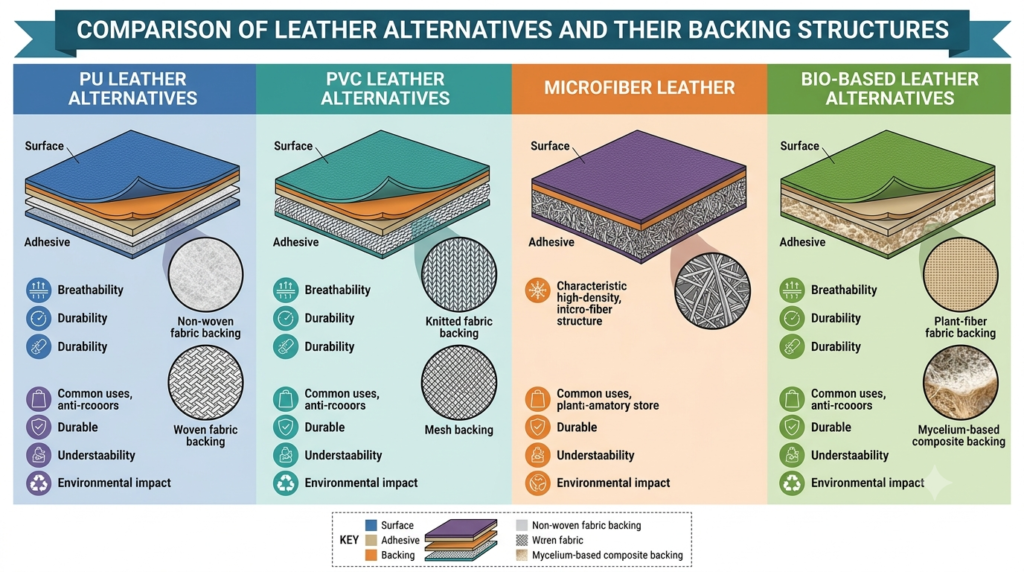
Unlike natural leather, which begins with animal hide or skin, faux leather is normally engineered from layers. A textile or nonwoven backing provides structure, while a polymer-based surface creates the leather-like appearance.
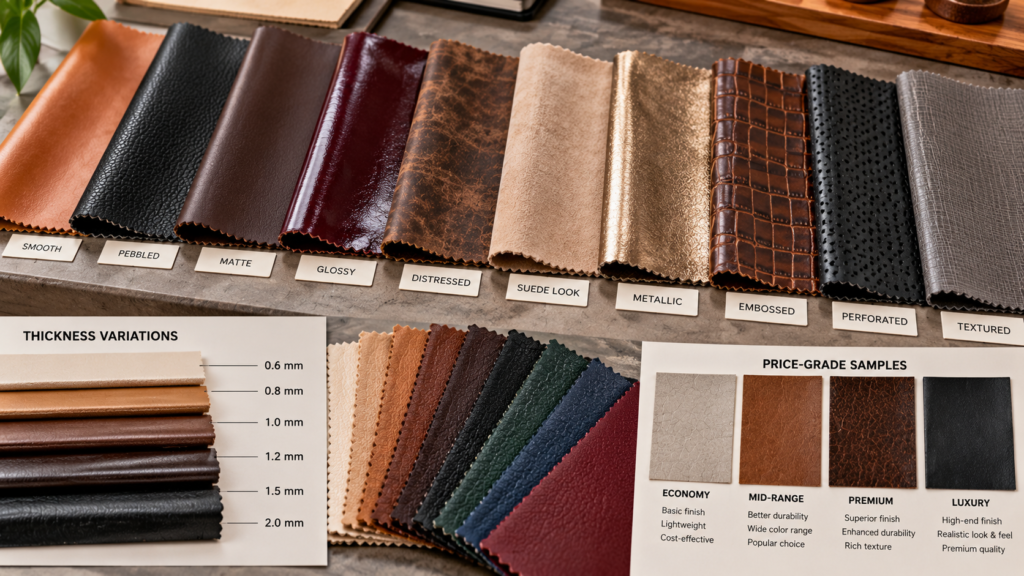
The surface can be smooth, embossed, matte, glossy, pebbled or textured to resemble different varieties of natural leather.
The term “faux leather” is therefore best understood as a category rather than a precise material specification.
Why Is Faux Leather Called Different Names?
You may encounter terms such as:
- Synthetic leather
- Artificial leather
- Imitation leather
- Leatherette
- Pleather
- Vegan leather
- PU leather
- PVC leather
These terms are not always interchangeable.
PU leather, for example, specifically refers to a polyurethane-based construction. PVC leather uses polyvinyl chloride. Vegan leather describes an animal-free material but does not tell you what the material is actually made from.
That distinction matters because two products advertised as “vegan leather” can have very different compositions and environmental profiles.
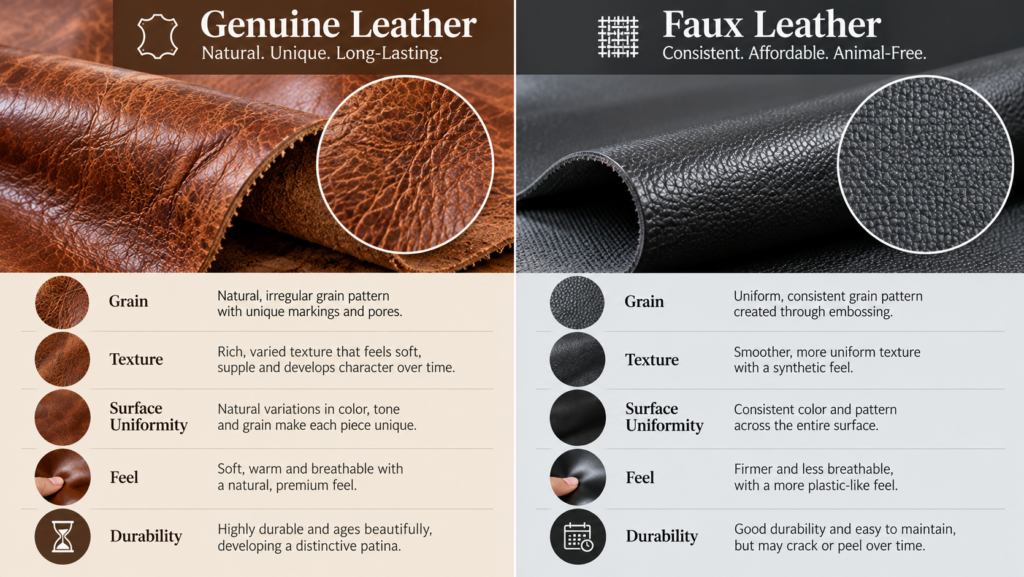
Faux Leather vs. Genuine Leather
The fundamental difference is the starting material.
Genuine leather is produced from animal hide or skin through tanning.
Faux leather is manufactured as an engineered material without requiring an animal hide.
Faux leather can provide a highly uniform appearance because manufacturers control its color, grain pattern and thickness during production. Natural leather, by contrast, contains variations that reflect the original hide.
2. History of Faux Leather
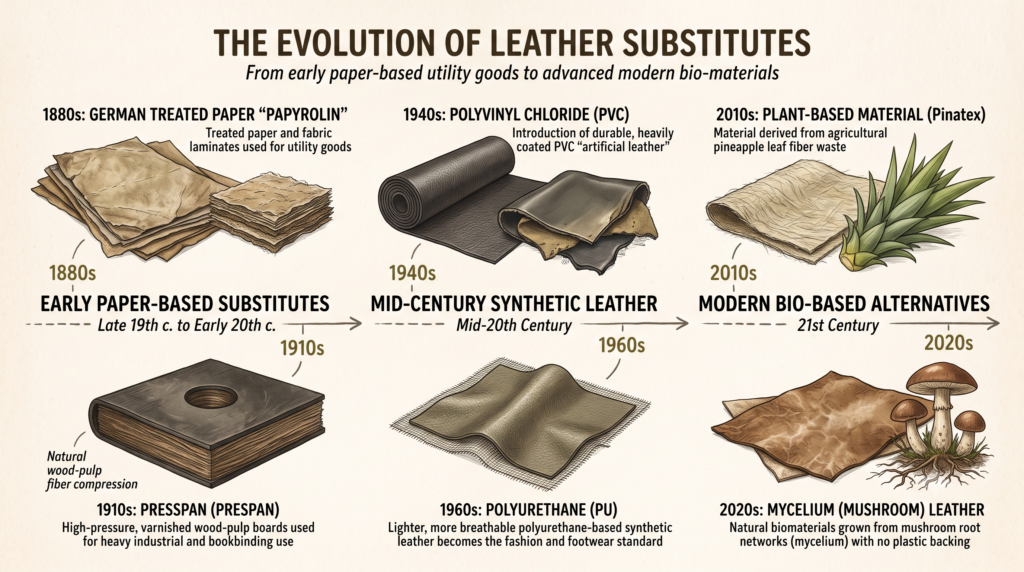
The idea of creating an alternative to animal leather is much older than today’s PU and PVC materials.
One early example was Presstoff, a leather substitute developed in Germany using a paper-based material treated to improve its strength and resistance. Its limitations, particularly around moisture and flexibility, prevented it from becoming a universal replacement for leather.
The development of synthetic polymers eventually changed the possibilities.
During the early twentieth century, commercially produced leather substitutes began appearing in broader markets. Naugahyde, a branded synthetic leather developed in the United States, became particularly well known and was used in products ranging from furniture to industrial applications.
As plastics and coating technologies developed, manufacturers gained more control over flexibility, thickness, color, texture and durability.
The introduction and expansion of polyurethane and PVC-based materials eventually made synthetic leather suitable for mass-market footwear, apparel, upholstery, accessories and automotive products.
More recently, attention has shifted toward non-animal materials that incorporate plant-derived or other renewable feedstocks. These materials represent a newer branch of the leather-alternative market rather than replacing conventional PU and PVC across the industry.
3. How Is Faux Leather Fabric Made?
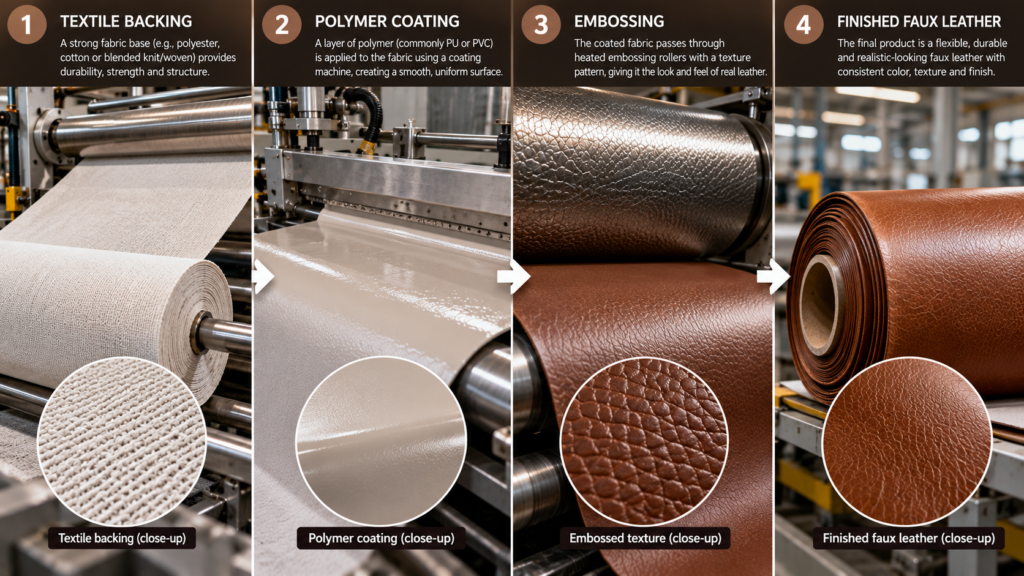
Although production methods vary, conventional faux leather generally follows a layered-material approach.
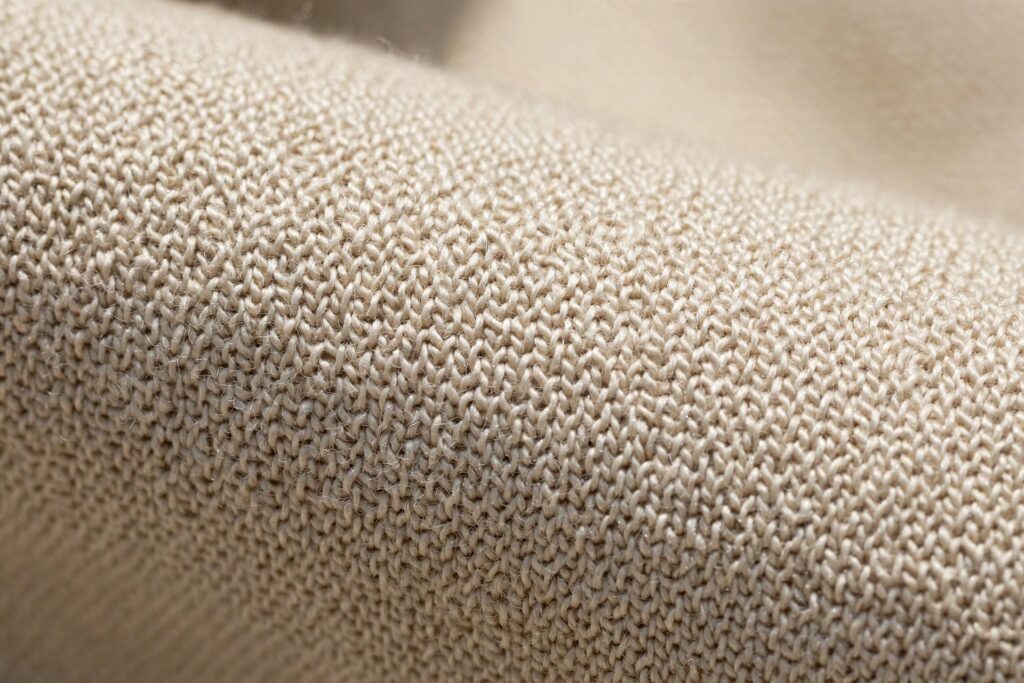
Step 1: Creating the Backing
The first layer provides the material with its basic structure.
Common backing materials include:
- Polyester
- Cotton
- Blended textiles
- Microfiber-based nonwoven materials
The backing determines many of the material’s mechanical properties, including flexibility, strength and how it behaves during cutting and sewing.
Step 2: Preparing the Surface Material
The surface layer is generally made from a polymer formulation.
Two major conventional choices are:
Polyurethane (PU):
PU can be formulated to produce a relatively soft, flexible surface and can closely imitate the hand feel of certain natural leathers.
Polyvinyl chloride (PVC):
PVC can produce a durable and highly consistent surface and is widely used in upholstery and other applications where resistance and easy cleaning are important.
The formulation can contain various additives that control flexibility, color, texture, processing and performance.
Step 3: Applying the Coating
The polymer is applied to the backing using a suitable coating or laminating process.
Manufacturers carefully control the thickness and distribution of the surface layer.
Some materials use several layers rather than one thick coating. This allows the manufacturer to engineer the surface, backing and intermediate layers for different performance requirements.
Step 4: Creating the Leather-Like Grain
The surface can then be embossed with a pattern.
This is one of the most important visual stages because natural leather has a characteristic grain. Embossing allows manufacturers to reproduce patterns resembling:
- Smooth calfskin
- Pebbled leather
- Crocodile-like textures
- Suede-like surfaces
- Other decorative grains
The final surface may also be printed, polished, laminated or given a protective finish.
Step 5: Finishing and Inspection
Once the material has been constructed, it is inspected for consistency.
Manufacturers may evaluate:
- Surface appearance
- Color
- Thickness
- Flexibility
- Adhesion between layers
- Abrasion resistance
- Tear strength
- Resistance to chemicals or cleaning agents
The finished material is then supplied in rolls or other formats for cutting and manufacturing.
4. How Is Faux Leather Fabric Used?
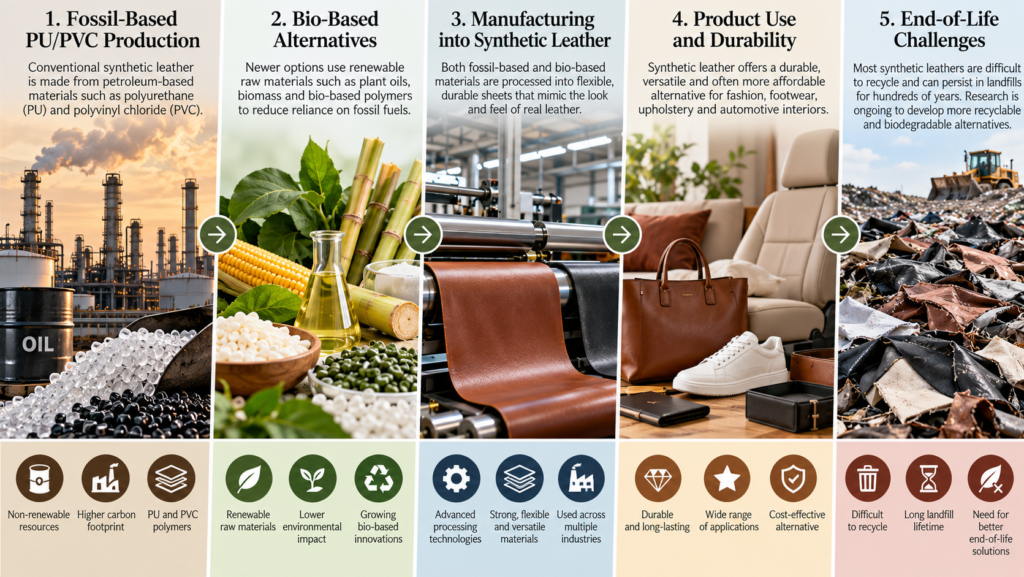
Faux leather is useful wherever manufacturers want a leather-like surface without using animal hide.
Clothing
Faux leather is commonly used for:
- Jackets
- Trousers
- Skirts
- Vests
- Gloves
- Fashion accessories
Its consistent thickness and ability to be produced in different colors make it useful for fashion collections where manufacturers want predictable material across multiple garments.

Footwear
Faux leather is used in many forms of footwear, including:
- Sneakers
- Boots
- Fashion shoes
- Sandals
- Casual footwear
Different constructions are selected depending on the desired flexibility, abrasion resistance and appearance.
Bags and Accessories
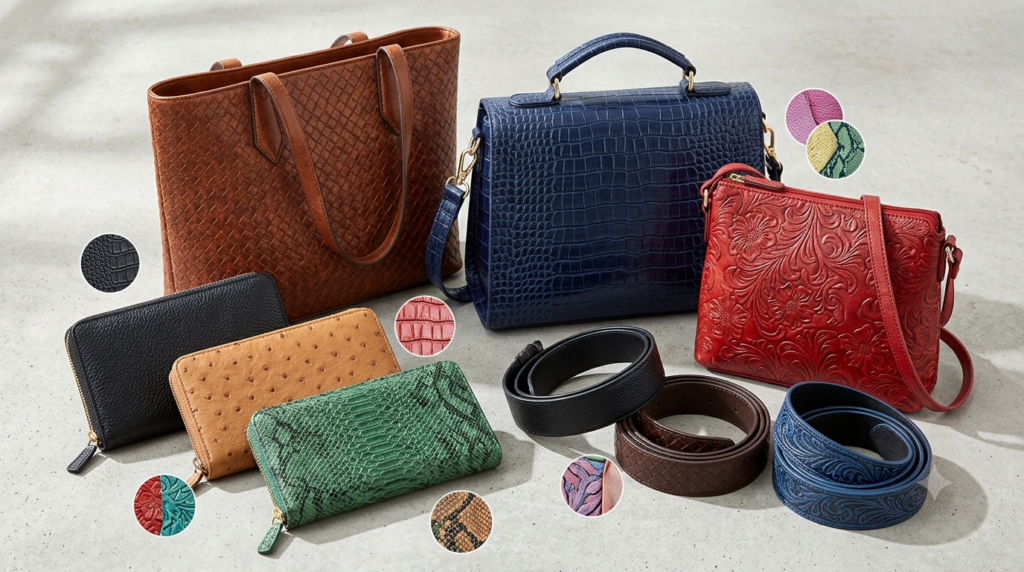
The material is particularly common in:
- Handbags
- Backpacks
- Wallets
- Belts
- Watch straps
- Phone cases
- Luggage
- Small accessories
Because the surface can be produced consistently, manufacturers can reproduce the same appearance across large production runs.
Furniture and Upholstery
Upholstery is one of the major applications for faux leather.
It can be used for:
- Sofas
- Chairs
- Benches
- Restaurant seating
- Office furniture
- Headboards
The ability to wipe many faux leather surfaces clean makes them useful in settings where maintenance is important.

Automotive Interiors
Synthetic leather can also be used for:
- Car seats
- Door panels
- Armrests
- Dashboard details
- Steering-wheel components
Automotive applications require materials with carefully controlled performance characteristics, so the faux leather used in vehicles is generally specified according to particular durability, safety and environmental requirements.
5. Where Is Faux Leather Fabric Produced?
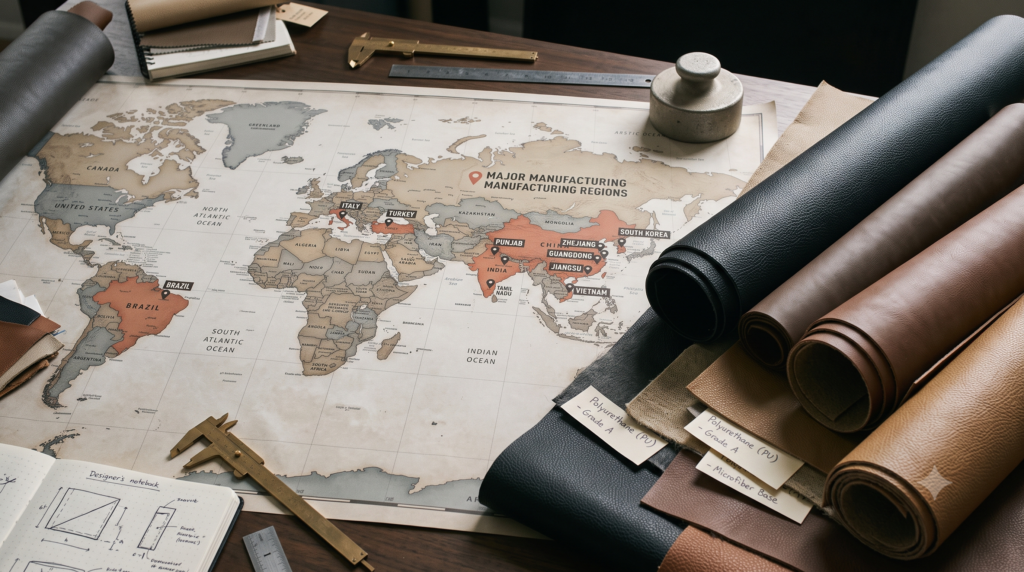
Faux leather is manufactured in many parts of the world, with large production networks across Asia, Europe and other industrial regions.
China is a major manufacturing center for synthetic leather and supplies materials to markets around the world. Other manufacturing activity exists in countries throughout Asia, Europe and the Americas.
However, production location does not by itself determine quality.
A high-quality faux leather depends on the polymer formulation, backing material, coating process, finishing, quality control and intended application.
For a manufacturer buying faux leather, technical specifications are generally more useful than simply knowing the country where the roll was produced.
6. How Much Does Faux Leather Fabric Cost?
Faux leather is generally less expensive than many premium natural leathers, but there is a wide price range within the category.
Cost depends on:
- PU, PVC or another material
- Backing construction
- Polymer quality
- Coating thickness
- Surface finish
- Embossing
- Performance requirements
- Fire or chemical resistance
- Order quantity
- Manufacturing location
- Certifications and testing
Basic faux leather intended for inexpensive accessories may cost relatively little, while high-performance upholstery, automotive-grade materials and advanced microfiber constructions can be considerably more expensive.
Plant-based or partially bio-based alternatives can also carry a higher price because many are still produced at smaller scales.
When comparing prices, it is therefore more useful to compare materials with equivalent specifications rather than comparing “faux leather” as a single category.
7. What Different Types of Faux Leather Fabric Are There?
There are several ways to classify faux leather. The most useful approach is to look at the material forming the surface and the construction underneath it.
1. PU Leather
PU leather uses polyurethane as the main surface material.
It is widely used in fashion because PU can be formulated to feel relatively soft and flexible.
It can also be produced in very thin constructions, making it suitable for garments and accessories where excessive stiffness would be undesirable.
2. PVC Leather
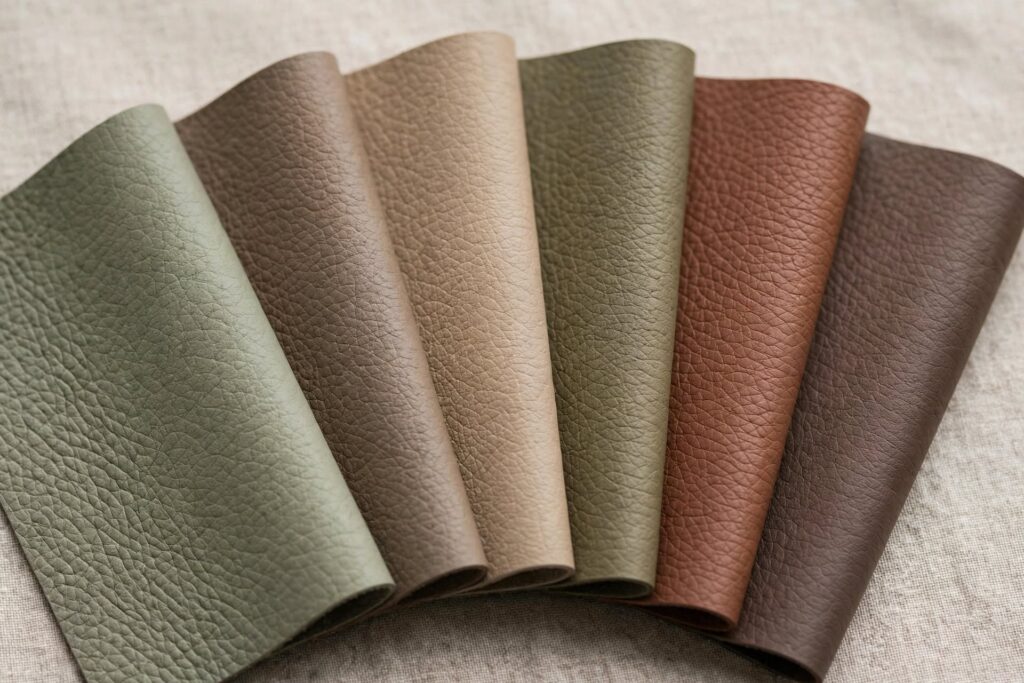
PVC leather uses polyvinyl chloride as its principal polymer.
It is valued in many applications for its durability, surface consistency and resistance to moisture and cleaning.
PVC can feel firmer than many PU constructions, although the final character depends on formulation and manufacturing.
It is widely used in upholstery and other applications where durability and easy maintenance are priorities.
3. Microfiber Synthetic Leather
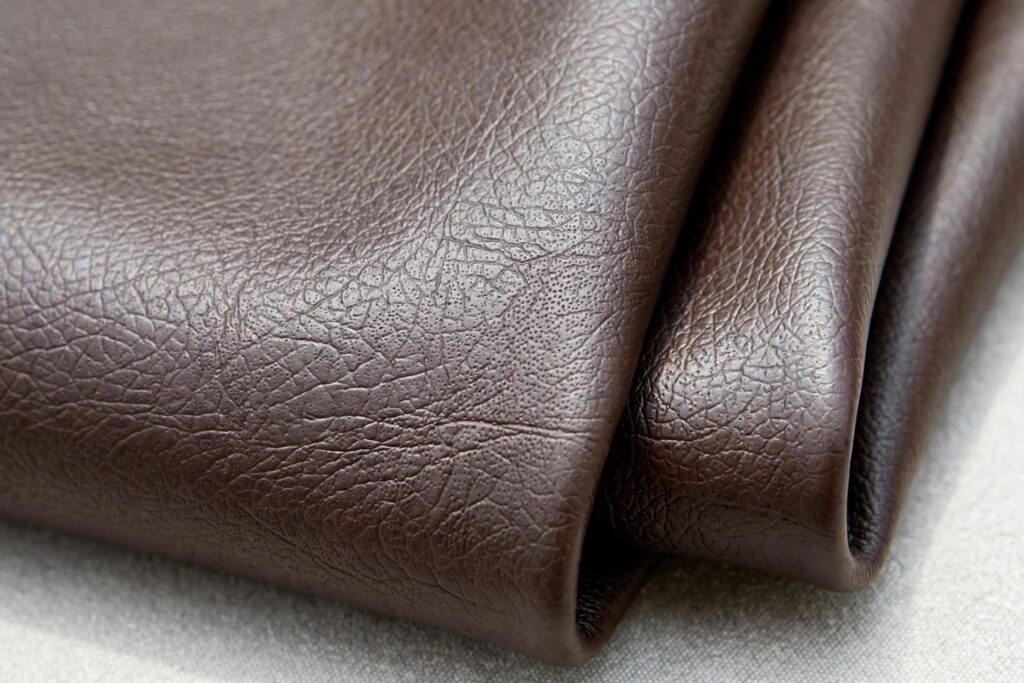
Microfiber-based synthetic leather uses an engineered microfiber backing combined with a suitable surface coating.
These constructions can be designed to reproduce some of the softness and structure associated with higher-end natural leather.
They are used in footwear, bags, accessories, upholstery and other applications where a more sophisticated synthetic material is required.
4. Leatherette
Leatherette is a broad term rather than one particular polymer.
It generally refers to an artificial leather material made with a textile or similar backing and a leather-like surface.
As a result, both PU-based and PVC-based materials can be described as leatherette.
5. Pleather
Pleather is an informal term derived from “plastic leather.”
It is generally used to describe synthetic leather and is most commonly associated with fashion products and accessories.
6. Bio-Based Leather Alternatives
A newer group of materials uses plant-derived or other renewable feedstocks as part of the material system.
Examples in the wider market include materials incorporating:
- Apple waste
- Cactus
- Grape residues
- Pineapple fibers
- Mushroom-derived materials
- Cork
- Other agricultural by-products
However, bio-based does not automatically mean plastic-free or biodegradable.
Some products marketed as plant-based still contain significant polymer content to provide strength, flexibility and durability.
The actual composition therefore matters more than the marketing label.
8. How Does Faux Leather Fabric Impact the Environment?
Faux leather presents a different environmental set of questions from animal-derived leather.
One of its clearest differences is that conventional faux leather does not require animal hide. But replacing an animal-derived material with a synthetic one does not automatically make a product environmentally preferable.
Fossil-Based Materials
Conventional PU and PVC are commonly produced using petrochemical feedstocks.
This means their environmental footprint can include fossil-resource extraction, polymer production, energy consumption and chemical processing.
PVC also has a distinct chlorine-based chemistry, while its performance often depends on additives and plasticizers.
Durability Matters
The useful life of faux leather can strongly influence its overall impact.
A low-cost material that cracks, peels or loses its surface quickly may need to be replaced more frequently than a higher-quality alternative.
This is particularly relevant for upholstery, bags, footwear and other products exposed to repeated flexing.
End of Life
Conventional synthetic leather can be difficult to recycle because it is often a multi-layer composite.
A textile backing may be permanently bonded to one or more polymer layers, making separation difficult.
Most conventional faux leather is also not biodegradable in the way untreated natural fibers can be.
Therefore, simply describing a synthetic leather as “vegan” does not tell you how it will behave at the end of its useful life.
Bio-Based Alternatives
Bio-based leather alternatives are being developed to reduce reliance on fossil-derived raw materials.
However, their environmental performance varies considerably.
A material can contain plant-derived ingredients while still using synthetic binders or coatings. Agricultural waste also needs to be processed, transported and converted into a stable material.
The most useful sustainability question is therefore not simply:
“Is it plant-based?”
Instead, consider:
- What percentage is bio-based?
- What polymer is used?
- How durable is the material?
- What chemicals are involved?
- Can it be recycled?
- Where was it manufactured?
- How long is the finished product expected to last?
9. Faux Leather Fabric Certifications Available
There is no universal certification that automatically means a faux leather material is sustainable.
Different certifications and testing standards address different aspects of the material.
OEKO-TEX
Relevant OEKO-TEX standards can help assess harmful substances in textile and material products.
For faux leather, the exact standard and certification scope should be checked because certification applies to particular products, components or production stages.
Global Recycled Standard
The Global Recycled Standard (GRS) may be relevant when a synthetic leather product contains qualifying recycled materials and the relevant supply chain meets the standard’s requirements.
It does not mean that every synthetic leather product is recyclable.
REACH Compliance
For products sold in the European market, REACH requirements can be relevant to chemical substances used in materials and finished goods.
This is a regulatory framework rather than a simple “eco-friendly” certification.
Other Product-Specific Testing
Depending on the application, faux leather may also be tested for:
- Abrasion resistance
- Tear strength
- Flex resistance
- Colorfastness
- Hydrolysis resistance
- Flame resistance
- Chemical resistance
- Restricted substances
For upholstery and automotive applications in particular, performance testing can be just as important as the material’s appearance.
10. Frequently Asked Questions
Is faux leather real leather?
No. Faux leather is designed to imitate real leather but is not made from an animal hide.
What is faux leather made from?
Most conventional faux leather is made from a textile backing coated with a polymer such as polyurethane or PVC. Other constructions use microfiber or newer bio-based materials.
Is PU leather the same as faux leather?
PU leather is a type of faux leather. Faux leather is the broader category, while PU identifies polyurethane as the main surface material.
Is PVC leather the same as faux leather?
PVC leather is also a type of faux leather. It uses polyvinyl chloride as the principal surface material.
Is vegan leather the same as faux leather?
Not necessarily. Vegan leather is a broad term for animal-free leather alternatives. It can include conventional synthetic materials as well as newer bio-based materials.
Is faux leather waterproof?
Many faux leather surfaces have good resistance to water, but the material should not automatically be considered completely waterproof. Seams, backing materials, coatings and construction all affect water resistance.
Is faux leather breathable?
Most faux leather is less breathable than many natural textile fabrics. Breathability varies significantly depending on the polymer, thickness and backing construction.
Does faux leather peel?
Some faux leather products can peel, crack or delaminate as they age, particularly when the surface coating deteriorates or the material is repeatedly flexed. Quality and construction make a significant difference.
Is faux leather cheaper than genuine leather?
Generally, many conventional faux leather materials cost less than premium natural leather. However, advanced synthetic materials and bio-based alternatives can be considerably more expensive than basic faux leather.
Is faux leather environmentally friendly?
Not automatically. Conventional faux leather can reduce reliance on animal hides but may depend on fossil-derived polymers and can create end-of-life challenges. Newer bio-based materials may reduce reliance on fossil resources, but their complete composition and life cycle need to be considered.
Can faux leather be recycled?
Some components and products may be recyclable, but recycling can be difficult because faux leather often combines a polymer surface with a textile backing. Recyclability depends on the specific construction and available recycling system.
How can you tell faux leather from real leather?
Texture, smell, grain pattern and behavior can provide clues, but modern synthetic leather can closely resemble natural leather. Checking the product’s material label and composition is more reliable than relying only on appearance.
Is faux leather good for clothing?
Yes. Lightweight PU-based materials are commonly used for jackets, trousers, skirts and other garments. The best choice depends on the required softness, flexibility, breathability and durability.