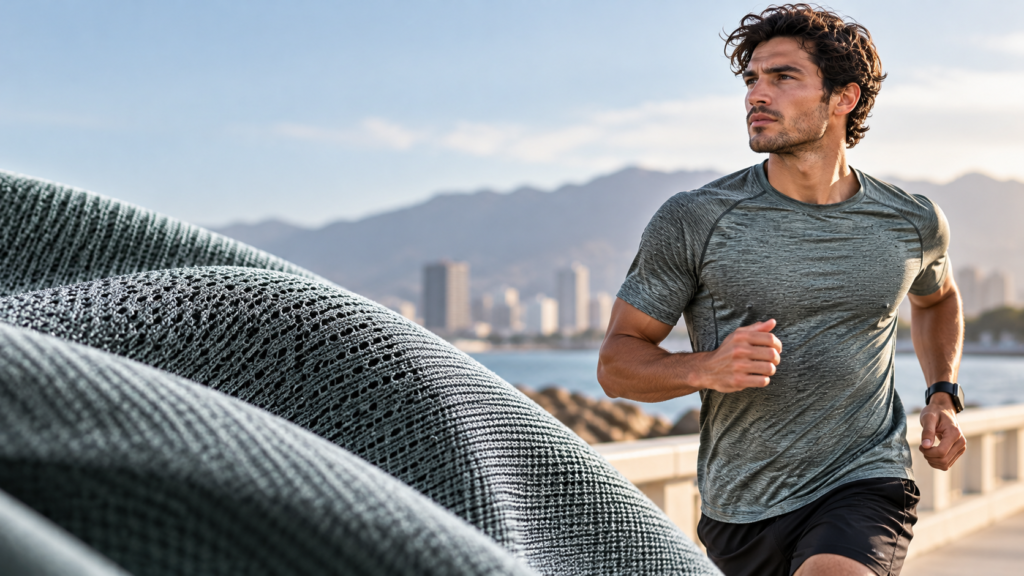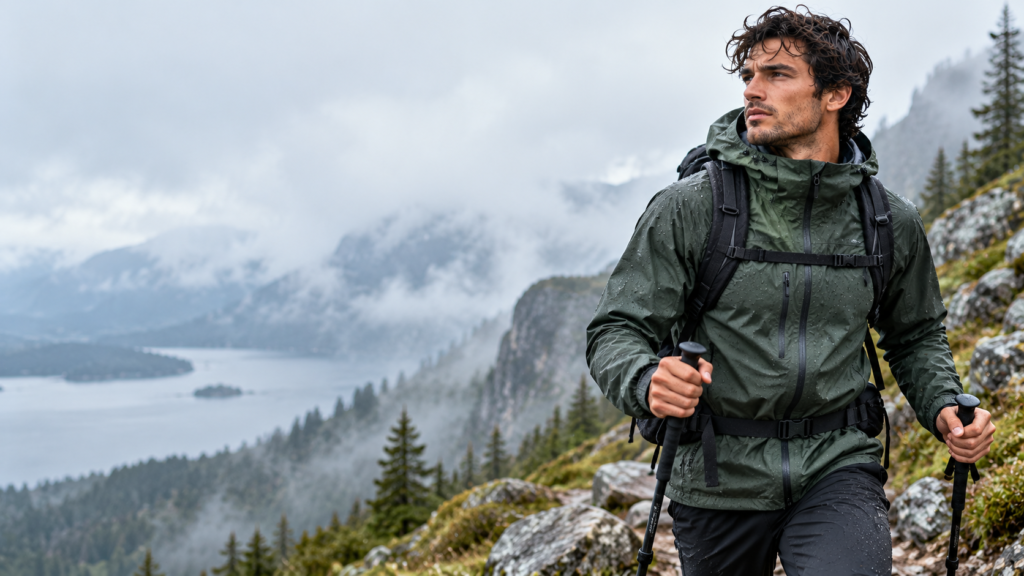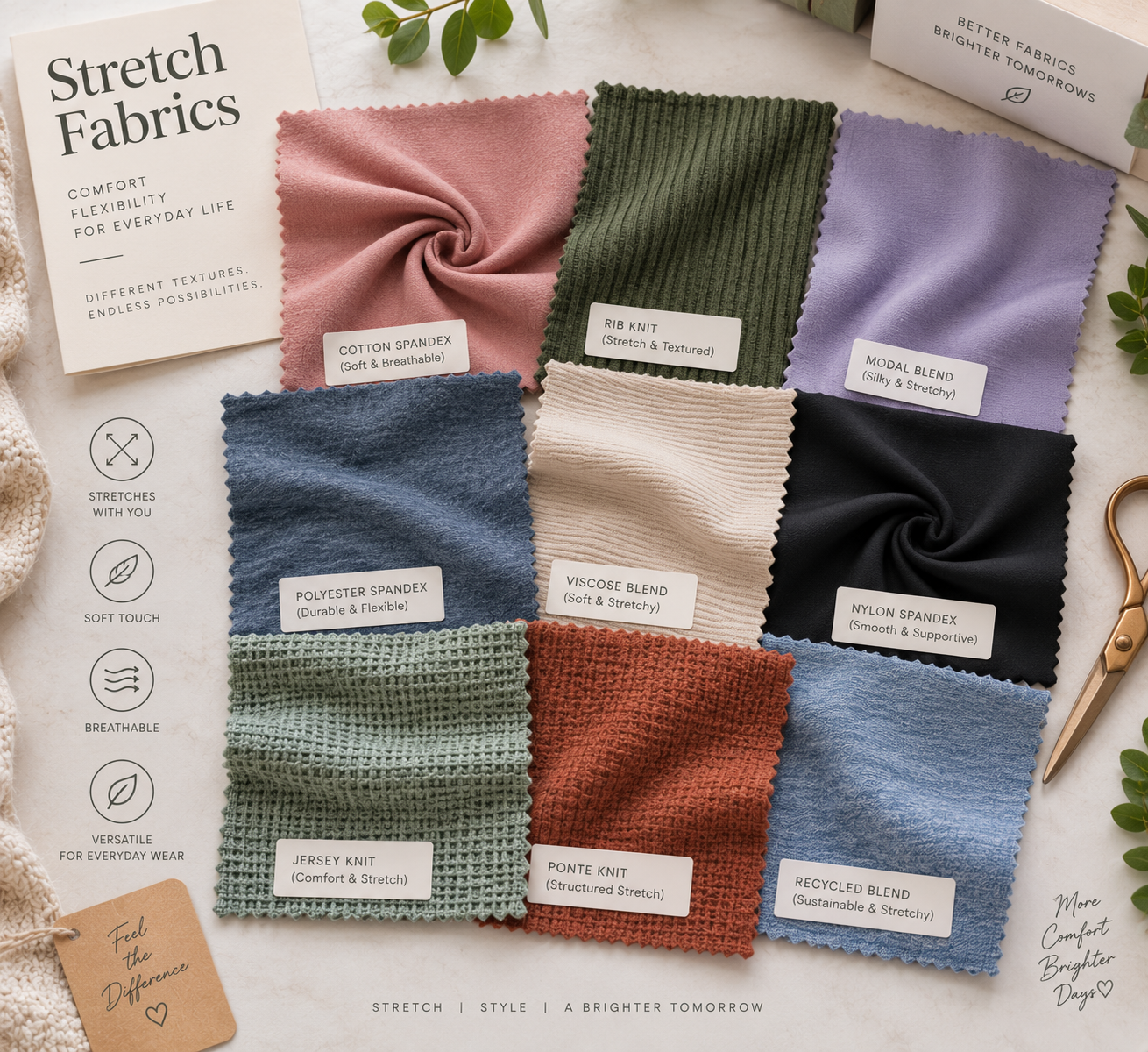
Quick answer: Some of the most useful stretchable fabrics for comfortable clothing include spandex blends, cotton-Lycra, jersey, ponte, scuba, ribbed knits, interlock, and French terry. Stretch can come from the fiber itself, such as elastane, or from the way the fabric is knitted. Knowing where the stretch comes from can help you choose a fabric that suits the garment you’re making or buying.
You usually don’t think much about fabric stretch until you put on something that doesn’t have enough of it.
A pair of jeans that won’t bend when you sit down. A fitted dress that feels fine for five minutes and uncomfortable an hour later. A top that looks great but makes reaching for something on a high shelf surprisingly difficult.
The right stretch fabric can prevent all of that. It can make a garment easier to move in, more comfortable through the day, and much more wearable.
Before looking at individual fabrics, there are two terms worth knowing: 2-way stretch and 4-way stretch.
A 2-way stretch fabric generally stretches across one direction, most often from side to side. A 4-way stretch fabric can stretch both horizontally and vertically. That’s why 4-way stretch is commonly preferred for activewear and close-fitting garments where the body needs to move freely in different directions.
For casual clothing and more structured pieces, 2-way stretch may be perfectly adequate.
Stretch itself usually comes from one of two places. It may be built into the fiber content through materials such as spandex or elastane, or it may come from the knitted construction of the fabric. Some knits have a natural amount of give simply because of the way their loops are formed.
With that in mind, here are ten stretchable fabrics that are widely used for comfortable clothing.
1. Spandex / Elastane
Spandex is the main stretch fiber used in many modern stretch fabrics. You may also know it as Lycra, although Lycra is a trademarked brand name associated with elastane.
Spandex is rarely used by itself. Instead, it is usually blended with another fiber to give the finished fabric more flexibility.
Even a small amount can make a noticeable difference. Many blends contain somewhere around 2% to 8% spandex, although the actual percentage depends on the garment and how much stretch it needs.
One of spandex’s most useful qualities is recovery. The fiber can stretch and then return toward its original shape. Good recovery helps clothing maintain its fit instead of becoming loose around areas such as the knees or elbows.
A fabric can have plenty of stretch but still perform poorly if it doesn’t recover well. That’s when you start seeing the baggy, stretched-out appearance that often develops after repeated wear.
Spandex blends are used in a huge range of clothing, including swimwear, activewear, underwear, denim, trousers, and workwear.
Generally speaking, a higher percentage of elastane gives the fabric more stretch. A swimsuit may contain around 15% to 20% elastane, while a pair of stretch trousers may need only 3% to 5%.
A useful way to think about it is that the spandex or elastane is the stretch component doing most of the work, even when it represents only a small part of the blend.
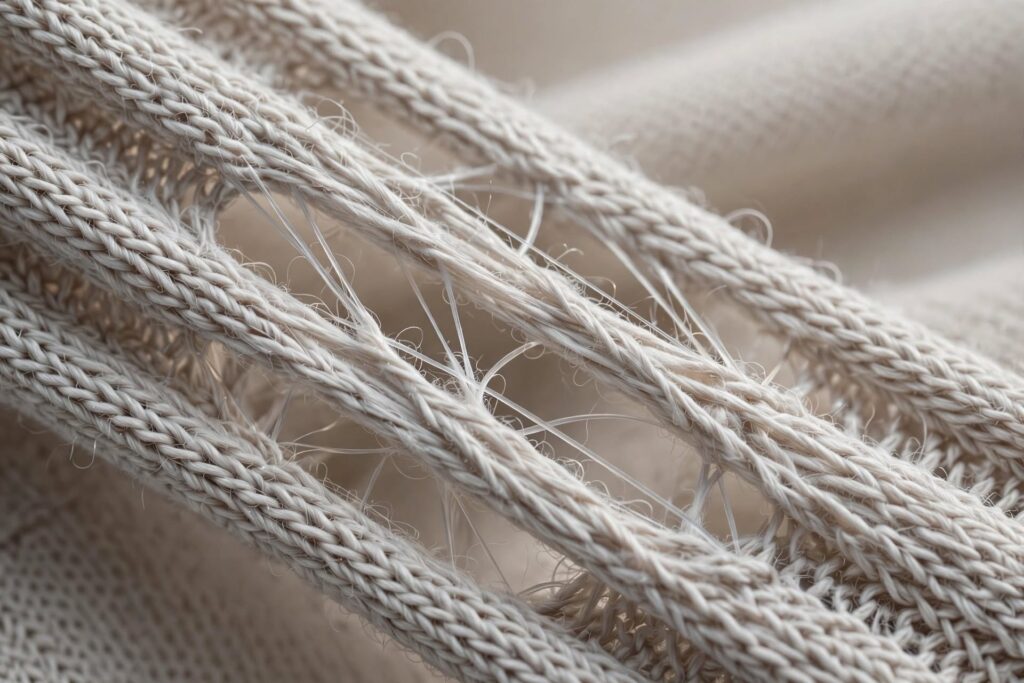
2. Cotton-Lycra Blends
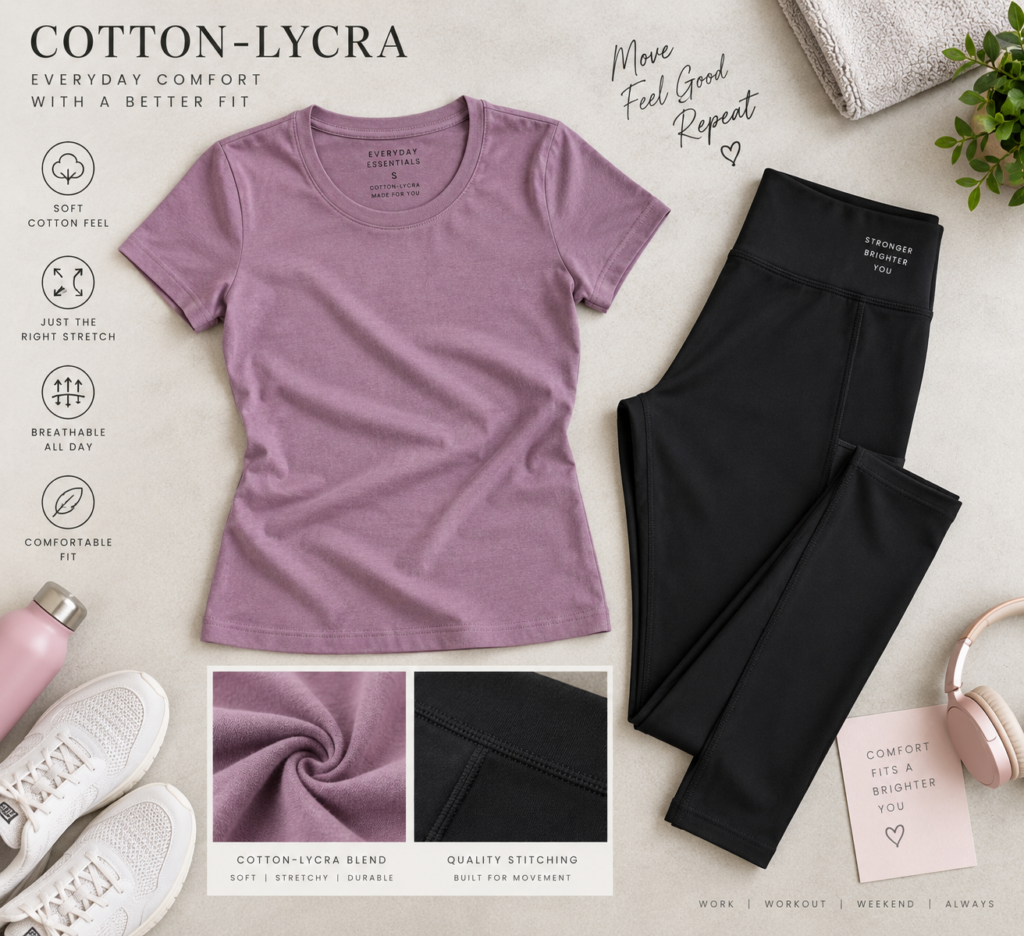
Cotton-Lycra combines two useful qualities: the softness and breathability of cotton with the stretch and recovery of elastane.
The result is fabric that feels familiar and comfortable against the skin while giving you much more freedom of movement.
It’s one of the most versatile stretch fabrics around, which is why it appears in everything from T-shirts and leggings to fitted tops, underwear, and children’s clothing.
It is also a popular choice for people learning to sew because it is relatively forgiving, easy to care for, and widely available.
The cotton content makes the fabric comfortable for everyday wear, especially in warm weather or during light activity. Pure spandex can feel quite synthetic and warm, whereas a cotton-heavy blend, often around 90% to 95% cotton, tends to feel much more breathable.
There is one care point to remember. Cotton can shrink when exposed to high heat, which may affect the fit of a cotton-elastane garment.
Cold washing and air drying are generally better choices when you want to maintain both the garment’s size and its stretch.
3. Jersey Knit
Jersey is a good example of a fabric that can stretch because of its construction rather than because of added stretch fiber.
The fabric is made using loops, and those loops naturally allow the material to stretch across the width. A cotton jersey can therefore have some stretch even without spandex.
Add a small percentage of elastane and the fabric becomes even more flexible, often allowing movement in multiple directions.
Jersey is everywhere in everyday clothing. The T-shirt you’re wearing may well be made from it.
It is generally soft, lightweight, and comfortable, with enough give to move with the body without feeling restrictive.
Not all jersey behaves exactly the same way. Single jersey, commonly used for lightweight T-shirts, usually has more stretch. Double jersey is thicker and tends to feel more stable.
Jersey also drapes well, which is why it is used for casual dresses, skirts, tops, and lightweight loungewear.
For sewing, a stretch stitch or serger is usually helpful because regular seams can pop when the fabric is stretched.
One small annoyance is that jersey can curl at the edges after cutting. That can make handling it a little trickier.
Still, its softness, comfort, breathability, and natural give make jersey one of the most useful fabrics for everyday clothing.
4. Ponte Knit
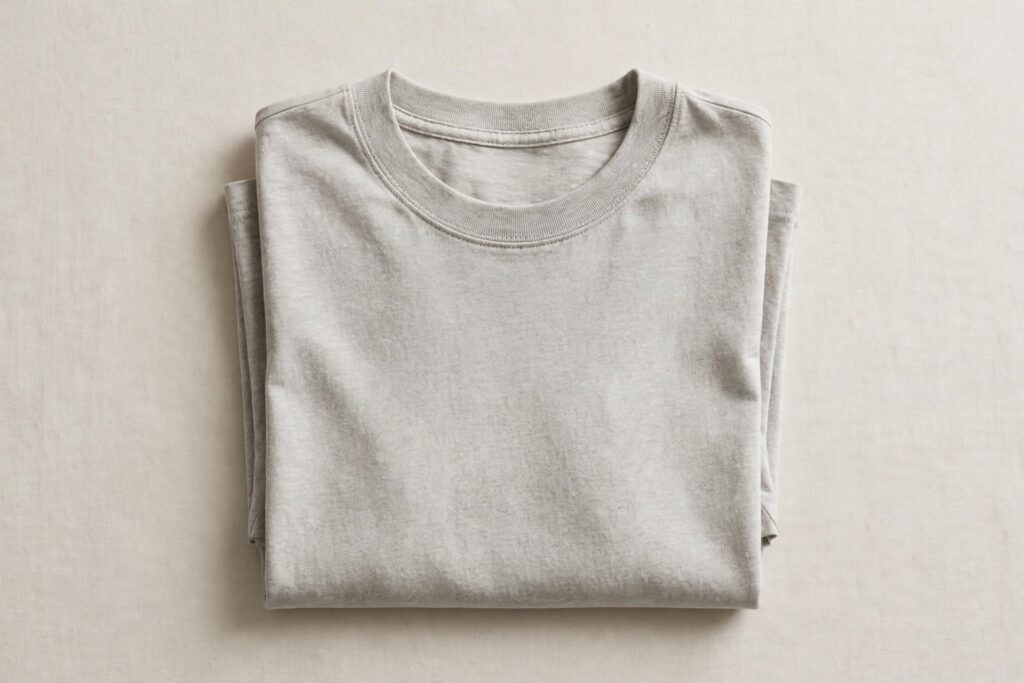
Ponte offers an interesting combination of stretch and structure.
It is usually made with a double-knit construction and often contains polyester, rayon, and a small amount of spandex. The finished fabric has a smooth, firm feel and is good at holding its shape.
That makes ponte particularly useful for clothing that needs to look polished without feeling restrictive.
Fitted trousers, structured dresses, skirts, and blazers are common examples. The fabric stretches when you move, but it doesn’t collapse or cling as much as softer knits can.
This is what makes ponte such a practical middle ground between formal and casual clothing. You can wear it to work and still be comfortable after several hours.
Ponte is denser than jersey, so it can provide a little more support and smoothing. Its stretch is usually moderate rather than dramatic, but it tends to have good recovery.
It is also relatively easy to care for. Many ponte garments can be machine washed, although cold washing and hanging them to dry can help preserve the fabric’s structure.
Ponte tends to hold color well and can resist pilling better than some lighter knits, which makes it a useful choice for wardrobe staples.

5. Ribbed Knit
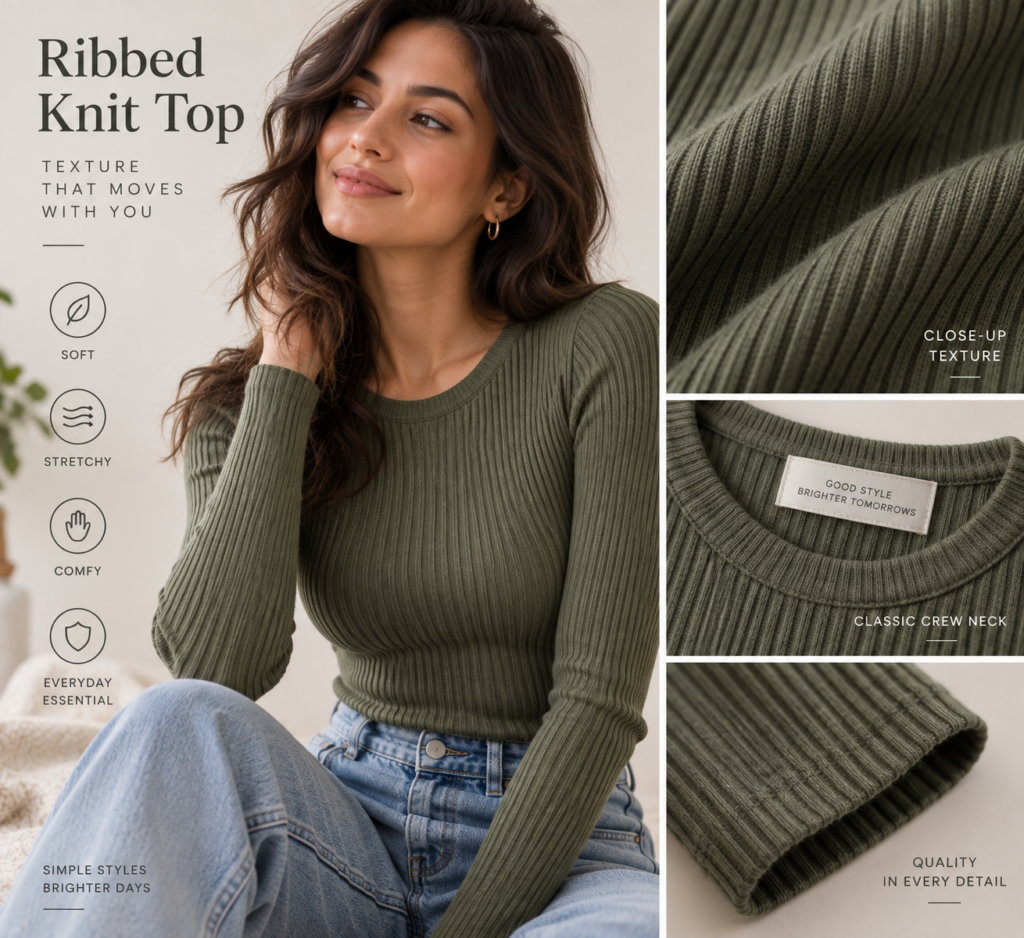
Ribbed knit is easy to recognise by its raised vertical lines. These are created by alternating knit and purl stitches.
The texture isn’t only decorative. It affects how the fabric behaves.
Ribbed knit can stretch considerably across its width and usually recovers well afterward. That makes it particularly useful for clothing that needs to fit closely without becoming uncomfortable.
You’ll commonly find ribbed knit in fitted tops, bodysuits, turtlenecks, and sweaters. It is also frequently used around cuffs, necklines, and waistbands because those areas need to stretch and then return to their original shape.
The fabric comes in different weights and fiber blends.
Lightweight cotton ribbing can work well in warmer weather, while thicker wool or acrylic versions are useful for colder seasons.
Its surface texture also adds interest to an outfit without needing a print or other decoration.
Because ribbed fabric follows the body’s shape without necessarily compressing it, it can be flattering on a wide range of body types.
6. Ottoman Knit
Ottoman knit is less familiar than ribbed knit, but the two have something important in common: texture contributes to the fabric’s structure.
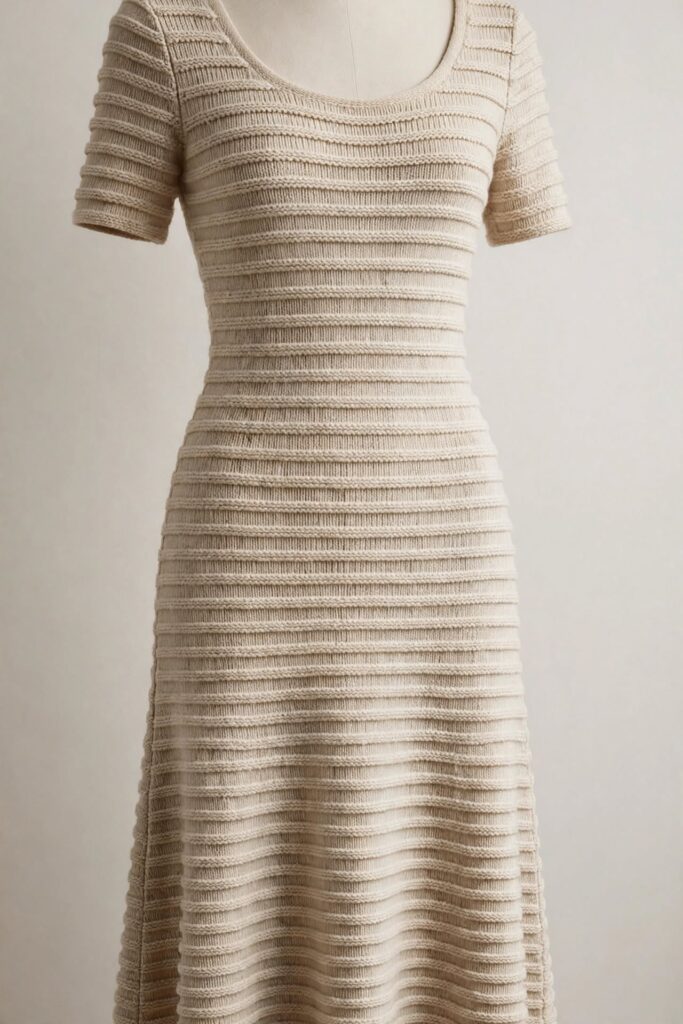
The main difference is the direction of the ribs. Ribbed knit generally has vertical ridges, while ottoman knit has broader horizontal ridges running across the fabric.
Those ribs give ottoman knit a heavier appearance and a more structured drape.
Its stretch tends to run lengthwise, which sets it apart from many other stretch fabrics. That makes it useful when you want some flexibility but still need a garment to maintain a polished shape.
Fitted dresses, midi skirts, and structured tops are common applications.
The heavier construction also helps the fabric resist wrinkles and retain its form throughout the day. That’s particularly useful for clothes that need to look neat from morning to evening.
The pronounced ridges add visual interest too. Despite the texture, ottoman knit generally feels more elegant than casual.
Care depends on the fiber blend, but gentle washing or dry cleaning is often recommended to protect the ribbed structure.
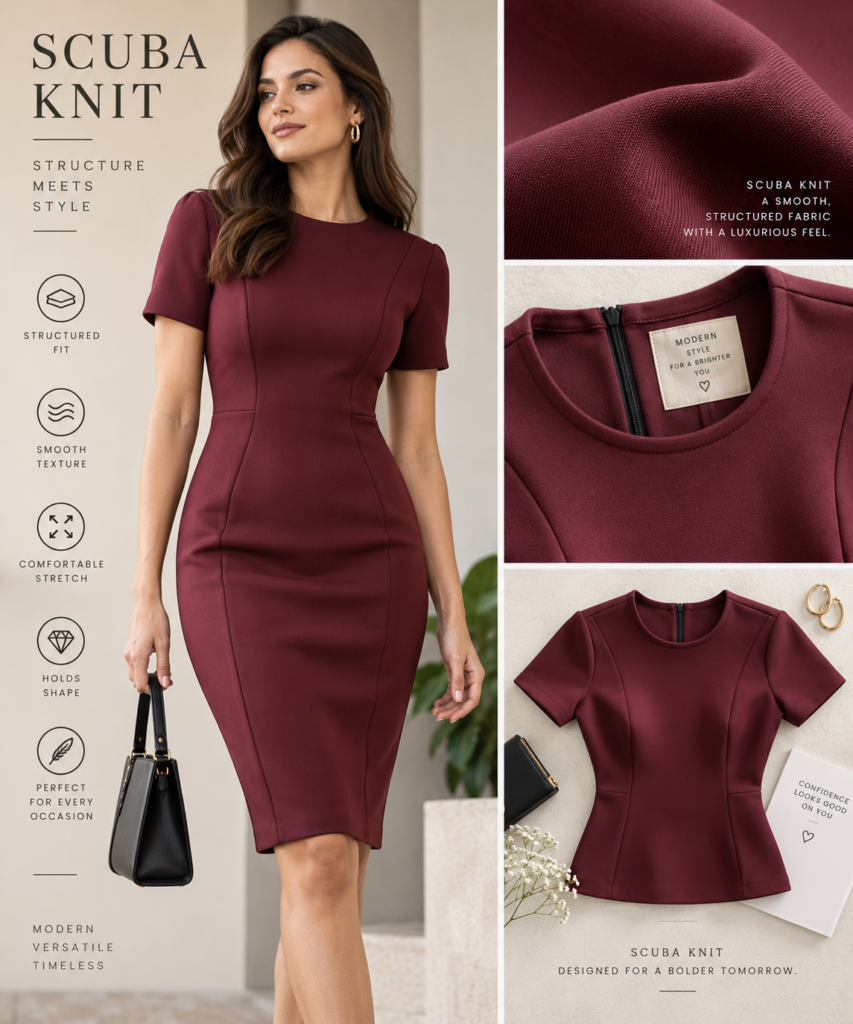
7. Scuba Knit
Scuba knit has a smooth surface and a dense feel that can remind you of neoprene, although it is a different material.
It is typically a double-knit fabric made from polyester and spandex. The combination gives it firm stretch and strong shape retention.
Unlike softer knits that drape and collapse, scuba holds its form. Hems tend to stay flat, seams look crisp, and the overall shape of a garment remains fairly stable throughout the day.
That makes scuba useful for fitted dresses, skirts, and pieces with a more structured or sporty look.
It is especially common in bodycon styles, where the fabric needs to stretch enough to follow the body while still maintaining the intended silhouette.
Scuba is also relatively easy to work with when sewing. It doesn’t usually fray, curl, or unravel as much as some other stretch knits.
There is one important drawback: breathability.
Scuba is quite dense, so it isn’t usually the best choice for hot weather or intense exercise. It makes more sense in cooler environments or air-conditioned spaces, and for lower-intensity activity where extreme moisture management isn’t required.
When you want stretch with strong structure and recovery, though, scuba is a dependable option.
8. 4-Way Stretch Denim
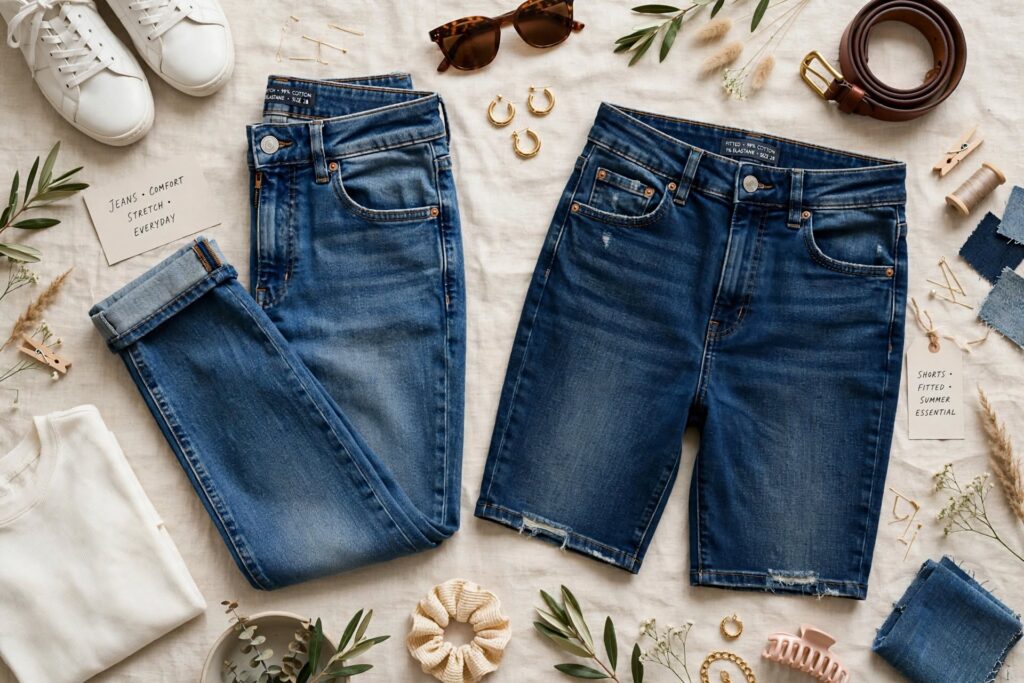
Traditional denim is strong and structured, but it isn’t known for flexibility. Standard denim is made from a tightly woven cotton twill that holds its shape rather than stretching with the body.
Stretch denim changes that by adding a small amount of elastane, often around 1% to 4%.
This gives the fabric the ability to move in both horizontal and vertical directions, which is why this category is described as 4-way stretch denim.
The finished material still looks like denim. It retains the familiar weave, weight, and texture, but it is much easier to move in.
That small addition can make a major difference in fitted jeans, particularly around the hips and thighs.
Stretch denim is especially common in skinny and slim jeans, as well as jeggings, fitted denim skirts, and shorts.
There is a trade-off, though. Higher elastane content can affect how denim ages.
If the fabric contains too much stretch fiber, it may gradually lose recovery after repeated washing and wearing. This can lead to a looser fit around the knees and seat.
Using a lower amount of spandex often helps the fabric maintain its shape over a longer period.
9. Interlock Knit
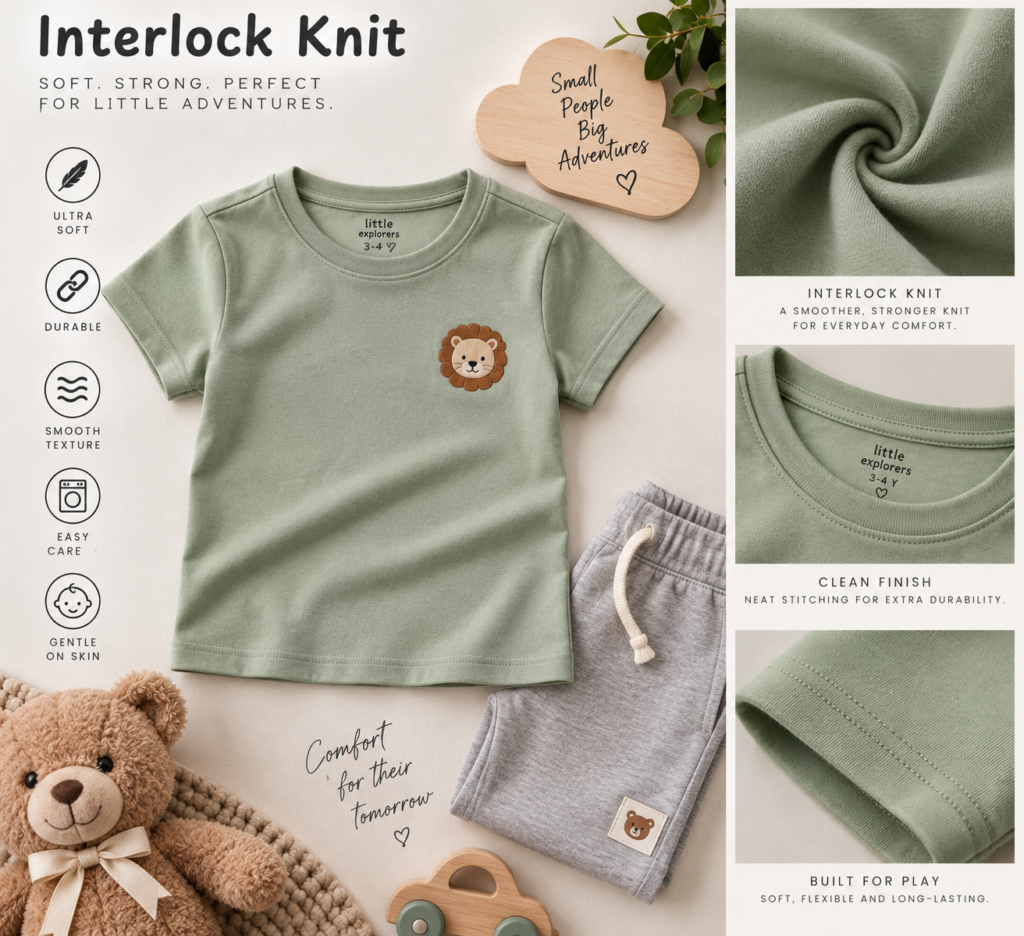
Interlock is sometimes thought of as a more substantial version of jersey.
Both are knitted fabrics, but interlock uses two layers of rib-knit loops joined together. This gives the fabric the same appearance on both sides.
The construction makes interlock smoother, slightly heavier, and more dimensionally stable than a typical single jersey.
It stretches in both directions, although usually not as dramatically as a lightweight jersey.
That moderate stretch makes it useful for T-shirts, polo shirts, children’s clothes, and loungewear.
There are some practical advantages too. Since both sides look similar, small construction mistakes or seam allowances are less noticeable.
Interlock also doesn’t curl at the cut edges as easily as single jersey, which makes it easier to handle when sewing.
For everyday clothing, the combination of softness, stretch, and shape retention makes interlock a dependable option.
It is particularly useful for children’s garments and other pieces that need to survive frequent washing and regular wear.
10. French Terry
French terry is probably more familiar than its name suggests.
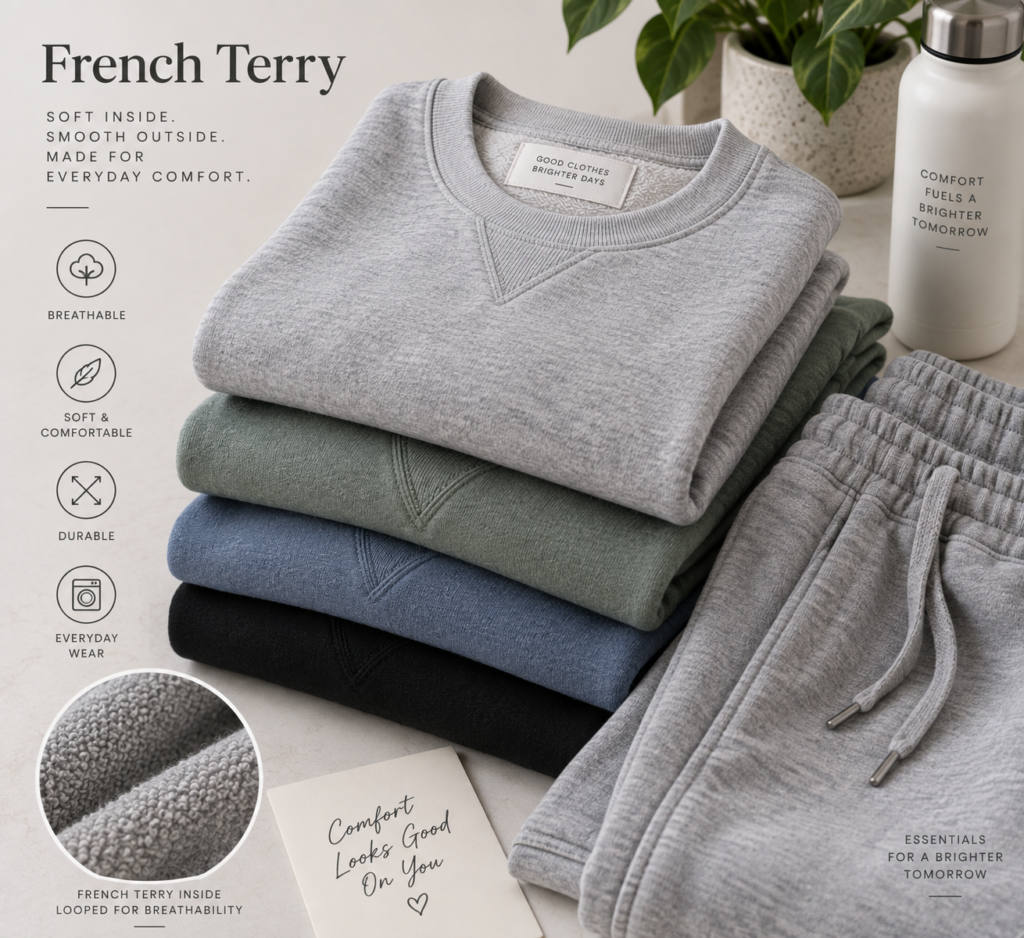
It has a smooth outer surface and soft loops on the inside. That is the construction you’ll often find in sweatshirts, hoodies, joggers, and other casual clothing.
Those inner loops create a little extra warmth and cushioning without making the fabric as heavy as fleece.
The stretch comes partly from the knitted construction itself and, in many blends, from a small amount of spandex.
The result is moderate stretch that feels comfortable when you move but doesn’t cling closely to the body.
French terry is particularly suited to relaxed clothing. It works well for loungewear, casual outfits, and athletic-casual pieces that you might wear for a light workout, a quick coffee run, or a day at home.
It is also lighter than fleece-backed fabrics, making it useful during transitional weather when you want some warmth without feeling bundled up.
Another advantage is durability. French terry generally washes well and becomes softer over time, which makes it a practical fabric for clothing that gets worn frequently.
The Right Stretch Fabric for Any Garment
Stretch comes from two main sources: the fiber and the fabric construction.
Spandex and elastane add flexibility and, importantly, recovery. Knitted fabrics such as jersey, ponte, and French terry can also have natural give because of the way their threads are looped together.
Many of the best-performing stretch fabrics combine both approaches.
There is no single fabric that works best for every garment. Activewear needs freedom of movement and strong recovery. Tailored clothing needs controlled stretch without losing its shape. Loungewear usually prioritises softness and easy movement, while a fitted occasion dress may need stretch that follows the body without becoming too clingy.
Once you understand those differences, choosing a stretchable fabric becomes much easier.
For more ideas on comfortable, practical clothing, explore our guides to [Casual Outfit Ideas] and [Breathable Fabrics for Warm Weather Dressing].
Frequently Asked Questions
What is the most stretchable fabric for clothing?
Fabrics with a high percentage of spandex or elastane generally provide the greatest amount of stretch. Swimwear fabrics and performance knits are good examples.
For everyday clothing, cotton-spandex blends and 4-way stretch fabrics such as scuba can offer a more practical balance between flexibility, comfort, and recovery.
The right choice depends on how much movement the garment needs.
What’s the difference between 2-way and 4-way stretch?
A 2-way stretch fabric generally stretches in one direction, most often from side to side.
A 4-way stretch fabric can stretch both horizontally and vertically.
Four-way stretch is particularly useful for activewear and fitted clothing because the body moves in several directions when walking, exercising, bending, or reaching.
For more structured garments, 2-way stretch is often enough.
Does spandex content affect how long a garment lasts?
It can.
Higher spandex content usually gives a garment more stretch, but too much elastane can affect long-term recovery. After repeated wear and washing, a high-stretch fabric may become looser and less able to return to its original shape.
A lower elastane percentage paired with good fabric construction often provides better long-term stability.
How you wash the garment matters as well. Cold washing and air drying are generally gentler on stretch fabrics than hot washing and tumble drying.
What stretch fabric is best for activewear versus everyday wear?
For activewear, look for fabrics with 4-way stretch and strong recovery. Scuba knit, nylon-spandex blends, and high-elastane performance fabrics are all options that can move with the body and recover after stretching.
For everyday clothing, cotton-spandex blends, jersey, and French terry are often more comfortable choices. They provide useful stretch without the highly technical feel of some performance fabrics.
Can stretch fabrics be used for structured or tailored garments?
Yes.
Ponte and ottoman knit are good examples of stretch fabrics that can work well in more structured clothing.
Both offer moderate stretch while maintaining their shape, which makes them suitable for trousers, blazers, fitted dresses, and other garments where you want comfort without losing a polished appearance.